Why the 1930s Strongman Leadership Style Fails in Matrix Organizations

The Illusion of Brute Force in Modern Business Structures
You are working longer hours, pushing your teams harder, and yet critical projects remain stalled as we head into the pivotal fall 2026 planning season—this is exactly why the 1930s strongman leadership style fails in matrix organizations. It is a frustrating reality for many modern directors and managers. At Driven Leadership, our team frequently coaches executives who try to force cross-functional alignment through sheer willpower and top-down directives, only to find that relying on brute authority creates systemic bottlenecks rather than solving them. The decision point arrives when you recognize that pushing harder and demanding faster results is actively stalling your Q4 initiatives. Unlearning these outdated, high-stress management habits requires specialized leadership trainings, and modern frameworks like BOLD leadership training offer a clear pathway out of this high-effort, low-yield cycle.
Many leaders fall into the trap of believing that if they just exert enough personal energy, the team will naturally follow suit. This mindset assumes that authority alone is enough to clear roadblocks. However, as we often see in our Puyallup training sessions, the most common leadership challenges in matrix organizations stem from this exact misunderstanding. When you apply linear, hierarchical pressure to a multi-dimensional, cross-functional team, the system pushes back. Your direct reports might comply out of obligation, but the wider team will often disengage, leaving you to carry the entire weight of the project.
Signs you are relying on brute-force leadership:
• Constant follow-ups: You spend the majority of your day chasing down status updates because no one moves without your explicit command.
• Meeting dominance: You find yourself doing most of the talking in cross-functional meetings to ensure your vision is executed exactly as you picture it.
• Exhaustion masking as dedication: You mistake your own severe burnout for a necessary sacrifice, believing the project would collapse if you stepped away for a single day.
• Lack of peer initiative: Team members wait for you to solve problems rather than proactively addressing roadblocks themselves.
Breaking this cycle means recognizing that your effort is not the problem—your approach is. The modern corporate environment does not reward the lone hero; it rewards the facilitator who can align diverse motivations toward a single goal.
Deconstructing the 1930s Strongman Metaphor
To understand why top-down directives fail today, we have to look at the origins of the "lone hero" leadership myth. The 1930s strongman approach is defined by isolated, brute physical lifting. In those days, a performer would step onto a stage, chalk their hands, and hoist an impossibly heavy barbell over their head entirely on their own. The audience applauded the sheer, solitary force of the individual. This is analogous to a modern leader trying to carry an entire enterprise project solo, believing their personal grit is the ultimate driver of success.
When you look at the history of the 1930s strongman competition, it becomes clear that this spectacle was never about teamwork. The 1930s strong man succeeded precisely because he did not have to coordinate with anyone else. He did not have to ask a committee for permission to lift the weight, nor did he have to align the competing priorities of different departments before he took action. He just lifted.
Today, applying that exact same isolated force to a highly interconnected corporate environment is a recipe for failure. In our experience analyzing 360-degree feedback reports across mid-sized firms, leaders who rely on this solo-hero tactic typically see a 30% to 40% drop in cross-functional engagement scores. Modern business is not a stage for solo performances. It is a complex web of shared resources, competing deadlines, and overlapping responsibilities. When a leader tries to play the strongman, they ignore the fundamental reality that no single person possesses the leverage to lift a cross-functional project alone.
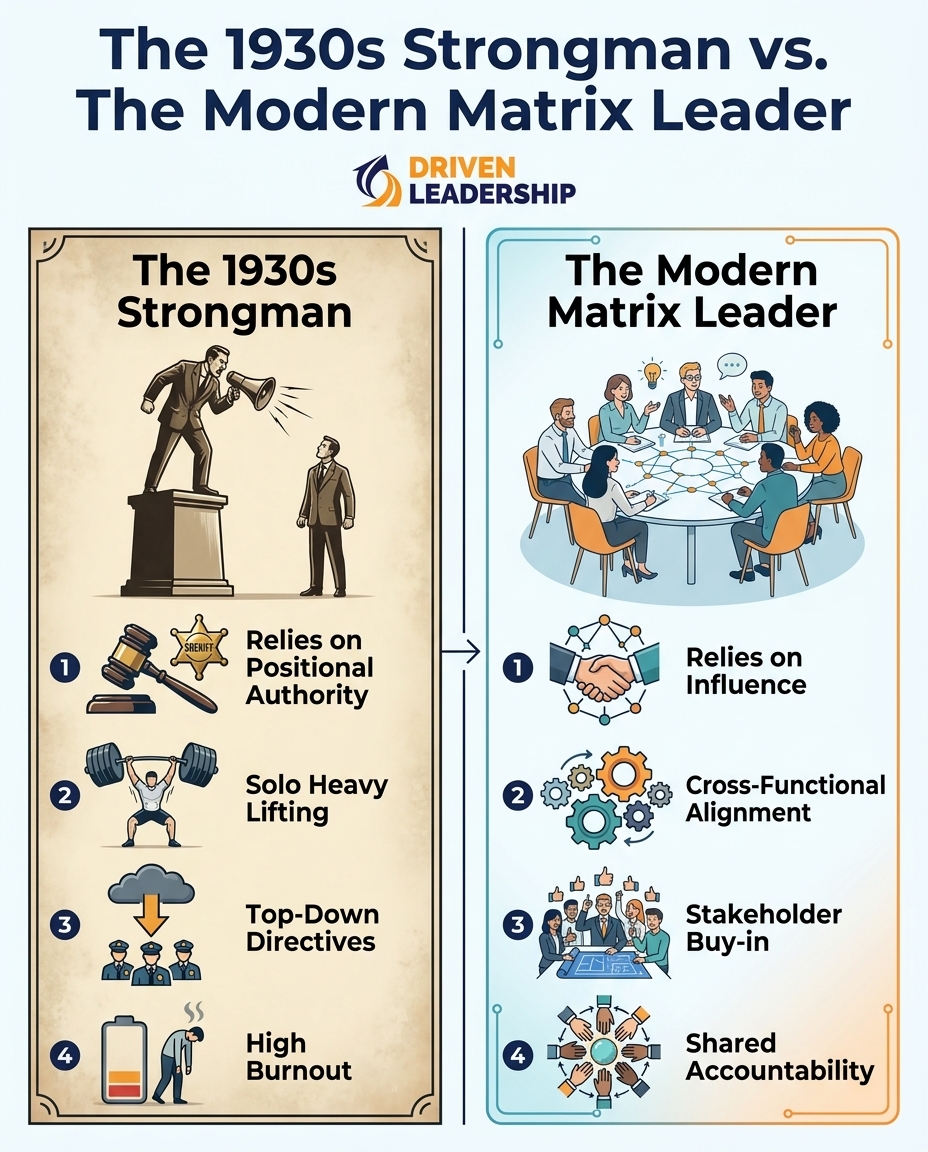
• Relies on positional authority and loud directives. — The Modern Matrix Leader Mindset: Relies on influence, trust, and active listening.
• Views pushback as insubordination. — The Modern Matrix Leader Mindset: Views pushback as vital data for problem-solving.
• Attempts to carry the project's weight alone. — The Modern Matrix Leader Mindset: Distributes accountability across the team.
• Measures success by personal effort and exhaustion. — The Modern Matrix Leader Mindset: Measures success by team velocity and alignment.
The contrast is stark. The strongman demands compliance, while the modern leader cultivates commitment. Transitioning away from this outdated metaphor is the first step toward building a sustainable, agile team that can execute without constant supervision.
Why Dotted-Line Reporting Resists Top-Down Directives
The core problem with brute-force leadership becomes glaringly obvious when you examine the mechanics of a cross-functional matrix organizational structure. In a traditional hierarchy, a solid-line reporting structure means you control the employee's performance reviews, their salary, and their career trajectory. If you issue a command, they have a vested, structural interest in complying. But in a matrix organization, you are frequently working with dotted-line reports—individuals who contribute to your project but report directly to someone else.
The Problem: Dotted-line reports do not respond well to unilateral "force of will" commands. When you try to push a project forward by simply demanding faster results, you run headfirst into the reality that these employees have competing key performance indicators (KPIs) from their primary managers. Your urgent September deadline might directly conflict with the core Q3 production duties assigned by their actual boss.
The Cause: When leaders fail to recognize this structural reality, they often interpret a lack of immediate compliance as laziness or incompetence. They push harder. This creates a predictable reaction: passive resistance. At Driven Leadership, a pattern we see often is that passive resistance is not an organizational design flaw; it is a direct symptom of an outdated leadership style. Team members will nod in meetings, agree to deadlines, and then quietly prioritize their solid-line manager's work. They will slow-walk your requests, knowing you lack the formal authority to penalize them.
The Solution: Relying on positional authority in a matrix creates massive organizational drag. To solve this, our team recommends you stop treating dotted-line reports as subordinates and start treating them as internal partners. You have to uncover what matters to their primary department and align your project's goals with their existing incentives. When you remove the friction of competing priorities, the passive resistance dissolves, and the project moves forward naturally without requiring you to push it every single step of the way.
The Psychological Toll and Systemic Bottlenecks
When a leader insists on operating like a strongman, the damage extends far beyond missed deadlines. There is a severe psychological toll on both the leader and the team. Gallup research indicates that highly matrixed employees are significantly more prone to burnout when expectations and leadership influence are unclear. When a team is subjected to constant top-down pressure without clear, collaborative alignment, morale plummets.
For the leader, the behavioral exhaustion is profound. If you are the only one pushing the project forward, you can never stop pushing. You spend your evenings answering emails, your weekends planning the next phase, and your workdays fighting fires that your team should be equipped to handle. This exhaustion is not a badge of honor; it is a glaring warning sign that your leadership framework is broken.
This dynamic creates systemic bottlenecks. If the team knows that you will ultimately make every final call, review every document, and dictate every next step, they will stop thinking critically. They will simply wait for your instructions. A team of highly paid, highly skilled professionals is suddenly reduced to a group of order-takers, bottlenecked by the processing speed of a single exhausted leader.
In the highly matrixed, fast-paced corporate and aerospace environments typical of the Pacific Northwest, particularly around Seattle and Tacoma, extreme agility is required to stay competitive. In our years working with organizations in these regional hubs, we consistently observe that projects move at lightning speed across dozens of departments. A leadership bottleneck here is not just an inconvenience; it is fatal to local executives' strategic goals. When a leader slows down the entire matrix because they refuse to distribute authority, the organization loses its competitive edge. Speed requires trust, and brute force destroys trust.
Pivoting from Brute Force to Influence-Based Leadership
Transitioning away from top-down demands requires a fundamental shift in how you view your role. You must pivot toward leading through influence, relationship building, and proactive stakeholder management. True influence is not about speaking the loudest in meetings or intimidating others into compliance. It requires vulnerability, active listening, and the ability to communicate effectively across functional silos.
Consider the experience of one manager who reached out to our Puyallup facility during a busy early fall quarter. They were struggling with a severe lack of confidence and an inability to communicate effectively during high-stakes cross-functional meetings. By stepping away from their daily grind and participating in an immersive advanced leadership training program—one that required full acceptance of a challenging behavioral process—they earned a challenge coin and fundamentally transformed their approach within a 3-day intensive window. They walked away with increased initiative, improved communication skills, and a positive impact that rippled through both their personal and professional life. They learned that influence is a skill you build, not a trait you are born with.
Here is how you can begin that pivot:
Mapping Stakeholder Motivations
1. Identify the primary drivers: Before you ask a dotted-line report for a deliverable, find out what their solid-line manager evaluates them on. Understanding what drives them is the foundation of influence.
2. Align your goals: Frame your project's success in a way that helps the stakeholder achieve their own departmental KPIs. If your project makes them look good to their boss, you will never have to force them to participate.
3. Acknowledge their workload: Openly discuss the competing priorities they face. Showing empathy for their schedule builds immediate trust and lowers their defensive posture.
Fostering Proactive Communication
1. Replace directives with questions: Instead of saying, "I need this by Friday," ask, "What needs to happen on your end for us to hit a Friday deadline?" This shifts the burden of problem-solving onto them.
2. Establish open feedback loops: Create an environment where team members feel safe telling you that a deadline is unrealistic before the deadline actually passes.
3. Build trust across silos: Spend time building relationships outside of immediate project needs. When you have a foundation of trust, cross-functional collaboration happens organically, accelerating project timelines significantly.
Building True Accountability and Team Execution
There is a massive difference between the performative "force of will" tactics of the past and the genuine behavioral change required to lead today. Many organizations attempt to solve matrix friction with structural fixes. They create elaborate RACI charts (Responsible, Accountable, Consulted, Informed), draft new communication protocols, and restructure reporting lines. But structural fixes cannot solve behavioral problems. If a leader still operates with a strongman mentality, no chart in the world will generate true team execution.
Genuine execution relies on mutual accountability frameworks, not a single leader's grit. It requires leaders to look inward and overcome their own personal and professional roadblocks. For example, during a recent 2025 cohort session, another professional found their personal and professional self-perception deeply challenged. Rather than sitting through a cliché corporate seminar filled with theoretical tips, they engaged with our passionate team in a program involving real behavioral tests. By stepping completely out of their comfort zone, they grew immensely as a person and leveled up their professional capabilities. They realized that elevating a team requires elevating oneself first.
Influence without authority is a highly learnable, behavioral skill. It is taught through rigorous practice, honest feedback, and a willingness to abandon the ego-driven need to be the sole hero of the story. At Driven Leadership, we emphasize this exact genuine behavioral change. When you learn to facilitate rather than dictate, you stop dragging your team across the finish line. Instead, you build an environment where mutual accountability thrives, and the team executes flawlessly because they are internally driven to succeed, not externally forced to comply.
Frequently Asked Questions
Why do matrix organizations fail?
Matrix organizations typically fail when leaders rely on outdated, top-down authority rather than cross-functional influence. Because employees in a matrix report to multiple managers, conflicting priorities and unclear expectations can quickly stall progress. When leadership does not actively align these competing goals, the structure breaks down into silos and passive resistance.
How do you lead effectively in a matrix organization without authority?
At Driven Leadership, we teach that leading without formal authority requires you to master stakeholder management and proactive communication. You must understand the specific motivations and KPIs of your dotted-line reports and align your project's goals with their departmental needs. By building trust and fostering mutual accountability, you can drive results through influence rather than demands.
What are the disadvantages of a matrix organization?
The primary disadvantages include potential role ambiguity, slower decision-making processes, and increased potential for conflict among managers. Employees can easily become overwhelmed if they are receiving urgent, conflicting directives from different leaders. This is why highly skilled, influence-based leadership is mandatory to keep a matrix functioning smoothly.
What is the difference between direct and dotted line reporting?
Direct (solid line) reporting means the manager has formal authority over the employee's performance reviews, compensation, and daily tasks. Dotted line reporting indicates a secondary relationship where an employee contributes to a specific project or team, but their ultimate career authority remains with their direct manager. Dotted line reports require influence, as you cannot rely on structural authority to mandate their compliance.
How does the 'strongman' leadership style create passive resistance?
When a leader uses brute force to demand compliance from dotted-line reports, those employees often feel their primary duties are being disrespected. Since the leader lacks the formal authority to penalize them, the employees will nod in agreement but quietly prioritize their solid-line manager's work. This results in slow-walked tasks, missed deadlines, and a complete lack of proactive problem-solving.
Ready to transform your approach? A clear deconstruction of why your high-effort, top-down approach is failing proves that the bottleneck is often the leadership style itself. By embracing a framework for leading through influence rather than force, you can eliminate passive resistance and accelerate your cross-functional projects. The time to unlearn the "why the 1930s strongman leadership style fails in matrix organizations" mindset is now.