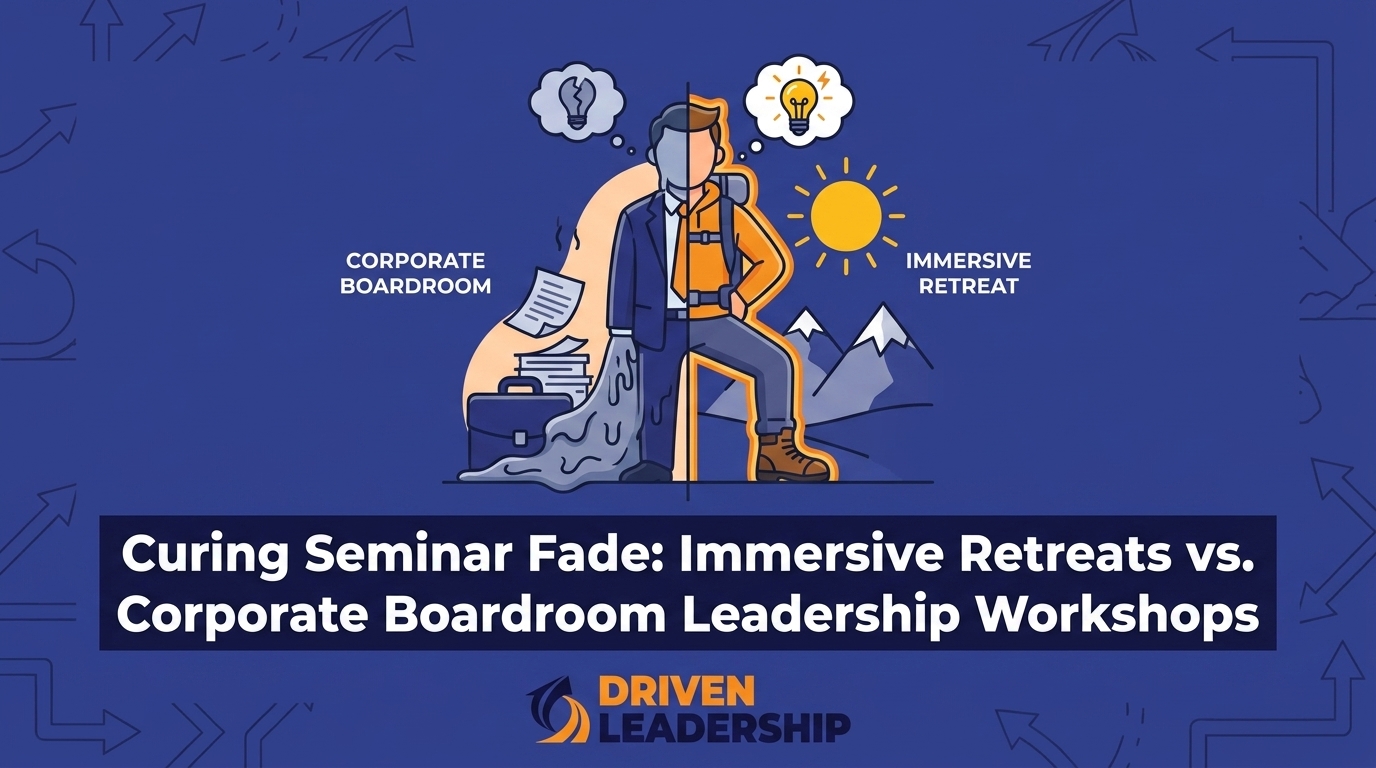
Immersive Retreats vs. Corporate Boardroom Leadership Workshops

The Illusion of Progress in the Corporate Boardroom
A climate-controlled office with high-speed Wi-Fi, ergonomic chairs, and catered lunches seems like the ideal setting for executive learning. However, in our years of facilitating executive development at Driven Leadership, we frequently see that if you are weighing immersive retreats vs. corporate boardroom leadership workshops, you must recognize that this very comfort is often what holds your leadership team back. The familiar environment of the corporate headquarters inadvertently reinforces the exact behavioral silos and communication barriers you are trying to break down. Leaders step into the room wearing their usual professional armor, and despite the best intentions of the facilitator, the underlying team dynamics remain completely undisturbed.
This dynamic creates a frustrating and recognizable problem: "seminar fade." Your executive team spends two days in a workshop, nodding along to new frameworks and pledging to change their communication styles. The enthusiasm is palpable in the room. Yet, by the following Monday morning, the energy evaporates. The binders go on a shelf, the daily operational fires take over, and everyone reverts to their baseline behaviors. The investment of time and capital yields zero long-term behavioral change because the environment never forced a true disruption of the status quo.
As you approach your early fall strategic planning sessions, you face a critical decision point. You can either repeat the cycle of temporary motivation by booking another standard seminar, or you can intentionally disrupt the environment to force genuine vulnerability and growth. If you want to move beyond fleeting enthusiasm, exploring BOLD immersive leadership retreats offers a proven pathway to lasting behavioral change.
The Comfort Trap: Why Traditional Workshops Lead to 'Seminar Fade'
Understanding why standard onsite corporate workshops often fail requires a close look at the psychology of adult learning and environmental conditioning. When executives remain in a familiar setting, their brains operate on autopilot. They are physically present, but psychologically, they are still tethered to their daily routines. To achieve a lasting impact, leaders require a physical reset—like the stark contrast of Pacific Northwest mountain isolation—to break the cycle of seminar fade. Through our firsthand experience observing executive teams, here is exactly how we see the comfort trap sabotage traditional training:
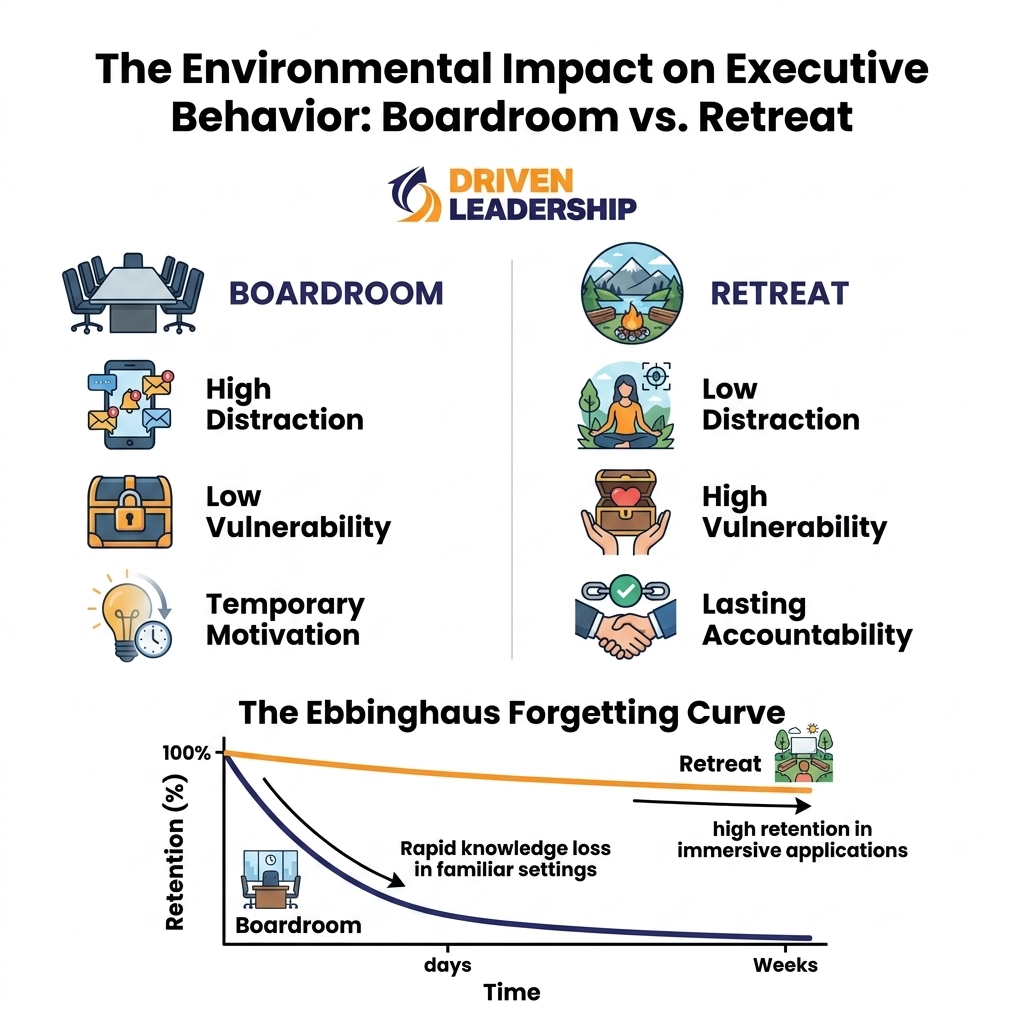
1. The Ebbinghaus Forgetting Curve in Action: Human memory naturally degrades over time. Without immediate, high-stakes application of new concepts, the Ebbinghaus forgetting curve dictates that participants will lose up to 75% of what they learned within a matter of days. Traditional workshops rely on passive listening and hypothetical role-playing, which do not anchor the lessons in deep emotional or physical memory.
2. The Distraction of Proximity: In a standard boardroom, executives are never truly disconnected. They are one notification away from an operational crisis. The proximity to their desks means they spend breaks checking emails and taking urgent calls, preventing the deep, uninterrupted focus required for true self-reflection and team bonding.
3. Reinforcing Behavioral Silos: Familiar environments trigger familiar behaviors—a psychological concept known as state-dependent memory. When the VP of Sales and the COO sit in the same room where they normally argue over budgets, they naturally fall back into their defensive postures. The physical space itself acts as a barrier to new ways of interacting.
4. The Illusion of Participation: Comfortable settings allow participants to "hide" in plain sight. They can nod, take notes, and offer surface-level insights without ever taking a genuine emotional risk. Because the environment feels safe and predictable, there is no catalyst forcing them to drop their guards and rely on one another.
Breaking this cycle requires removing the safety net. When you take a team out of the boardroom and place them in an environment that demands active participation and peer reliance, you bypass the comfort trap entirely.
Breaking the Corporate Armor: The Psychology of Isolation
There is a profound psychological shift that occurs when you remove leaders from their habitual workspaces and place them in novel, unfamiliar environments. Psychological safety and vulnerability accelerate rapidly when the corporate facade is stripped away. In the office, a CEO or Director relies on their title, their corner office, and their established authority. In an isolated setting, those superficial markers of power disappear. They are no longer just a title; they are an individual who must communicate, trust, and collaborate with their peers to navigate unfamiliar challenges.
The contrast between comfortable, climate-controlled corporate offices and the rugged, isolated natural environments of the Pacific Northwest is intentional and necessary. The physical discomfort and unpredictability of the outdoors force leaders out of their comfort zones. They cannot rely on their standard scripts. Our team at Driven Leadership intentionally uses these immersive, isolated environments as part of our BOLD training methodology to break down professional facades and drive true behavioral change. By removing technological crutches and familiar comforts, the methodology accelerates the transition from a group of individual contributors to a unified, cohesive team.
This approach yields tangible results that standard seminars simply cannot replicate. For example, during a recent spring program we facilitated, a participant facing debilitating personal and professional roadblocks found that the unfamiliar environment provided the exact support and guidance needed to acknowledge and overcome those obstacles. The isolation removed the daily distractions, allowing them to focus entirely on their internal barriers, which ultimately led to significant personal and company-wide elevation. True behavioral change requires disrupting the habitual workspace. When you step into Pacific Northwest mountain isolation, the environment itself becomes the primary facilitator of growth, making an Advanced Leadership Program a deeply transformative experience.
Side-by-Side Comparison: Environmental Impact on Executive Behavior
Based on our extensive field experience, to clearly see the difference in outcomes, you have to look at how the physical space directly dictates human interaction. The environment sets the rules of engagement. Whether you are planning your early fall strategic planning initiatives or looking to resolve deep-seated communication issues, choosing between a boardroom and an isolated retreat will determine your ultimate return on investment. If you are considering off-site leadership development, this side-by-side comparison highlights the stark contrasts in behavioral impact.
• Vulnerability Level — Corporate Boardroom Workshop: Low. Participants maintain professional facades and stick to safe, surface-level discussions. — Isolated Immersive Retreat: High. Unfamiliar challenges strip away titles, forcing authentic reliance on peers.
• Distraction Level — Corporate Boardroom Workshop: High. Constant access to devices, emails, and proximity to daily operational fires. — Isolated Immersive Retreat: Low to None. Physical isolation removes technological tethers and forces pure presence.
• Retention & Motivation — Corporate Boardroom Workshop: Temporary. Enthusiasm spikes during the event but fades rapidly upon returning to work. — Isolated Immersive Retreat: Lasting. Shared adversity anchors lessons in emotional memory, creating permanent shifts.
• Peer Accountability — Corporate Boardroom Workshop: Siloed. Interactions remain constrained by existing departmental boundaries and rivalries. — Isolated Immersive Retreat: Unified. Overcoming obstacles together creates a new, shared language of accountability.
• Long-Term ROI — Corporate Boardroom Workshop: Minimal. Often results in a binder on a shelf and no measurable change in team dynamics. — Isolated Immersive Retreat: High. Produces a cohesive leadership front ready to tackle Q4 and Q1 strategic goals.
Boardroom Workshops: The Status Quo
The standard corporate workshop is built for convenience, not transformation. Because the setting is highly controlled and familiar, the interactions remain siloed. Leaders participate in a state of partial attention, keeping one eye on the facilitator and the other on their inbox. The resulting motivation is entirely temporary. While they may learn a new framework for conflict resolution, the lack of deep vulnerability means they are unlikely to actually use it when a real conflict arises the following week. The boardroom enables the status quo.
Immersive Retreats: The Catalyst for Change
In contrast, an immersive retreat is designed to be a catalyst. By introducing a degree of physical or psychological unpredictability, these environments demand high peer reliance. You cannot fake your way through a challenge in the woods the way you can fake your way through a PowerPoint presentation. This forced presence generates deep vulnerability, which is the absolute prerequisite for trust. The behavioral shifts forged in these environments are lasting because they are rooted in shared, lived experiences rather than abstract theory.
From Temporary Motivation to Lasting Accountability
We always tell our clients that the true measure of any leadership initiative is what happens thirty, sixty, and ninety days after the event concludes. The transition from temporary motivation to lasting accountability hinges entirely on the shared experiences of the executive team. In a standard seminar, learning is characterized by passive listening. The facilitator speaks, the executives take notes, and the interaction is largely one-directional. In an immersive retreat, learning is characterized by active, high-stakes participation. The team must physically and mentally navigate challenges together, which fundamentally alters how they view one another.
This shared adversity creates a new baseline for communication. When leaders return to the office, they no longer communicate as isolated department heads; they communicate as a unified front. The shared vulnerability experienced in the Pacific Northwest mountain isolation translates directly back to the boardroom. If a team can successfully navigate high-pressure, unfamiliar situations off-grid, they can easily navigate a tense budget meeting without resorting to defensive posturing. They hold each other accountable long after the retreat ends because they have seen each other at their most authentic.
The real-world outcomes of this shift are profound. In another instance during a spring immersive retreat we hosted near Puyallup, WA, an executive struggling with assertiveness and communication leaned heavily into the shared vulnerability of the experience. The environment demanded a level of directness they had previously avoided. The resulting shift was so significant that their management team and associates immediately noticed the newfound confidence and improved listening skills upon their return to the office. This is the difference between learning a concept and actually embodying it.
Structuring Your Strategic Initiatives for Maximum Impact
When our team guides organizations through these transitions, we emphasize that to guarantee your investment in leadership development yields actual results, you must structure the initiative with intentionality. Taking a team offsite requires more than just booking a venue; it requires a strategic approach to timing, preparation, and reintegration. If you are planning your early fall strategic planning sessions, follow these steps to maximize the impact of your immersive transition:
1. Time the Transition Strategically: Taking teams offsite during seasonal transition periods—specifically early fall—sets critical behavioral foundations before the chaos of Q4 and the launch of Q1 initiatives. It provides a clean psychological break from the summer slowdown and aligns the team's focus for the heavy lifting ahead.
2. Prepare the Team Psychologically: Do not spring an immersive retreat on your executives at the last minute. Prepare them for the fact that this will not be a standard "sit and listen" seminar. Set clear expectations that they will be stepping out of their comfort zones, disconnecting from their devices, and engaging in deep, reflective work.
3. Prioritize Behavioral Shifts Over Generic Team-Building: There is a massive difference between a retreat focused on behavioral psychology and a generic corporate outing. Ensure you are choosing a methodology that challenges entrenched habits rather than just offering a fun day out. Incorporating BOLD training exercises for trust and cooperation ensures the activities tie directly back to workplace communication.
4. Integrate Lessons Back into Operations: The retreat does not end when you leave the woods. Schedule immediate follow-up sessions upon returning to the office to discuss how the newly established trust and communication protocols will be applied to current operational challenges. Anchor the new behaviors in daily routines before the "seminar fade" can take root.
Frequently Asked Questions About Leadership Training Environments
Why do traditional leadership workshops often fail to produce lasting change?
Traditional workshops fail because they rely on passive learning in familiar, comfortable environments. When executives remain in a climate-controlled office, they are not forced out of their habitual thought patterns, leading to "seminar fade" where initial enthusiasm disappears within days. Without physical or psychological disruption, entrenched behavioral silos remain completely undisturbed.
What are the psychological benefits of offsite leadership retreats?
Offsite retreats rapidly accelerate psychological safety and vulnerability. By removing leaders from their standard corporate armor and placing them in unfamiliar settings, they are forced to rely on their peers authentically. This shared adversity strips away egos and builds a profound level of trust that translates directly back to better boardroom communication.
How does a physical environment affect executive leadership training?
The physical environment dictates the rules of engagement and focus. A setting like Pacific Northwest mountain isolation inherently removes daily technological distractions, forcing executives to be entirely present. Unfamiliar, rugged environments trigger a physical and mental reset, making participants far more receptive to deep behavioral shifts than they would be in a predictable office setting.
What is the difference between an immersive leadership retreat and generic team-building?
Generic team-building focuses on surface-level morale boosts, like trust falls or escape rooms, which rarely impact daily work dynamics. An immersive leadership retreat is rooted in behavioral psychology, intentionally using environmental discomfort to expose and resolve deep-seated communication barriers, resulting in measurable, long-term accountability.
How long should a corporate leadership retreat be to ensure behavioral shifts?
To achieve true behavioral shifts, a retreat typically requires multiple days of continuous immersion to break down initial resistance. A single afternoon is not enough time to bypass the comfort trap; it takes sustained time away from daily operational fires for executives to drop their guards, build authentic trust, and establish new communication baselines.
Selecting the Right Environment for Your Next Executive Initiative
Curing seminar fade requires a fundamental shift in how you approach executive education. You cannot expect a team to change their deeply ingrained habits if you never change the environment in which they operate. While comfortable boardrooms offer convenience, they ultimately enable the status quo, producing temporary motivation that fails to survive the reality of daily operations.
Isolated, immersive retreats provide the necessary disruption to forge lasting behavioral change. By stripping away professional facades and forcing deep, authentic peer reliance, these environments guarantee a return on investment that standard seminars simply cannot match. As you re-evaluate your early fall strategic planning sessions, consider the long-term impact of your setting. If you are ready to move beyond the illusion of progress and build a truly unified executive team, it is time to explore the transformative power of an immersive Advanced Leadership Program.