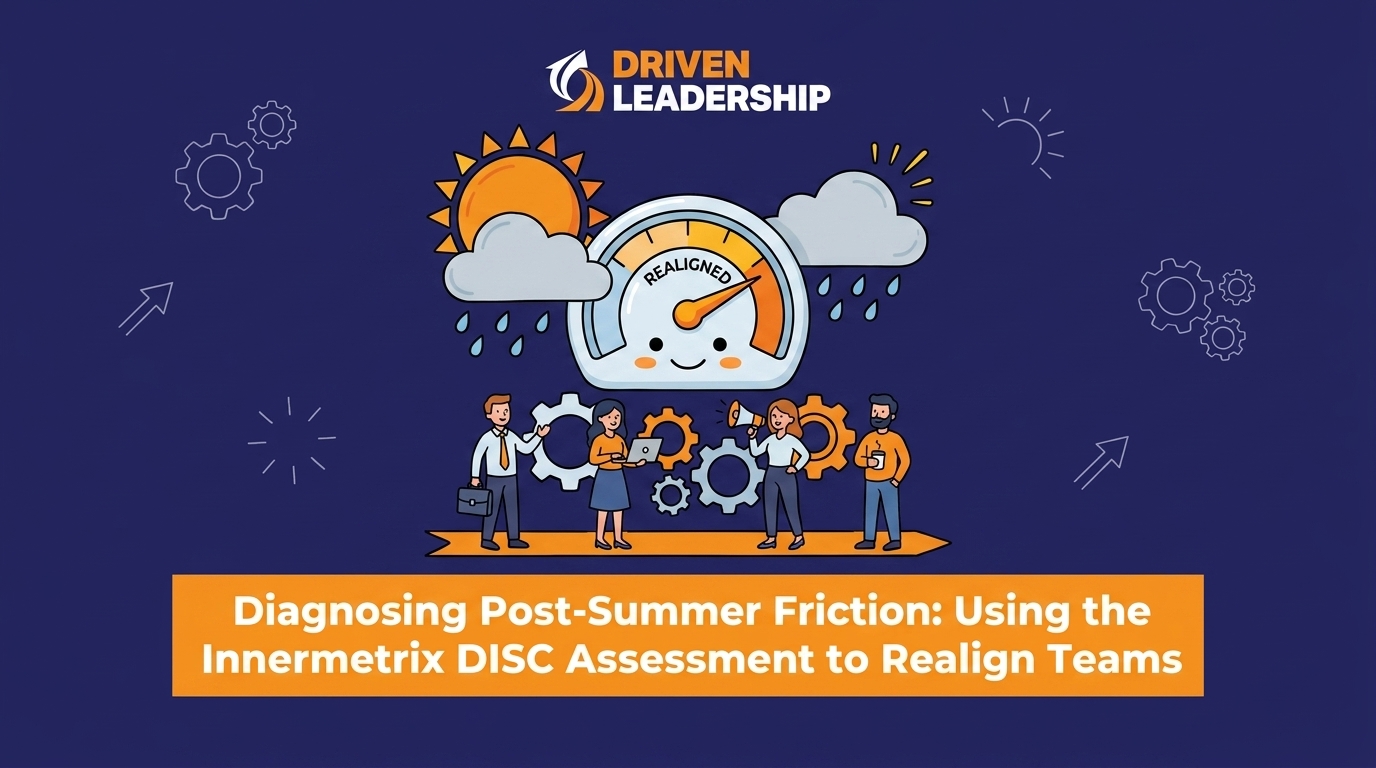
Using the Innermetrix DISC Assessment to Realign Teams After Summer Turnover

The Q4 Threat: When New Hires and Legacy Employees Clash
Your team brought on fresh talent over the last few months, but as the post-summer/early fall transition takes hold, that initial momentum has stalled. In our experience coaching organizations throughout Puyallup and the greater Pacific Northwest, Using the Innermetrix DISC Assessment to realign teams after summer turnover is often the necessary step to bridge the gap between a fractured group and a highly functional unit. You are likely noticing that new hires are struggling to integrate, while your veteran staff seems increasingly frustrated by disrupted workflows. This dynamic creates a dangerous bottleneck right as your company prepares for the heavy demands of the fourth quarter.
Many business leaders default to subjective performance reviews when they see this friction. They assume the new recruits lack a strong work ethic, or they worry that their long-term employees have become too rigid. However, relying on gut feelings or hasty disciplinary action rarely solves the root issue. To build a resilient workforce, you need an objective approach to organizational development that removes emotion from the equation.
Team friction is rarely about a lack of skill or a fundamental personality flaw. Instead, our team typically sees that it is almost always a structural communication mismatch. Legacy employees have established, unspoken rules for how information is shared and decisions are made. When new hires step into that environment without a map of those behavioral expectations, clashes are inevitable. Recognizing these clashes as communication gaps rather than competence failures is the first step toward effective realignment.
Common signs of this structural mismatch include:
• Siloed workflows: Veteran staff hoarding tasks because it is "faster to do it themselves" rather than explaining the process to a new hire.
• Passive-aggressive communication: Short, terse emails or a distinct lack of participation during team meetings.
• Missed handoffs: Critical project details falling through the cracks because team members assume someone else is handling the communication.
• High stress levels: An overarching sense of tension in the office that drains energy before the Q4 workload even peaks.
Moving Past the 'Bad Hire' Myth: Identifying Structural Communication Mismatches
At Driven Leadership, a pattern we see often from frustrated managers involves new hires not gelling with legacy employees. It is incredibly tempting to label a struggling recent addition as a "bad hire" and cut your losses. However, the psychological dynamics at play are far more complex than a simple attitude problem. Legacy employees naturally want to protect their established territory and proven workflows. Meanwhile, new recruits are eager to prove their worth but lack the historical context of why certain processes exist.
Standard onboarding programs typically focus on the technical aspects of a job. They cover software logins, company policies, and daily task lists. What they entirely ignore is behavioral integration. A new team member might know exactly how to operate your CRM, but if they do not know how their manager prefers to receive bad news, they will quickly find themselves out of favor. This lack of effective communication skills and behavioral awareness often masquerades as incompetence.
In one recent spring training cohort at Driven Leadership, a participant struggled with a severe lack of confidence and initiative in their workplace. Management initially viewed this as a performance failure. However, after the individual attended our immersive leadership program, it became clear that the core issue was a communication barrier, not a lack of ability. Once the individual learned how to adapt their communication style, their active listening improved, they began taking initiative, and their overall performance transformed.
The Cost of Subjective Bias in Team Evaluations
Subjective bias is a silent drain on corporate resources. Managers routinely misdiagnose communication friction as a poor cultural fit. When a fast-paced, decisive manager (a high "D" style) evaluates a cautious, detail-oriented new hire (a high "C" style), the manager might label the employee as slow or unmotivated. The employee is actually highly capable, but their natural communication style conflicts with the manager's expectations.
The data behind the friction: Over 80% of executives cite ineffective communication as a primary cause of workplace failures. When you rely solely on subjective evaluations, you risk firing talented individuals simply because their behavioral style does not naturally mirror your own. Utilizing the Innermetrix Leadership Assessment provides the objective data required to see past these biases and evaluate your team based on how they actually process information and make decisions.
How the Innermetrix Index Outperforms Standard Personality Tests
While many organizations attempt to solve team friction by deploying basic personality tests, these introductory tools often fall short. Standard assessments might tell you that an employee is outgoing or analytical, but they fail to diagnose deep-seated friction points. If you want to stop new hires not gelling with legacy employees, you need a diagnostic tool that goes beneath the surface level of observable behavior.
Our team at Driven Leadership utilizes the Innermetrix index because we have found it serves as an advanced, objective diagnostic tool that goes far beyond standard tests. While a basic assessment measures "how" a person behaves, the full Innermetrix suite measures "why" they make certain choices and "what" natural talents they bring to the table. This comprehensive approach uncovers the hidden behavioral bottlenecks that surface during high-stress periods.
Understanding the differences between Innermetrix and standard personality tests is essential for business leaders who want genuine team cohesion rather than superficial team-building exercises. Superficial exercises might make the team smile for an afternoon, but they do not provide a framework for resolving a dispute over project deadlines the following week.
• Scope of Measurement — Standard Behavioral Tests: Only measures observable behavior (the "How"). — The Innermetrix Index: Measures behavior, core values (the "Why"), and cognitive processing (the "What").
• Depth of Insight — Standard Behavioral Tests: Provides broad categories and generalized personality labels. — The Innermetrix Index: Delivers highly specific, individualized data points on decision-making and motivators.
• Application in Conflict — Standard Behavioral Tests: Highlights that two people are different, but offers little actionable advice. — The Innermetrix Index: Provides a precise map of where communication breaks down and how to bridge the gap.
• Business Value — Standard Behavioral Tests: Useful for basic icebreakers and general self-awareness. — The Innermetrix Index: Functions as a structural blueprint for organizational realignment and leadership development.
Mapping the Friction: Applying Behavioral Assessments to Post-Summer Turnover
To successfully navigate the post-summer/early fall transition, you need a structured methodology. Simply handing your team their assessment results and asking them to get along will not yield results. You must actively map the friction points and build a bridge between your legacy staff and your new additions. Here is the objective framework we recommend for realigning your workforce.
1. Baseline the legacy team's established styles: Before you can integrate new members, you must understand the existing ecosystem. Assessing your veteran staff reveals the unwritten communication rules and hidden expectations that govern your daily operations. This establishes a behavioral baseline for your company culture.
2. Profile the new hires: Next, evaluate your recent additions to understand their natural behavioral tendencies, core motivators, and decision-making processes. This step highlights how they prefer to receive feedback, how they handle stress, and what environments allow them to thrive.
3. Overlay the profiles to identify objective friction: This is where the data becomes actionable. By comparing the legacy baseline against the new hire profiles, you can pinpoint exactly where conflict will occur. For example, if your legacy team values rapid execution but a new hire is motivated by meticulous accuracy, you now have an objective explanation for their recent disagreements.
4. Implement targeted training: With the friction points mapped, you can provide specific, actionable strategies to bridge the gap. This involves teaching the team how to adapt their natural styles to communicate effectively with one another, ensuring that everyone is moving in the same direction.
Applying this data requires guided implementation. Engaging in advanced insights training ensures that your team does not just read their reports, but actively uses the shared language to navigate daily challenges and improve their collaborative efforts.

Building a Strong Business Foundation Through Improved Communication
The transition from a fractured group of individuals to a cohesive, high-performing unit requires intentional effort. When new hires not gelling with legacy employees threatens your productivity, objective behavioral data is the ultimate equalizer. It removes the emotion and personal attacks from conflict resolution. Instead of a manager saying, "You are being too aggressive," the conversation shifts to, "Your high-D communication style is overwhelming this team member; let's adjust the delivery."
Understanding one another's profiles leads to a dramatic improvement in active listening. Team members stop waiting for their turn to speak and start listening for the behavioral cues of their peers. This shared language fosters an environment where individuals feel safe taking initiative, knowing that their communication will be received as intended rather than misinterpreted as a threat to the established order.
During a recent winter leadership intensive we hosted, an attendee seeking personal growth wanted to become a stronger leader and a better risk-taker. By understanding the behavioral drivers that influenced their decision-making—similar to the insights gained by family members who had previously attended our program—they were able to step out of their comfort zone. They emerged as a stronger, more effective communicator, proving that effective communication is a learned skill that requires the right diagnostic tools to develop and refine.
Realigning Corporate Goals for the Q4 Push
The early fall window is a critical period for resetting corporate goals. As the third quarter closes, the margin for error shrinks drastically. If your team is still arguing over how to format weekly reports or misinterpreting email tones, they will not have the bandwidth to handle the impending end-of-year workload. Proactive realignment in September is vastly more efficient than attempting reactive damage control in November or December.
Here in Puyallup and the broader Pacific Northwest, the late summer/early fall transition brings a noticeable psychological shift to the workplace. As the weather turns, the days get shorter, and the rain returns, the collective energy moves away from summer distractions and focuses heavily indoors. This environmental change naturally aligns with an intensive focus on end-of-year execution. Capitalizing on this shifting mindset allows leaders to unify their teams around a shared objective.
Aligning your workforce now prevents costly communication breakdowns when the stakes are highest. By addressing the friction head-on, you ensure that every member of the team understands their role and how to interact with their peers under pressure. Implementing clear team execution strategies based on behavioral data guarantees that your organization enters Q4 with a unified front, ready to tackle the busiest season of the year.
Frequently Asked Questions About Team Realignment and DISC
How does the Innermetrix DISC assessment help with team turnover?
The Innermetrix index objectively maps communication styles to identify exactly why new hires and legacy staff are clashing. By providing concrete data on behavioral tendencies, it removes subjective bias and emotion from the evaluation process. This allows managers to address the root cause of the friction rather than making hasty decisions to terminate struggling employees.
How do you resolve conflict between new hires and legacy employees?
You resolve this conflict by treating the friction as a structural communication mismatch rather than a performance or attitude issue. Using behavioral data, you can show both parties how their natural styles conflict and provide them with a shared language to bridge the gap. This objective framework transforms personal grievances into actionable communication adjustments.
How can DISC profiles improve team communication post-onboarding?
DISC profiles provide a shared vocabulary for the entire team to understand differing behavioral tendencies. Once onboarding is complete, this data helps new hires adapt their communication approaches to match the expectations of veteran staff, and vice versa. It turns abstract concepts like "being a team player" into measurable, observable actions.
Why do new hires often clash with existing employees in the fall?
The combination of summer turnover integration and the high-pressure ramp-up to the fourth quarter exacerbates any underlying communication differences. As the workload increases, legacy employees default to their fastest, most ingrained behaviors, leaving new hires behind. This high-stress environment turns minor misunderstandings into significant operational bottlenecks.
Preparing Your Team for Fall Success
Hidden behavioral clashes do not resolve themselves, but they can be objectively identified and corrected before they derail your end-of-year goals. By using the Innermetrix DISC Assessment to realign teams after summer turnover, you provide your workforce with the exact blueprint they need to communicate effectively and execute efficiently. Navigating the post-summer/early fall transition requires a clear, actionable understanding of your team's dynamics. We encourage business leaders to move beyond subjective evaluations and explore advanced assessment options with Driven Leadership to fully integrate their workforce for a successful fourth quarter.