Transitioning from a Managerial Mindset to a Driven Leadership Focus

The Myth of the Year-End Manager: Why Q4 Demands True Leadership
There is a pervasive misconception in corporate environments that pushing a team across the December finish line through sheer willpower is the ultimate test of authority. The truth is quite different. Transitioning from a Managerial Mindset to a Driven Leadership Focus requires recognizing that simply closing out the year's task list does not equate to effective leadership. As the November / Q4 year-end closeout approaches, the pressure to finalize budgets, conduct annual reviews, and tie up loose ends creates a concrete problem: professionals get stuck in a rigid, box-checking mentality.
This late-fall period presents a critical decision point for anyone in a position of authority. You can choose to coast through the end of the year, managing the status quo and letting the calendar dictate your team's energy, or you can proactively plan and cast a vision for the upcoming year. The temptation to just "get through the holidays" is strong because checking boxes feels productive. It provides immediate gratification. However, this task-oriented approach often leaves teams feeling adrift and uninspired just when they need direction the most.
Overcoming year-end complacency means returning to foundational leadership principles. True leaders do not just close out the old year; they set the emotional and strategic stage for the new one. They understand that a managerial focus looks backward at what needs to be finished, while a leadership focus looks forward at what needs to be built. By stepping back from the daily grind of administrative checklists, you can begin the uncomfortable but necessary work of charting a course for the next twelve months, ensuring your team hits the ground running in January rather than stumbling out of the gate.
The Trap of the Tactical Mindset During Late Fall
The descent into a purely tactical mindset rarely happens on purpose. It is usually the result of environmental pressure, seasonal fatigue, and the sheer volume of end-of-year administrative duties. When the pressure of year-end closeouts mounts, many professionals retreat into a strictly tactical, status-quo mentality because it feels safer and more controllable than strategic planning.
Here is how the tactical trap typically unfolds during the fourth quarter:
1. The shift to survival mode: As deadlines pile up, the focus narrows from "how can we grow?" to "how can we finish?" Long-term projects are shelved in favor of immediate, short-term tasks.
2. The over-reliance on delegation: Instead of inspiring the team, interactions become purely transactional. Conversations revolve entirely around status updates, deadlines, and deliverables.
3. The loss of connection: When leaders stop sharing the "why" behind the work, team members lose their emotional connection to the company's broader mission.
The stakes for falling into this trap are incredibly high. Statistical realities show that managers account for 70% of the variance in team employee engagement. When a leader's mindset shifts to pure survival, the team's engagement plummets correspondingly. This is especially true when factoring in environmental changes. In regions like the Pacific Northwest, the shift to dark, rainy winter weather naturally drains team energy. A visionary leader is required to sustain momentum through these seasonal slumps, rather than a manager who simply pushes checklists regardless of the team's emotional state. Navigating this requires a deliberate effort, much like transitioning from individual contributor to team leader, where the focus must shift from personal output to collective inspiration.
Recognizing the Signs of Year-End Burnout
To prevent the tactical trap from destroying your team's momentum, you must be able to identify when a team is merely surviving versus thriving. Letting seasonal fatigue dictate workplace productivity is a dangerous game. Watch for these common indicators:
• Decreased initiative: Team members only do exactly what is asked of them, waiting for the next instruction rather than anticipating needs.
• Increased friction: Small disagreements over minor tasks escalate quickly due to underlying exhaustion and lack of clear direction.
• Silence in meetings: Brainstorming sessions and strategy meetings are met with blank stares, as the team lacks the energy to think beyond the current week.
• Hyper-focus on the calendar: Conversations are dominated by countdowns to the holidays rather than excitement about upcoming projects.
Driven Leadership: Embracing a Profound Identity Shift
Moving away from a task-oriented approach is not about adopting a new time-management app or memorizing a soft-skills checklist. It requires a profound identity shift. You have to fundamentally change how you view your role, your team, and your value to the organization. A manager derives their value from ensuring things are done correctly; a leader derives their value from ensuring the right things are being done for the right reasons.
This transition is often accompanied by significant self-doubt. When you stop spending your days checking off tangible tasks, it can feel like you aren't "working" hard enough. Strategic vision-casting, emotional intelligence development, and team alignment are largely invisible processes. They do not produce immediate, quantifiable results in the same way that clearing an inbox does. Embracing this discomfort is a core tenet of the Driven Leadership philosophy, which pushes executives past standard corporate theory and out of their comfort zones to become true, visionary leaders.
Consider the case of two professionals starting a business together last spring. They quickly realized that relying solely on task management left them without a strong foundation. They lacked the foundational leadership skills and effective communication strategies required to scale their operations. By participating in transformational events and an online virtual leadership program, they acquired the necessary tools to bridge that gap. They didn't just learn new procedures; they underwent an immersive development process that changed how they operated under pressure. The outcome was a successfully built business foundation rooted in strong leadership and effective communication, proving that growth requires stepping entirely outside of familiar operational habits.
Side-by-Side: The Managerial Mindset vs. Driven Leadership Focus
To fully grasp the magnitude of this transition, it helps to look at the specific behavioral differences. The search pattern for a manager vs leader mindset often focuses on abstract concepts, but applying these differences to the concrete reality of Q4 provides a much clearer picture. A managerial approach prioritizes maintaining the status quo, while a leadership approach prioritizes driving change and preparing the team for what comes next.
• Primary Goal — Managerial Mindset (Q4 Task Focus): Clearing the immediate backlog of tasks. — Driven Leadership Focus (Next-Year Vision): Setting the strategic tone for January.
• Communication Style — Managerial Mindset (Q4 Task Focus): Transactional and directive (giving orders). — Driven Leadership Focus (Next-Year Vision): Inspirational and inquisitive (asking questions).
• Handling Fatigue — Managerial Mindset (Q4 Task Focus): Pushing the team harder to meet deadlines. — Driven Leadership Focus (Next-Year Vision): Acknowledging the fatigue while casting a compelling vision.
• Problem Solving — Managerial Mindset (Q4 Task Focus): Fixing the immediate symptom to stay on track. — Driven Leadership Focus (Next-Year Vision): Addressing the root cause to prevent future issues.
• Value Metric — Managerial Mindset (Q4 Task Focus): How many boxes were checked this week. — Driven Leadership Focus (Next-Year Vision): How aligned and energized the team feels.
• Delegation — Managerial Mindset (Q4 Task Focus): Assigning tasks based on who has capacity. — Driven Leadership Focus (Next-Year Vision): Assigning responsibilities based on growth potential.
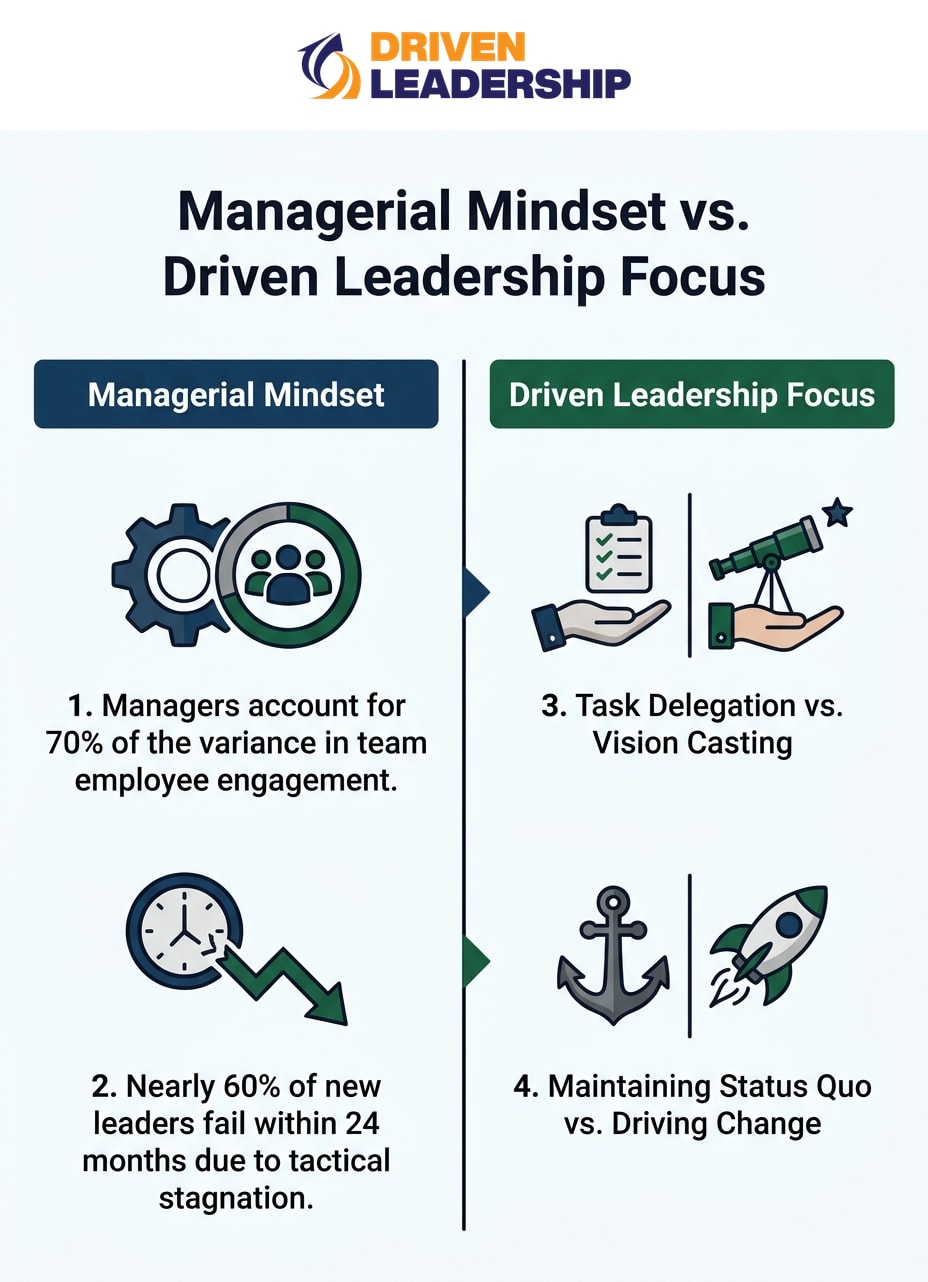
The stark contrast in this table highlights the difference between tactical task delegation and emotional intelligence in leadership. Anyone can assign a task, but it takes a high degree of emotional intelligence to recognize when a team is burning out and pivot the strategy accordingly.
Overcoming Seasonal Fatigue with Visionary Communication
Even with the right mindset, executing a leadership strategy during the end-of-year rush requires exceptional communication skills. Seasonal fatigue is real, and it acts like a heavy weight on team morale. To counteract this, leaders must employ visionary communication techniques that cut through the exhaustion and re-engage the team's sense of purpose.
Active listening is your most powerful tool during critical Q4 professional meetings. When team members express frustration or exhaustion, a manager might dismiss it as complaining or tell them to "push through." A leader listens actively, validates the concern, and uses that feedback to adjust the operational tempo. Confident communication is equally important. How a leader carries themselves directly counteracts the team's seasonal dips in workplace energy. If you walk into a late-November meeting looking defeated by the workload, your team will mirror that defeat. If you walk in with calm, grounded confidence, you provide an anchor for the team's anxiety.
This kind of transformation happens frequently when professionals commit to improving their presence. One executive, for example, faced significant roadblocks last spring due to a lack of confidence and passivity in professional meetings. Deficient in the communication skills needed to drive a team forward, they enrolled in an Advanced Leadership Program designed to identify skill gaps. By focusing on active listening and learning how to take charge of the narrative, this individual completely altered their thinking, enhanced their communication abilities, and improved their overall professional trajectory.
Casting a Vision for Next Year
Shifting from passive communication to taking charge of the narrative means you cannot wait until the calendar flips to start talking about the future. Waiting until January to set the tone is too late; by then, the team is already playing catch-up.
• Start early: Begin weaving next year's goals into your late-fall meetings. Connect the hard work being done now to the success you plan to achieve in the new year.
• Focus on the "Why": Remind the team why their current efforts matter in the grand scheme of the organization's mission.
• Celebrate the pivot: Acknowledge the transition from wrapping up old business to launching new initiatives, making it a celebrated milestone rather than just another deadline.
Moving Past the Status Quo to Energize Your Team
Understanding the difference between managing and leading is only the first step. Actually executing that transition under pressure requires targeted development. The reality is stark: nearly 60% of new leaders struggle or fail entirely without a structured transition plan. They fall back on the tactical habits that made them successful individual contributors, ultimately stagnating their careers and their teams.
Breaking these debilitating career roadblocks requires more than reading a book or watching a seminar. It requires advanced, immersive training that forces you to confront your limitations. Stepping out of your comfort zone builds the emotional intelligence necessary for true executive presence. You have to be placed in scenarios where your standard managerial tactics fail, forcing you to rely on influence, empathy, and strategic thinking instead.
Programs like BOLD advanced leadership training facilitate this exact identity shift by challenging participants through immersive exercises. These experiences are designed to strip away the crutch of the "checklist" and expose the core of how you interact with others. By engaging in this level of rigorous self-examination, leaders learn how to sustain momentum, inspire trust, and energize their teams, even during the most demanding seasons of the corporate calendar.
Frequently Asked Questions About the Leadership Mindset Shift
What is the difference between a manager mindset and a leader mindset?
A manager mindset focuses on maintaining the status quo, optimizing processes, and ensuring tasks are completed on time. A leader mindset focuses on driving change, casting a vision for the future, and developing the people who execute those tasks. Managers react to immediate problems, while leaders proactively plan for long-term success.
How do you transition from a manager to a leadership mindset?
Transitioning requires a deliberate identity shift from valuing your own output to valuing your team's growth. It involves stepping back from daily tactical execution, improving emotional intelligence, and learning to communicate a compelling vision. Immersive leadership training and mentorship are often required to break old, task-oriented habits.
What are the core characteristics of a leadership mindset?
Core characteristics include high emotional intelligence, a high tolerance for ambiguity, forward-thinking strategic vision, and exceptional active listening skills. A leadership mindset also embraces calculated risks and prioritizes long-term team alignment over short-term checklist completion.
What is the difference between managing tasks and leading people?
Managing tasks involves organizing schedules, assigning duties, and tracking progress against a specific deadline. Leading people involves understanding their motivations, removing roadblocks, and inspiring them to achieve a goal that they might not have thought possible on their own.
Why is the transition from manager to leader especially critical during Q4?
During Q4, teams are often exhausted, and the pressure to close out the year can easily force a team into a stressful survival mode. A true leader is needed to counteract this seasonal fatigue, keep the team focused on the bigger picture, and seamlessly transition their energy into the upcoming year.
How does seasonal fatigue impact a leader's ability to cast vision?
Seasonal fatigue can drain a leader's personal energy, making it tempting to retreat into quiet, administrative tasks rather than engaging with the team. Recognizing this fatigue is the first step; leaders must intentionally summon the confidence and communication skills to inspire their team despite the environmental drain.
Take the Next Step Toward Strategic Executive Leadership
Making clear, actionable distinctions between a managerial task-focus and a vision-focus is what separates average departments from high-performing organizations. As the year draws to a close, mid-level managers and newly promoted executives face a clear choice: succumb to the pressure of the Q4 checklist, or step into a more strategic role that sets the stage for future success. Applying these principles to your year-end planning will not only improve your team's immediate morale but also establish your reputation as a forward-thinking visionary.
If you find yourself stuck in the tactical trap, you do not have to navigate the transition alone. Structured, immersive development can provide the exact tools and environmental challenges needed to solidify this executive transition. We invite you to explore the Executive Manager Program to begin developing the strategic presence, emotional intelligence, and visionary communication skills required to lead your team confidently into the new year.
