Why Pierce County Founders Are Shifting Focus to Emerging Leaders Programs This Fall

The Pre-Q4 Talent Threat Facing Pierce County Businesses
At Driven Leadership, we consistently see that your mid-level managers are the backbone of your business. However, if you are noticing signs of burnout and disengagement, you are already experiencing the early stages of a costly turnover cycle, which explains exactly why Pierce County founders are shifting focus to emerging leaders programs this fall. As the high-stakes end-of-year sprint approaches, the threat of regional talent poaching in the Tacoma-Puyallup region becomes a stark reality. Many local business owners wait until January to address employee engagement and set new development goals, leaving their teams vulnerable during the most critical quarter of the year. Instead of hoping your best people stick around through the holiday rush, you need a proactive strategy to secure them right now.
If you are ready to secure your team and stop regional turnover in its tracks, explore our leadership trainings and discover how an advanced leadership program can build a resilient foundation for your company.
Establishing structured leadership development in September acts as a proactive defense mechanism to lock in top talent. The proximity to larger corporate hubs creates a constant, gravitational pull on your most capable employees. When larger organizations ramp up their Q4 hiring to exhaust annual budgets, your mid-level managers become prime targets. By focusing on an advanced training initiative now, you stabilize your mid-level management before year-end reviews even begin.
The strategic advantage of early action:
• Preempting end-of-year fatigue: Equipping leaders with resilience tools before the Q4 workload peaks prevents the burnout that often leads to resignation letters.
• Demonstrating immediate investment: Showing your team that you value their growth right now builds deep loyalty when they are most likely to be recruited by competitors.
• Aligning strategic goals: Training in early fall ensures your management team is entirely unified on your end-of-year operational targets.
• Creating internal momentum: A focused development initiative injects fresh energy into the workplace, countering the natural fatigue that accumulates over the course of the year.
How Proximity to the Seattle-Tacoma Corridor Accelerates Turnover
Operating a business in the Tacoma-Puyallup region offers tremendous advantages, but it also places you directly in the shadow of massive corporate hubs. The gravitational pull of the Seattle-Tacoma corridor means your employees are constantly exposed to recruitment efforts from larger enterprises with deep pockets. If your mid-level staff cannot see a clear, structured path for their own professional growth within your walls, they will eventually look north for their next opportunity.
Workplace data consistently highlights that a lack of visible career advancement opportunities is a primary driver of employee turnover. When capable employees feel they have plateaued, their engagement drops. They stop bringing innovative ideas to the table, their communication becomes reactive rather than proactive, and they begin quietly updating their resumes. Local founders must offer compelling professional development to remain competitive against larger regional players who use training programs as a standard recruitment enticement.
The Hidden Costs of Replacing Mid-Level Managers
Losing a key manager in October or November does more than just leave a vacant desk; it creates severe operational disruptions that can derail your entire Q4 profitability. When a mid-level leader departs, the remaining team members are forced to absorb their workload, leading to cascading burnout and a heightened risk of further resignations.
In our experience working with Pierce County businesses, the compounding costs of turnover are staggering, echoing data from organizations like SHRM and Gallup. Replacing an employee often costs a significant multiple of their annual salary when you factor in lost productivity, recruitment expenses, onboarding time, and the inevitable errors made by new hires learning the ropes. Furthermore, the institutional knowledge that walks out the door is irreplaceable in the short term. Securing your talent through proactive development is not just an HR initiative; it is a vital operational safeguard.
Overcoming the Summer Slump Before the Q4 Push
As the calendar turns from August to September, a profound psychological shift occurs in the workplace. Employees are transitioning from relaxed summer routines back into a highly structured, high-stakes operational mindset. This transition period is the perfect window to proactively re-engage teams and overcome the lingering "summer slump" hangover before the intense demands of the fourth quarter arrive.
In the Pacific Northwest, this transition is amplified by dramatic shifts in our climate. As the bright, long days of summer give way to the rainy, overcast fall season, workplace morale and energy levels naturally dip. The environmental shift toward gray skies requires proactive, intentional engagement from leadership to keep teams aligned, motivated, and energized. If you allow the seasonal shift to dictate your team's energy, you will enter your busiest season with a sluggish, disconnected workforce.
Signs your team is struggling with the seasonal transition:
• Decreased initiative: Employees wait for directions rather than anticipating needs and solving problems proactively.
• Siloed communication: Departments stop sharing critical information, leading to duplicated efforts and dropped responsibilities.
• Heightened reactivity: Minor operational hiccups cause outsized frustration and conflict among team members.
• Clock-watching culture: A noticeable decline in the willingness to go the extra mile to ensure client satisfaction.
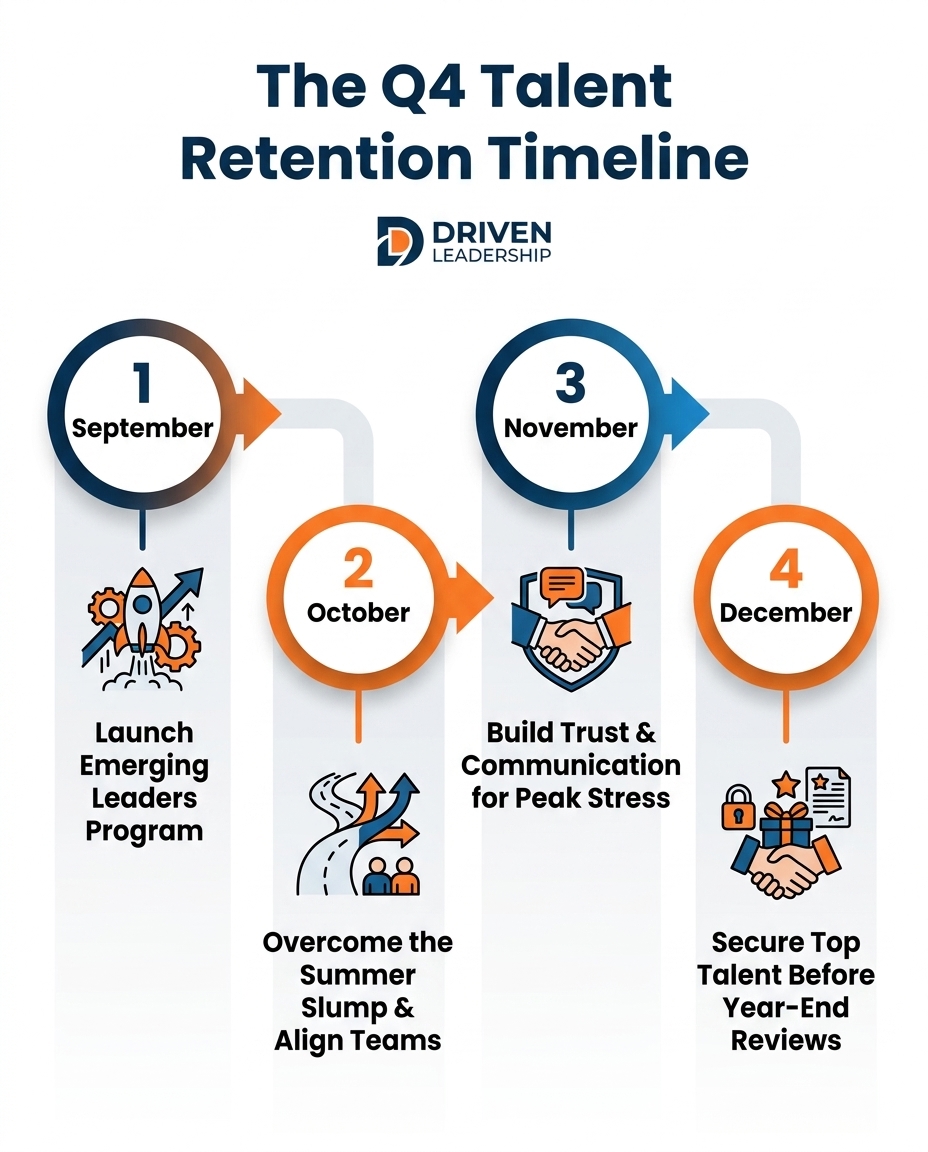
Positioning a leadership intervention during this early fall / pre-Q4 transition aligns your team's mindset with your business goals. By addressing communication gaps and building resilience now, you prevent the typical Q4 spike in employee burnout and job hunting, ensuring your team remains cohesive when the pressure is highest.
Building a Leadership Pipeline to Secure Mid-Level Talent
An effective emerging leaders program is much more than a series of lectures or a binder full of management theories. For a mid-sized local business, it is a structured, transformative process that helps employees overcome personal and professional roadblocks, equipping them to take extreme ownership of their roles. When you invest in your people, you build a pipeline of capable leaders who can manage crises, drive revenue, and mentor junior staff.
Structured development requires stepping away from the daily grind to focus entirely on behavioral growth. We witness this transformation firsthand at Driven Leadership. One local professional reached out to our team this past spring while facing debilitating personal and professional roadblocks that were hindering their effectiveness at work. After attending a highly immersive leadership experience, they received the exact support and framework needed to break through those barriers. The result was profound personal and professional growth that elevated their performance to new heights, directly benefiting their employer and their own career trajectory.
This is the distinct advantage of investing in BOLD leadership training. It directly connects the employee's personal growth to their professional loyalty. When an organization provides the tools for an individual to become a stronger, more confident version of themselves, the temptation to look for outside opportunities diminishes significantly. Elevating internal communication and fostering a culture of initiative creates a workplace environment that larger competitors simply cannot replicate.
Why Online Training Falls Short for True Leadership Development
In an effort to check the "professional development" box quickly, many businesses default to generic online learning modules. While these platforms might be useful for teaching software shortcuts or compliance regulations, they fail miserably at building meaningful loyalty or preventing regional talent poaching. Click-through online modules do not challenge a person's core behaviors, nor do they build the interpersonal trust required for effective leadership.
True behavioral change requires stepping out of the day-to-day environment. You cannot learn how to navigate complex team dynamics, handle high-stakes conflict, or inspire a burned-out department by watching a pre-recorded video at your desk while answering emails. Achieving genuine professional growth demands an interactive, challenging, and locally accessible experience that forces participants to engage deeply with the material and with each other.
Generic Modules vs. Behavioral Retreats
Working with an immersive Engage Elevate program fosters deep connections among local teams. It replaces the isolation of digital learning with collaborative problem-solving, ensuring that the lessons learned translate directly into improved workplace performance.
• Generic Online Modules — Engagement Level: Low (Passive listening, multitasking) — Retention Impact: Minimal (Viewed as a corporate chore) — Behavioral Change: Information retention only; no real behavioral shift
• Immersive Behavioral Retreats — Engagement Level: High (Active participation, peer accountability) — Retention Impact: High (Builds deep loyalty and team cohesion) — Behavioral Change: Transformative; addresses core communication and leadership habits
Essential Components of a Pre-Q4 Leadership Initiative
If you are ready to secure your talent pipeline this fall, you need a structured approach. Throwing a quick seminar together at the last minute will not yield the retention benefits you need. A successful initiative requires identifying the right candidates, focusing on the correct skills, and executing on a timeline that delivers results before the end-of-year rush.
Consider the experience of a local Puyallup business team that came to us realizing they needed a stronger foundation as leaders and communicators to support their growing operations. During a spring session with our facilitators, they participated in comprehensive management programs that equipped them with resilient techniques and communication strategies. This proactive step gave them the strong foundational skills necessary to handle rapid organizational change without losing their core team members.
Steps to implement an effective fall leadership initiative:
1. Identify the core skills needed: Focus on the competencies that matter most for Q4: high-stakes communication, emotional resilience, strategic prioritization, and conflict resolution.
2. Select the right candidates: Look for mid-level employees who demonstrate high potential but lack the formal training to take the next step. These are the individuals most at risk of being poached if they feel stagnant.
3. Choose an immersive format: Rely on advanced leadership programs to retain talent in Puyallup that pull your team out of their daily routine to focus entirely on growth.
4. Build a foundation of trust: Ensure the training emphasizes interpersonal connection. Trust built in September pays massive dividends when deadlines loom in November and December.
5. Establish a follow-up timeline: Launch the program in early fall, but schedule specific check-ins and accountability sessions throughout Q4 to ensure the new behaviors are actively applied.
Frequently Asked Questions About Local Leadership Programs
What is an emerging leaders program?
An emerging leaders program is a structured development initiative designed to equip high-potential employees with the core competencies needed to step into management roles. It focuses on closing the gap between technical expertise and interpersonal leadership skills. Rather than just teaching business theory, these programs emphasize communication, conflict resolution, emotional intelligence, and strategic thinking. By investing in this training, businesses build a reliable internal pipeline of capable managers ready to guide the company forward.
Why is leadership development important for retention?
Leadership development is critical for retention because a lack of career advancement is one of the primary reasons top performers leave their jobs. When employees see a clear, supported path for their own growth, their loyalty to the organization deepens significantly. It transforms their daily work from a stagnant job into a dynamic career trajectory. Furthermore, employees who feel invested in are far less likely to entertain recruitment offers from competing firms in the region.
How do you develop emerging leaders in the workplace?
Developing emerging leaders requires a combination of immersive behavioral training, mentorship, and the delegation of meaningful responsibility. You must pull candidates out of their day-to-day routines to challenge their existing habits and build new leadership frameworks. Once they return to the workplace, they need opportunities to apply these new skills in real-world scenarios, supported by regular feedback from senior management. True development is an ongoing process of education, application, and refinement.
When is the best time to start leadership training?
The early fall / pre-Q4 transition is the absolute best time to initiate leadership training. Starting in September allows you to re-engage your workforce after the summer slowdown and align their goals before the high-pressure end-of-year sprint begins. Waiting until January to focus on development means you miss the opportunity to stabilize your team during your most critical and stressful operational months.
How does an emerging leaders program prevent regional talent poaching?
An emerging leaders program prevents regional talent poaching by creating a workplace culture that larger, corporate competitors cannot easily replicate. When mid-level managers feel deeply connected to their peers and see tangible investment in their personal growth, their job satisfaction skyrockets. This deep-rooted loyalty acts as a powerful shield against the lure of slightly higher salaries offered by larger enterprises in neighboring corporate hubs.
What makes immersive leadership training more effective than online courses?
Immersive leadership training is more effective because it drives actual behavioral transformation rather than just passive information retention. Online courses isolate the learner and rarely challenge their core communication habits or emotional responses. In contrast, in-person, immersive retreats force participants to engage in collaborative problem-solving, face their limitations in real-time, and build the deep interpersonal trust required to lead teams effectively through difficult challenges.
Secure Your Top Performers Before the Year Ends
Waiting until the new year to focus on team development is simply too late to prevent Q4 turnover. The pressures of the final quarter, combined with the aggressive recruitment tactics of larger regional competitors, mean your mid-level managers need support and direction right now. Proactive founders in Pierce County understand that securing their leadership pipeline in early fall is the most effective way to guarantee a strong, unified finish to the year.
Take proactive steps today to secure your top talent. Our team at Driven Leadership encourages you to explore an advanced leadership program tailored to local business needs, ensuring your team has the resilience, communication skills, and loyalty required to thrive through the end of the year and beyond.