
How to Skyrocket Your Coaching Leadership Skills in 5 Steps

Why Learning How Athletic Coaches Can Become More Effective Leaders for Their Programs Changes Everything
Understanding how athletic coaches can become more effective leaders for their programs starts with one honest truth: great coaching is not just about X's and O's. It's about people.
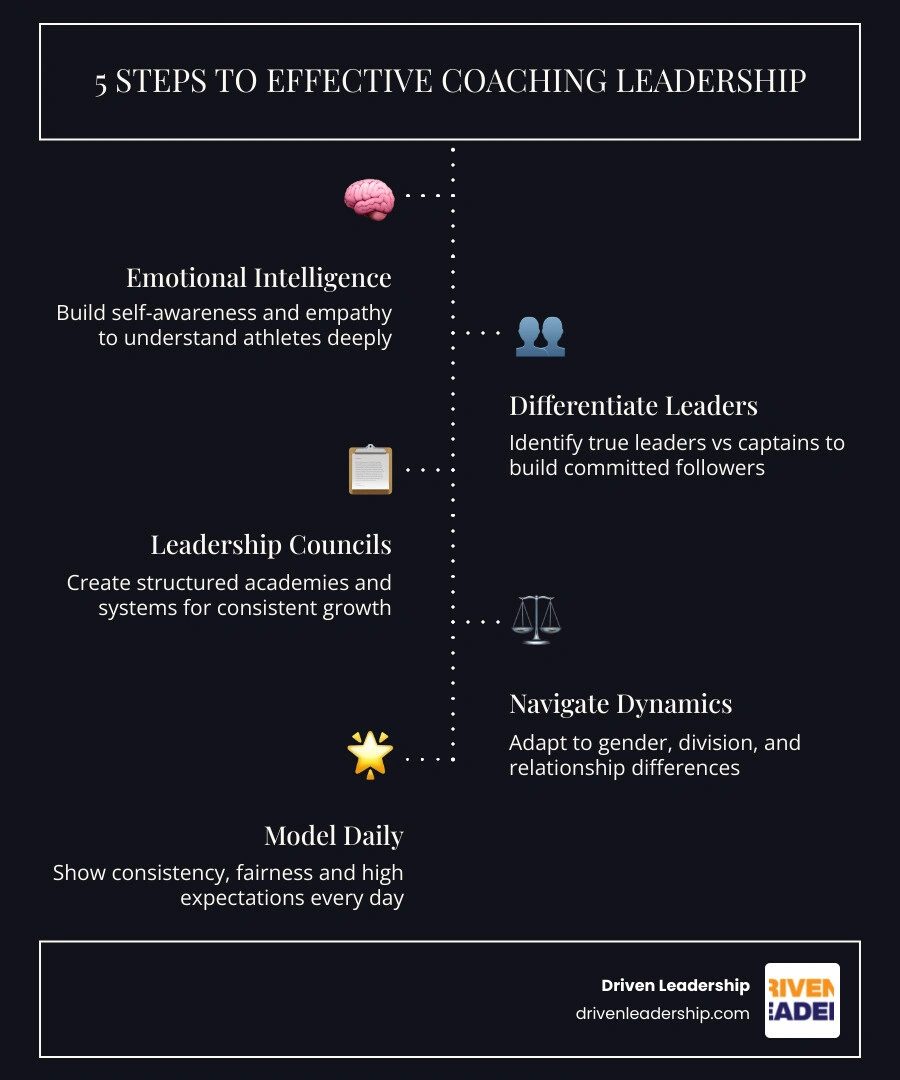
Here's a quick overview of the 5 steps covered in this guide:
1. Cultivate emotional intelligence and self-awareness - Know yourself before you can lead others
2. Differentiate leaders from captains - Build strong followers, not just figureheads
3. Establish structured leadership councils and academies - Create systems that develop leadership consistently
4. Navigate gender, division, and relationship dynamics - Adapt your approach to your athletes and context
5. Model key leadership qualities daily - Consistency, fairness, and high expectations build lasting culture
Think about this: research shows that athletes' perceptions of coaching behavior matter more than the actual behavior itself. In other words, how your athletes experience your leadership determines whether it works — not just what you intend.
Yet most coaches never receive formal leadership training. They're handed a roster, a practice schedule, and the unspoken expectation that they'll figure it out. One telling example from the research captures this well: a senior athlete — considered one of his program's top leaders — admitted in a single conversation that he had never once been taught how to lead. He had simply been told to do it.
That gap between expectation and development is exactly where programs stall. And it's the gap this guide is designed to close.
Whether you're a head coach, an assistant, or a team leader who manages people off the field, the principles here apply. Effective leadership in athletics is not a personality trait you're born with. It's a skill set you can build — deliberately, step by step.
Step 1: Cultivate Emotional Intelligence and Self-Awareness

To build a legendary program, you must first look in the mirror. Emotional intelligence (EI) is the bedrock of modern coaching. In fact, research across major organizations shows that emotional intelligence is twice as important as IQ or technical skills for overall leader performance. In sports, where stakes are high and emotions run hot, this ratio is likely even higher.
Emotional intelligence in coaching is built on five core pillars:
• Self-Awareness: Recognizing your own emotional triggers and how they impact your team.
• Self-Regulation: Managing your reactions, especially in high-stress game situations.
• Motivation: Leading from a passion for athlete development rather than just a desire for personal status or wins.
• Empathy: Understanding the personal lives, academic pressures, and emotional states of your athletes.
• Social Skills: Building genuine rapport and navigating team conflicts with clarity.
When a coach lacks emotional intelligence, the consequences can be devastating. Consider the real-world case of Tony, a high school track athlete who suffered a knee injury. Because his coach was temperamental and known to accuse injured athletes of being "soft" or "faking it," Tony hid his injury out of fear of ridicule. He ran through the pain, performed poorly at the sectional meet, and ultimately caused long-term damage to his body. Fear-based leadership forces athletes to hide their struggles, which directly harms both team culture and athletic performance.
To prevent this, you must actively work on your self-awareness. One of the most practical ways to do this is through daily journaling. Taking just 5 to 10 minutes after practices and competitions to write down your thoughts, emotional reactions, and interactions can completely change how you self-regulate.
Ask yourself:
• What triggered my anger or frustration today?
• How did my body language affect the team when we fell behind?
• Did I praise the process, or only the outcome?
By identifying your emotional patterns, you can create a list of common scenarios that trigger negative reactions and proactively replace those instinctual outbursts with constructive, positive solutions. When you understand your own emotional landscape, you are far better equipped to guide your athletes through theirs. If you want to dive deeper into mastering these personal dynamics, exploring our tailored Leadership Coaching Programs can provide the structured guidance you need to elevate your coaching self-awareness.
Step 2: Differentiate Leaders from Captains to Build Strong Followers
Many coaches make the mistake of assuming that handing an athlete a captain’s band automatically makes them a leader. It does not. A captain is a formal title, but true leadership is an active, relational process.
A team captain has three broad, formal responsibilities:
1. Acting as a bridge between the coaching staff and the players.
2. Leading scheduled team activities and warm-ups.
3. Representing the program in the school, media, and community.
However, formal leadership positions do not automatically yield influence. True leadership is often informal. It develops naturally over time through peer interactions, trust, and shared struggles. While you may only have two or three named captains, your program needs dozens of informal leaders who step up in different ways.
For instance, an athlete with incredible organizational skills might take the lead on scheduling team dinners or compiling travel playlists. A socially confident player might focus on welcoming newcomers and checking in on injured teammates. By recognizing these unique personality strengths, you can assign informal leadership tasks that empower everyone to contribute to the program's culture.
At the same time, we must understand that not every athlete is meant to be a vocal, front-facing leader. A healthy team culture requires a balance of strong leaders and committed, high-character followers. Good followers are the backbone of any championship team. They are the ones who buy into the vision, execute their roles with pride, and hold their peers to the team’s standards. To build this dynamic across your roster, utilizing Accountability Training for Managers can help you establish clear, fair standards of accountability that apply to every player, regardless of their status.
Balancing Captains and Followers: How Athletic Coaches Can Become More Effective Leaders for Their Programs
To successfully balance these dynamics, think of your formal captains as the middle of an hourglass.
The top of the hourglass is the coaching staff, and the bottom is the rest of the player roster. The captains sit in the narrow neck, acting as a vital bridge. They must have the autonomy to relay information from the coaching staff to the players in their own voice, while also bringing player concerns back up to the coaches.
When captains operate this way, they foster peer-to-peer accountability, which is the ultimate indicator that your leadership development is working. When a player corrects a teammate’s effort or attitude, it carries a different weight than when it comes from a coach.
However, managing peer-to-peer dynamics requires a high level of conflict resolution. If your captains or informal leaders do not know how to address a slacking teammate without causing division, the team's cohesion will suffer. This is why coaches must actively teach conflict resolution strategies, ensuring that leaders know how to confront issues with empathy and clarity rather than aggression. For structured support in teaching these essential skills, consider integrating Conflict Resolution Training for Leaders into your program's development plan.
Step 3: Establish Structured Leadership Councils and Academies
If you want your athletes to lead, you have to teach them how. Leaving leadership development to chance is a recipe for inconsistent team culture. The most effective athletic programs build dedicated, structured systems — like leadership councils or off-season academies — to intentionally train their athletes.
A player-voted leadership council is a highly successful model. Instead of hand-picking the members yourself, allow your team to vote on who represents them. Provide them with clear criteria based on core character traits (such as integrity, work ethic, and empathy) rather than athletic talent alone. A player-voted council carries far more legitimacy in the locker room than a group hand-selected by the coaching staff.
Once established, meet with your council bi-weekly during lunch or off-season athletic periods. Use these sessions to work through a structured curriculum. A great framework to guide these meetings is the GROW model, which is highly effective for goal-setting and problem-solving:
• Goal: What do we want our team culture or performance to look like?
• Reality: What is happening right now? Where are our gaps?
• Options: What can we do to close those gaps? What are our choices?
• Will: What specific actions will we commit to taking this week?
By walking your student-athletes through this process, you teach them how to think critically and solve problems autonomously. To build a comprehensive training system for your program, utilizing Leadership Development Training resources can help you design a curriculum that aligns perfectly with your program's core values.
Overcoming Program Resistance: How Athletic Coaches Can Become More Effective Leaders for Their Programs
Implementing a structured leadership program is not always smooth sailing. Coaches often face several common challenges:
• Scheduling Conflicts: Student-athletes are incredibly busy with classes, homework, practices, and personal lives.
• Popularity Contests: If not framed correctly, player votes can result in a council of the most popular players rather than the most respected leaders.
• Multi-Sport Athletes: Players who transition directly from one sport to the next may struggle to attend off-season leadership academy sessions.
To overcome these hurdles, you must be flexible and creative. Design your program to meet during times when athletes are already gathered, such as the first 15 minutes of an existing athletic period or during a team lunch.
To prevent popularity contests, make character education an ongoing part of your daily team communications before you hold elections. Clearly outline what leadership looks like in action so athletes know exactly what qualities they are voting for. If you need practical strategies to design and run these sessions smoothly, hosting targeted Leadership Workshops can provide your staff with the tools to navigate scheduling and engagement challenges effectively.
Step 4: Navigate Gender, Division, and Relationship Dynamics
Effective leadership is not one-size-fits-all. To truly understand how athletic coaches can become more effective leaders for their programs, you must recognize how competitive levels, gender, and personal relationship dynamics influence how your coaching is perceived.
Academic research highlights clear differences in coaching dynamics across competitive divisions and genders. For example, NCAA Division I coaches often adopt a more authoritarian or dictatorial leadership style. Because of intense job security pressures and high-stakes scholarship environments, DI coaches tend to have exceptionally high expectations, provide less explanation for their decisions, and have very little tolerance for athletes who "freelance" during competition.
In contrast, Division II and youth coaches often have more room to utilize a democratic, transformational style that encourages athlete input and focuses heavily on personal and social development.
Gender dynamics also play a massive role in how coaching behaviors are perceived:
• Female Coaches: Research indicates that female coaches are often perceived as highly involved in settling personal conflicts among team members and actively encouraging both formal and informal relationships with and among their athletes.
• Male Athletes: Studies show that male athletes often place a premium on goal-oriented feedback, clear technical instruction, and consistent competition routines.
• Female Athletes: Female athletes often report a strong preference for coaches who provide high levels of social support, clear communication, and conflict-resolution assistance.
Despite these general trends, there are far more similarities than differences between how male and female athletes experience coaching. Both value clear communication, individual consideration, and mutual respect. To ensure your staff communicates effectively across all these diverse dynamics, implementing Leadership Communication Training can help coaches tailor their messages to resonate with every athlete on the roster.
To visualize these differences, look at the table below:
• Primary Focus — Division I Dynamics: High-stakes performance, winning, and strategic execution. — Division II & Youth Dynamics: Personal growth, skill acquisition, and team cohesion.
• Decision-Making — Division I Dynamics: Authoritarian; less explanation of actions; low tolerance for freelancing. — Division II & Youth Dynamics: Democratic; collaborative; higher athlete autonomy and input.
• Relationship Style — Division I Dynamics: Highly professional; task-oriented; structured routines. — Division II & Youth Dynamics: High social support; focus on personal and social development.
• Pressure Source — Division I Dynamics: Multiple external stakeholders (media, administration, donors). — Division II & Youth Dynamics: Internal program goals and athlete development metrics.
Step 5: How Athletic Coaches Can Become More Effective Leaders for Their Programs
To truly skyrocket your coaching leadership, you must model the behaviors you want to see. This is the essence of transformational leadership. Transformational leaders do not rely on fear or control; instead, they inspire, motivate, and develop their athletes by modeling high moral standards, articulating a clear vision, and showing genuine individual consideration.
According to research on sports psychology, transformational coaching behaviors directly build mental toughness in athletes. Mental toughness is characterized by three core dimensions:
1. Confidence: A belief in one's ability to succeed under pressure.
2. Constancy: Persistent effort and focus, even when facing setbacks.
3. Control: The ability to regulate emotions and remain calm in chaotic environments.
When you lead with consistency and fairness, you create a safe learning environment where athletes feel secure enough to take risks and grow. A consistent coach is the same person from day to day — whether after a tough loss or a massive win. This emotional stability acts as a thermostat for the team; when things get frantic, you bring calm, and when things get flat, you bring intensity.
Don't forget to bring a sense of humor to the court or field, either. A well-timed joke or a lighthearted moment reduces performance anxiety and reminds your team that while the standards are high, the journey should still be filled with joy. To master these daily, front-facing leadership behaviors, coaches can greatly benefit from developing their Frontline Leadership Skills, which focus on real-time communication, active listening, and relationship management.
Addressing Setbacks and Maintaining Accountability
Even the best-run programs face behavioral issues, broken rules, and setbacks. How you handle these moments determines the strength of your culture.
When an athlete violates team rules, avoid reacting with immediate, anger-fueled punishment. Instead, use the moment as an opportunity for self-reflection. Ask the athlete to answer these five questions:
• What kind of person do you want to be?
• Do you see yourself as a leader on this team?
• What positives and negatives did your actions add to our program?
• Can your teammates trust you right now?
• What will you do differently next time to rebuild that trust?
By forcing the athlete to evaluate their own behavior, you transition from a purely punitive model to an educational one. This approach balances high standards with warmth, ensuring that accountability is paired with a clear path for forgiveness and growth. For coaches looking to build a comprehensive system for managing these tough conversations and maintaining program standards, exploring Leadership Training for Managers can provide invaluable frameworks for handling discipline and accountability.
Frequently Asked Questions About Coaching Leadership
What is the difference between successful and effective leadership in sports?
Successful leadership occurs when a coach changes an athlete's behavior to achieve a specific outcome (like winning a game or executing a play), but does so through force or fear, ignoring the athlete's personal needs. Effective leadership occurs when the team achieves its performance goals while the athletes find their own psychological and developmental needs fully satisfied. Effective leadership builds long-term commitment, whereas successful-only leadership often leads to burnout and high turnover.
How does leadership development in sports impact life beyond the game?
The character traits and self-regulatory skills developed in athletics translate directly to academic success, career readiness, and community impact. Athletes who learn accountability, emotional intelligence, and resilience under pressure carry those skills into the classroom, their future workplaces, and their personal relationships. As the research shows, the attributes learned in sports settings help athletes succeed long after their last game is played.
How can coaches measure the success of their leadership programs?
While scoreboard wins are the easiest metric to track, they do not tell the whole story. Coaches can measure leadership success by tracking team cohesion, assessing athletes' mental toughness through self-evaluation surveys, and monitoring academic performance. High peer-to-peer accountability in the locker room, low rates of behavioral issues, and positive feedback on anonymous athlete surveys are all clear indicators of a highly successful leadership program.
Conclusion
Building a legendary athletic program requires a deliberate shift from simply teaching technical skills to actively developing human beings. By cultivating your emotional intelligence, differentiating your leaders, establishing structured councils, adapting to team dynamics, and modeling transformational leadership, you will create a championship culture that runs itself.
At Driven Leadership, we specialize in delivering measurable, lasting behavioral change that improves performance across Washington, California, Nashville TN, and SoCal. We help leaders build the self-awareness, communication skills, and accountability structures needed to transform their cultures.
Ready to take your program to the next level? Explore our comprehensive resources on Leadership or discover our specialized Immersive Athletic Leadership Programs to start building a culture of elite leaders today.