
The Ultimate Guide to Leadership Training for Entrepreneurs

Why Leadership Training Is the Missing Link for Entrepreneurs Who Want to Grow
Can entrepreneurs benefit from the same leadership training as corporate executives? Yes — but with important nuances. Here's the short answer:
Entrepreneurs can benefit from core executive leadership training when it covers:
• Strategic planning and decision-making under pressure
• Building and aligning teams around a shared vision
• Delegating effectively instead of doing everything yourself
• Communication systems that scale as the organization grows
• Transitioning from a "doer" mindset to a true leadership role
However, standard corporate programs work best when adapted to the realities of entrepreneurial ventures — not applied wholesale without modification.
Most entrepreneurs are exceptional at starting things. They're driven, fast-moving, and comfortable with risk. But as a business grows, those same strengths can quietly become liabilities. The founder who once thrived wearing every hat can become the bottleneck holding the whole organization back.
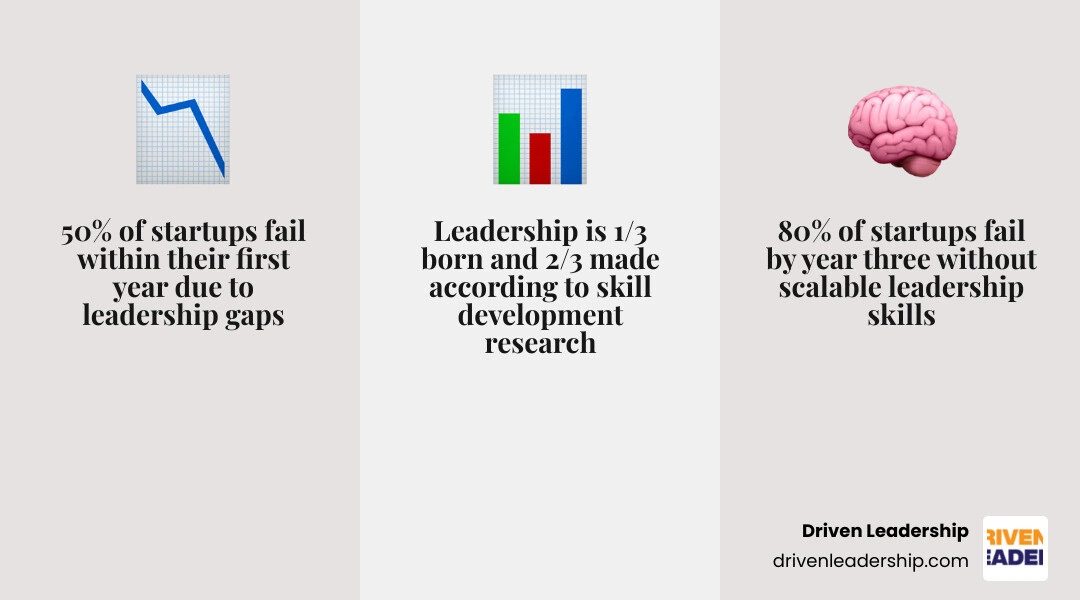
The numbers make this painfully clear. Fifty percent of startups fail within their first year, and 80% are gone by year three. Leadership gaps — not just market gaps — are a major reason why.
Here's something worth knowing: according to the Center for Creative Leadership, leadership is roughly one-third born and two-thirds made. That means the skills, behaviors, and mindsets that define great leaders can be developed. The question isn't whether entrepreneurs can grow as leaders. It's whether the training they access is actually built for where they are.
Can Entrepreneurs Benefit from the Same Leadership Training as Corporate Executives?

When we look at the high-stakes environments of corporate boardrooms and startup workspaces, they can feel like entirely different worlds. Corporate executives often navigate established systems with thousands of employees, while entrepreneurs build systems from scratch. Because of these distinct environments, many wonder: can entrepreneurs benefit from the same leadership training as corporate executives?
The answer is a resounding yes, but with a critical caveat: the training cannot simply be copied and pasted.
Corporate leadership training programs excel at teaching structured management, organizational alignment, and systemic scaling. When entrepreneurs access these frameworks, they gain the tools required to move past the chaotic "survival" phase of a business. However, if a program is too rigid or bureaucratic, it can stifle the very agility that makes a startup successful.
To bridge this gap, founders must look for training that honors the entrepreneurial spirit while instilling professional discipline. Understanding the Advantages of Enrolling in an Executive Leadership Program helps entrepreneurs identify which structured corporate tools will serve their growing companies best.
How Can Entrepreneurs Benefit from the Same Leadership Training as Corporate Executives?
The most valuable crossover skills from corporate training lie in strategic planning, systemic decision-making, and structural design.
In the early days of a business, founders make decisions based on gut instinct and immediate survival. As the business grows, this approach becomes unsustainable. Corporate-style training teaches leaders how to run decisions through structured frameworks, evaluate risk objectively, and build repeatable operational systems.
By enrolling in a high-caliber Executive Leadership Program, entrepreneurs learn how to step away from daily firefighting. They acquire the tools to design clear communication channels, set measurable key performance indicators (KPIs), and align their teams around long-term strategic goals rather than daily tasks.
When Can Entrepreneurs Benefit from the Same Leadership Training as Corporate Executives?
Timing is everything. An entrepreneur who is still validating their product-market fit or working out of a garage probably does not need corporate-level executive training yet. At that stage, they need tactical business coaching.
The right time to transition to structured executive training is during the scaling phase. When a business grows from a handful of close-knit employees to a larger, multi-layered organization, the founder faces a developmental crisis.
This is the moment where informal chats over coffee no longer suffice for internal communication. If we notice that our teams are misaligned, priorities are constantly shifting, or the founder is working 80-hour weeks just to keep operations from collapsing, it is time for professional management development. Utilizing targeted Leadership Development Training during this critical pivot ensures that the organization can scale without breaking.
Entrepreneurial Leadership vs. Corporate Executive Leadership
To understand why a customized approach is necessary, we must compare the core challenges faced by these two types of leaders:
• Primary Focus — Entrepreneurial Leadership: Creating systems, establishing product-market fit, and driving growth. — Corporate Executive Leadership: Navigating, optimizing, and protecting established systems.
• Risk Tolerance — Entrepreneurial Leadership: High; comfortable with ambiguity and rapid pivots. — Corporate Executive Leadership: Moderate to low; focused on risk mitigation and compliance.
• Resource Environment — Entrepreneurial Leadership: Often resource-constrained; requires extreme efficiency. — Corporate Executive Leadership: Typically well-resourced with specialized departments.
• Authority Structure — Entrepreneurial Leadership: Flat, informal, and centered heavily around the founder. — Corporate Executive Leadership: Hierarchical, matrixed, and process-driven.
• Common Pitfalls — Entrepreneurial Leadership: Micromanagement, lack of structure, and founder burnout. — Corporate Executive Leadership: Bureaucracy, slow decision-making, and inertia.
To navigate these differences successfully, founders must develop a specialized approach to Small Business Leadership that blends the best of both worlds.
The Transition from Founder to Executive Leader
The transition from a startup founder to an executive leader is more of an emotional and intellectual journey than a simple skill upgrade.
In the beginning, the founder is the product, the salesperson, the customer service rep, and the visionary. As the company scales, they must learn the art of true delegation. This means passing on not just tasks, but real authority and decision-making power to professional managers.
Workforce management becomes a primary responsibility. Instead of doing the work, the leader's job is to align the team, remove roadblocks, and build an environment where others can execute the vision.
Overcoming the Pitfalls of the 'Doer' Mindset
The "doer" mindset is what gets a business off the ground, but it is also the number-one cause of entrepreneurial plateau and burnout. When a founder takes their natural personal strengths to an extreme, those strengths turn into weaknesses.
For example, a passion for quality can easily devolve into controlling micromanagement. Consider the common scenario of a brilliant technical founder who builds a fantastic product but struggles to trust their team. They end up hovering over every project, frustrating high-performing hires, and creating an organizational bottleneck.
To scale, founders must build trust through integrity and consistent behavior. By empowering employees and stepping back, they allow the business to run smoothly even when they are not in the room.
Adapting Corporate Leadership Frameworks for Growing Ventures
Applying corporate frameworks directly to an entrepreneurial venture without modification can lead to disaster. If we force a fast-moving, creative team into a rigid, highly bureaucratic corporate structure, we risk killing the innovative spark that made the venture successful in the first place.
Instead, we must adapt these systems. We can use "systems thinking" to build light, flexible communication structures and clear operational boundaries without adding unnecessary layers of management. Developing emotional intelligence is key here; it allows leaders to maintain strong personal connections with their teams while implementing necessary professional boundaries.
For many founders, working with an external guide through Executive Coaching is the most effective way to customize these frameworks for their specific business stage.
Balancing Innovation with Professional Control
How do we keep our agile, innovative spirit alive while establishing standard operating procedures (SOPs)?
The secret lies in setting clear, binary goals (what we call a "High-Definition Destination") while giving our teams the autonomy to figure out how to reach them. This creates a safe, structured space where innovation can thrive.
Professional controls should not feel like handcuffs. Instead, they should act as guardrails that prevent costly errors while allowing the team to move fast and make decisions confidently.
The Role of Mentors, Coaches, and Advisory Boards
Entrepreneurs often make the mistake of relying solely on an advisory board for leadership growth. While advisory boards are fantastic for providing "business know-how" — such as financial strategies, market connections, and industry insights — they rarely provide "leadership know-how."
This is where mentors and professional executive coaches come in. A coach focuses on the leader's internal capacity, emotional resilience, and behavioral patterns. While an advisory board helps you optimize your business tactics, a leadership coach helps you optimize yourself so you can lead your team through the inevitable storms of scaling.
Aligning the Entrepreneurial Personality with Structured Training
The typical entrepreneurial personality — high energy, high risk tolerance, and a bias for action — can sometimes clash with the structured, process-oriented nature of corporate training.
Research shows that different leadership styles yield vastly different results in entrepreneurial environments:
• Transformational Leadership: This style shows the strongest correlation (R = 0.747) with innovation and firm performance in dynamic environments. It inspires teams through a shared vision and encourages creative problem-solving.
• Laissez-Faire Leadership: This hands-off style shows a much lower, moderate correlation (r = 0.476), particularly in regions with lower entrepreneurial intensity. Leaving a growing team without direction often leads to confusion and operational drift.
An entrepreneurial mindset actually enhances the explanatory power of these leadership-outcome relationships (R² = 0.568). This means that when structured leadership training is combined with a founder's natural entrepreneurial drive, the positive impact on business performance is magnified exponentially.
Navigating the Four Stages of Organizational Transition
To successfully integrate professional leadership practices without losing our entrepreneurial soul, we must guide our organizations through four developmental stages:
1. Recognizing the Need: We must first acknowledge that our current, informal ways of operating are no longer working and that change is necessary for survival.
2. Planning the Change: We assemble a transition team, gather input from across the organization, and design a clear roadmap for implementing systems.
3. Tolerating Instability: Transition is messy. We must tolerate temporary discomfort and emotional friction as the team adapts to new structures and roles.
4. Integrating Systems: Finally, we blend our original entrepreneurial flexibility with our new professional controls, creating a sustainable, high-performing culture.
Frequently Asked Questions about Entrepreneurial Leadership
Are leaders born or made?
According to extensive research by the Center for Creative Leadership, leadership is approximately one-third born and two-thirds made. While some individuals may naturally possess traits like high energy or charisma, the critical skills required to run an organization — such as delegation, strategic planning, and emotional intelligence — are entirely learnable.
What is the greatest challenge entrepreneurs face when scaling?
The greatest challenge is transitioning from a "doer" to a "leader." This requires letting go of daily operational tasks, trusting others to execute the vision, and focusing instead on strategic alignment, workforce management, and building organizational infrastructure.
How does an entrepreneurial mindset impact leadership outcomes?
An entrepreneurial mindset acts as a powerful multiplier. When leaders combine structured management systems with an entrepreneurial focus on opportunity and innovation, it explains over 56% of the variance in successful firm performance (R² = 0.568), particularly in fast-changing markets.
Conclusion
At Driven Leadership, we believe that leadership is a discipline that can be developed, refined, and sustained over time. We serve business owners and leaders across Washington, California, Nashville, TN, and SoCal, helping them make the vital transition from hands-on founders to visionary executive leaders.
Our focus is not on short-term inspiration or theoretical lectures. We deliver immersive training programs, workshops, and EOS implementation designed to create measurable, lasting behavioral change that directly improves your business performance.
If you are ready to stop firefighting, step out of the daily grind, and build a self-sustaining business that can scale to the next level, explore our Advanced Leadership Course today. Let's build your leadership foundation together.