A Comprehensive Guide to DISC Assessments

Why DISC and Behavioral Assessments for Better Communication Actually Work
DISC and behavioral assessments for better communication give teams a shared language for understanding how each person prefers to work, communicate, and respond under pressure. Here is a quick overview of how they help:
• D (Dominant): Direct, results-focused, prefers brief and to-the-point communication
• I (Influencing): Enthusiastic, relationship-driven, prefers open and energetic dialogue
• S (Steady): Patient, supportive, prefers calm and collaborative conversation
• C (Conscientious): Analytical, detail-oriented, prefers written and fact-based communication
By identifying your style and the styles of those around you, you can reduce misunderstandings, resolve conflict faster, and lead more effectively.
Have you ever walked out of a team meeting wondering why nothing got resolved? Or sent a message you thought was clear, only to have it land completely wrong?
You are not alone. Most workplace friction does not come from a lack of skill or effort. It comes from people with different behavioral styles trying to communicate without a common framework.
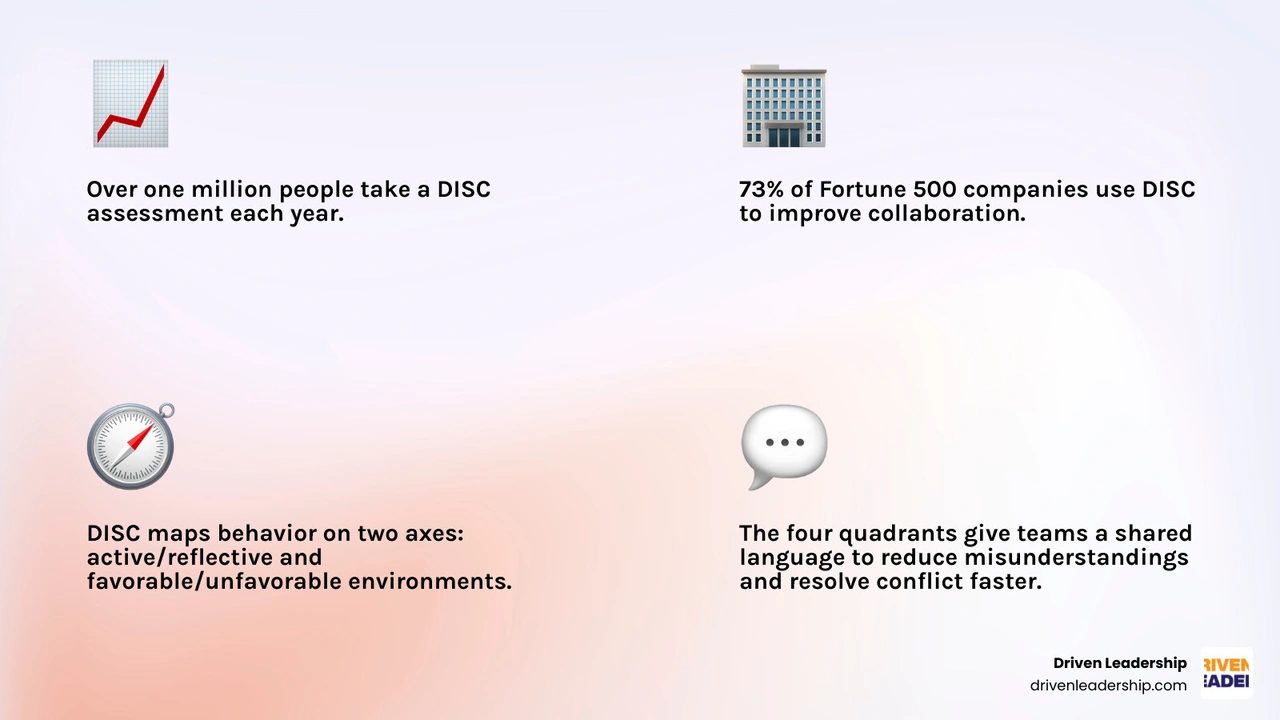
That is exactly where DISC comes in. DISC is one of the most widely used behavioral assessment tools in the world. Over one million people take a DISC assessment each year, and 73% of Fortune 500 companies rely on it to improve team communication and collaboration. The model sorts observable workplace behavior into four tendencies — Dominance, Influence, Steadiness, and Conscientiousness — giving managers and teams a practical, non-judgmental way to understand each other.
For mid-level managers and business owners dealing with team misalignment, repeated conflict, or communication breakdowns, DISC offers something concrete: a way to stop guessing and start connecting.
This guide walks you through everything you need to know about using DISC to build stronger teams and lead with more confidence.
What is the DISC Behavioral Model?
The foundation of the DISC model dates back to 1928, when psychologist William Moulton Marston published Emotions of Normal People. Marston theorized that human behavioral tendencies could be mapped along two primary axes: how active or reflective a person is, and whether they view their environment as favorable or unfavorable. This translates into four distinct behavioral quadrants that define how we interact with the world and process information.
Importantly, Marston did not design DISC to measure intelligence, mental health, or core values. Instead, it focuses entirely on observable workplace behavior.
The two axes create four distinct zones:
• Active vs. Reflective: Active profiles move quickly, make rapid decisions, and speak dynamically. Reflective profiles prefer to observe, process information internally, and proceed with deliberate caution.
• Task-Oriented vs. People-Oriented: Task-oriented profiles focus primarily on logic, data, and results. People-oriented profiles prioritize relationships, team harmony, and personal connection.
At Driven Leadership, we utilize the Innermetrix DISC Assessment to help leaders across our hubs in California, Washington, and Nashville, TN, map out these behavioral tendencies. By understanding these baseline traits, organizations can build a framework that turns abstract communication concepts into concrete, daily habits.
The Four DISC Personality Types and Their Communication Styles

To build a high-performing team, we must understand how each of the four core profiles prefers to interact. When we ignore these styles, we risk creating unnecessary friction.
By utilizing Innermetrix DISC Profiles Team Communication strategies, teams can decode these styles and build highly targeted collaboration norms. Below is a quick breakdown of how these four styles differ across key communication metrics:
• Dominant (D) — Preferred Pace: Fast / Decisive — Focus: Tasks & Results — Communication Style: Direct, brief, assertive — Key Needs: Control, efficiency, challenge
• Influencing (I) — Preferred Pace: Fast / Energetic — Focus: People & Relationships — Communication Style: Enthusiastic, expressive — Key Needs: Recognition, collaboration
• Steady (S) — Preferred Pace: Deliberate / Calm — Focus: People & Harmony — Communication Style: Patient, supportive, warm — Key Needs: Stability, clarity, cooperation
• Conscientious (C) — Preferred Pace: Deliberate / Precise — Focus: Tasks & Accuracy — Communication Style: Analytical, objective, factual — Key Needs: Data, logic, high standards
Dominant (D) Style: Direct and Results-Oriented
The Dominant style is characterized by high assertiveness and an active, task-oriented focus. "D" types are motivated by solving problems, achieving goals, and driving progress.
• How they communicate: D types speak in a direct, to-the-point manner. They tend to focus on the big picture, bypass small talk, and may interrupt others when they feel a conversation is stalling or losing efficiency.
• How to communicate with them: When speaking to a D-style colleague, be brief, focus on outcomes, and present high-level solutions. Avoid over-explaining background details unless asked. Focus on "what" rather than "how."
Influencing (I) Style: Enthusiastic and Social
The Influencing style is active and highly people-oriented. "I" types thrive on social interaction, optimism, and team energy.
• How they communicate: I types are expressive, enthusiastic, and relationship-focused. They use open body language, speak quickly, and naturally gravitate toward brainstorming and collaborative discussions.
• How to communicate with them: Maintain a positive, warm atmosphere. Allow time for social connection before diving into business. Ask for their ideas, give them room to express their thoughts, and make sure to recognize their contributions publicly.
Steady (S) Style: Patient and Supportive
The Steady style is reflective and people-oriented. "S" types value consistency, predictability, and team harmony.
• How they communicate: S types are deliberate, empathetic, and excellent active listeners. They speak at a calmer pace and prefer to build consensus rather than push their own agenda. They may nod along to show they are listening, which can sometimes be mistaken for agreement.
• How to communicate with them: Slow down your delivery and provide a predictable, safe environment. Give them time to process changes and reflect before asking for a decision. Focus on building trust and showing how decisions will impact the team.
Conscientious (C) Style: Analytical and Precise
The Conscientious style is reflective and task-oriented. "C" types are driven by a need for accuracy, quality, and logical clarity.
• How they communicate: C types are analytical, precise, and objective. They prefer written communication over spontaneous meetings and rely heavily on facts, data, and logic rather than intuition or emotion.
• How to communicate with them: Come prepared with data and clear documentation. Answer their questions calmly, thoroughly, and systematically. Avoid vague generalizations and give them the space to work independently without micromanagement.
Using DISC and Behavioral Assessments for Better Communication
Understanding your own DISC profile is only the first step. The real magic happens when we practice active behavioral adaptation. This does not mean changing who you are; it means temporarily flexing your natural communication style to meet the psychological needs of the person you are interacting with.
When teams commit to using disc and behavioral assessments for better communication, they build deep empathy. For example, a fast-moving "D" executive learns that their short, one-sentence emails can stress out an "S" assistant who interprets the brevity as anger. By adding a simple greeting and a clear timeline, the executive reduces anxiety and improves performance.
Similarly, an "I" sales manager learns that their analytical "C" operations director needs written data before a meeting, rather than a spontaneous brainstorming session. Discovering these dynamics is why we emphasize identifying team blind spots. You can read more about this in our guide on the Top 5 Ways Innermetrix DISC Assessment Reveals Team Blind Spots.
Adapting Leadership Styles with DISC and Behavioral Assessments for Better Communication
Effective leadership is never one-size-fits-all. The best leaders adapt their delegation, coaching, and performance reviews to match the behavioral profiles of their direct reports.
• Delegating to a D: Give them the desired outcome and the authority to achieve it, then step back.
• Delegating to an I: Frame the task around its impact on people and the company's vision, and schedule regular check-ins to keep them on track.
• Delegating to an S: Provide step-by-step instructions, explain the "why" behind the process, and offer ongoing support.
• Delegating to a C: Outline the exact parameters, quality standards, and resources available, then allow them to work independently.
By matching your management approach to your team's natural tendencies, you accelerate onboarding, increase engagement, and reduce management overhead. To dive deeper into this leadership approach, explore our article on Analyzing Leadership Styles with Innermetrix.
Resolving Team Conflicts with DISC and Behavioral Assessments for Better Communication
Workplace conflict is rarely about bad intent. More often, it is a clash of communication styles under pressure.
When stress levels rise, our natural behavioral tendencies become exaggerated. A "D" might become overly blunt or demanding, while an "S" might shut down and withdraw to protect team harmony. A "C" might over-analyze and stall decision-making, while an "I" might become overly emotional or disorganized.
By establishing a shared, neutral vocabulary, teams can address these friction points without making them personal. Instead of saying, "You are being difficult," a team member can say, "I realize my 'D' style is pushing for a fast decision, but I want to respect your 'C' style's need to review the data first." This neutral language preserves psychological safety and shifts the focus back to collaborative problem-solving. Learn how to navigate these challenges in our resource on how Personality Conflicts Use Innermetrix DISC models to restore team alignment.
Practical Applications: Hiring, Onboarding, and Team Building
Many organizations make the mistake of using DISC only as a one-time team-building exercise. To unlock its full value, behavioral insights should be woven into the entire employee lifecycle—from recruitment through long-term development.
1. Hiring with Behavioral Alignment: While DISC should never be used as the sole deciding factor in a hiring decision, it provides invaluable context. Comparing a candidate’s natural behavioral tendencies to the actual demands of the role helps ensure a strong fit. For example, a highly reflective "C" style might struggle in a , relationship-driven business development role, but thrive in compliance or data analysis.
2. Accelerated Onboarding: Instead of using a generic onboarding plan, managers can tailor their training approach. A new hire with a dominant "S" style will benefit from a structured, relational onboarding process with clear milestones, while an "I" style will get up to speed faster through interactive, collaborative projects.
3. Optimizing Team Dynamics: A balanced team is a successful team. If a leadership team consists entirely of high "D" profiles, they may make decisions rapidly but experience constant power struggles. Conversely, a team of only "C" profiles will produce high-quality work but may suffer from analysis paralysis. Using behavioral insights allows organizations to intentionally build complementary teams.
To see how these practical applications can transform your workplace culture, read our piece on how to Enhance Team Morale with DISC Insights.
Understanding DISC as a Behavioral Tool
It is important to clarify what DISC actually is—and what it is not. Unlike deep-trait personality tests like the Myers-Briggs Type Indicator (MBTI) or the Big Five, which measure hard-wired psychological traits and internal motivations, DISC focuses strictly on observable behavior.
Because behavior is dynamic and contextual, DISC is incredibly practical for rapid workplace application. It answers a simple question: How does this person prefer to act, communicate, and work right now?
At Driven Leadership, we utilize the Innermetrix Leadership Assessment because it pairs behavioral DISC data with values and cognitive thinking patterns. This multidimensional approach ensures that organizations get a scientifically validated, highly reliable view of their talent, rather than a superficial label.
Limitations and Ethical Best Practices for Organizations
While DISC is an incredibly powerful tool, it must be used ethically and effectively to maintain trust and psychological safety within your organization:
• Never use DISC to "box" or label people: A person's DISC profile is a description of their behavioral preferences, not a limitation of their capabilities. Anyone can flex to any style with conscious effort and practice.
• Do not use DISC as a pass/fail hiring test: DISC should be used alongside skills assessments, interviews, and reference checks to understand how a candidate will communicate and work—not to automatically filter them out.
• Ensure psychological safety and data privacy: Employees must feel safe sharing their profiles. Keep results descriptive and constructive rather than evaluative, and ensure that individuals retain control over how their data is discussed.
• Normalize behavioral flexing: Encourage a culture where adapting your style is celebrated as a sign of high emotional intelligence and leadership maturity, rather than seen as being inauthentic.
Frequently Asked Questions about DISC Assessments
How accurate are DISC assessments?
High-quality, scientifically validated DISC assessments—such as Everything DiSC or the Innermetrix profiles we use—are exceptionally reliable. Validated assessments utilize computer-adaptive testing to ensure high test-retest reliability (often scoring around .86) and consistently receive accuracy ratings of 90% or higher from participants.
Can a person's DISC style change over time?
While our core, natural behavioral tendencies remain relatively stable throughout our adult lives, our adapted behavior can and does change based on our environment, role, and situational context. A person may naturally be an "S" style at home, but adapt to a "D" style in a high-pressure executive role.
How do organizations implement DISC to improve collaboration?
The most successful organizations implement DISC by establishing it as a shared, everyday language. This involves starting with a facilitated team workshop to build foundational understanding, creating visual team maps, and providing managers with ongoing coaching tools to reinforce behavioral flexing in daily meetings, emails, and feedback sessions.
Conclusion
Building a high-performing, aligned organization starts with how your team communicates. When you replace assumptions and misunderstandings with a objective, shared behavioral language, you unlock faster decision-making, higher morale, and reduced workplace friction.
At Driven Leadership, we don't just deliver short-term inspiration. Across our training centers in California, Washington, and Nashville, TN, we specialize in helping organizations implement the Innermetrix DISC Assessment to drive measurable, lasting behavioral change that directly improves business performance.
Ready to transform your team's communication and build a stronger, more collaborative workplace culture? Reach out to our team today through our Innermetrix Inquiry form to schedule a consultation.