
Cheat Sheet to Why Avoiding Conflict Destroys Team Performance

The Silent Team Trap: Why Conflict Avoidance Is Costing You More Than You Think
Why avoiding conflict destroys team performance over time is one of the most underestimated problems in leadership today. Most managers assume a quiet team is a healthy team. It isn't. That silence is often a warning sign — one that compounds quietly until it shows up as missed deadlines, disengaged employees, and your best people walking out the door.
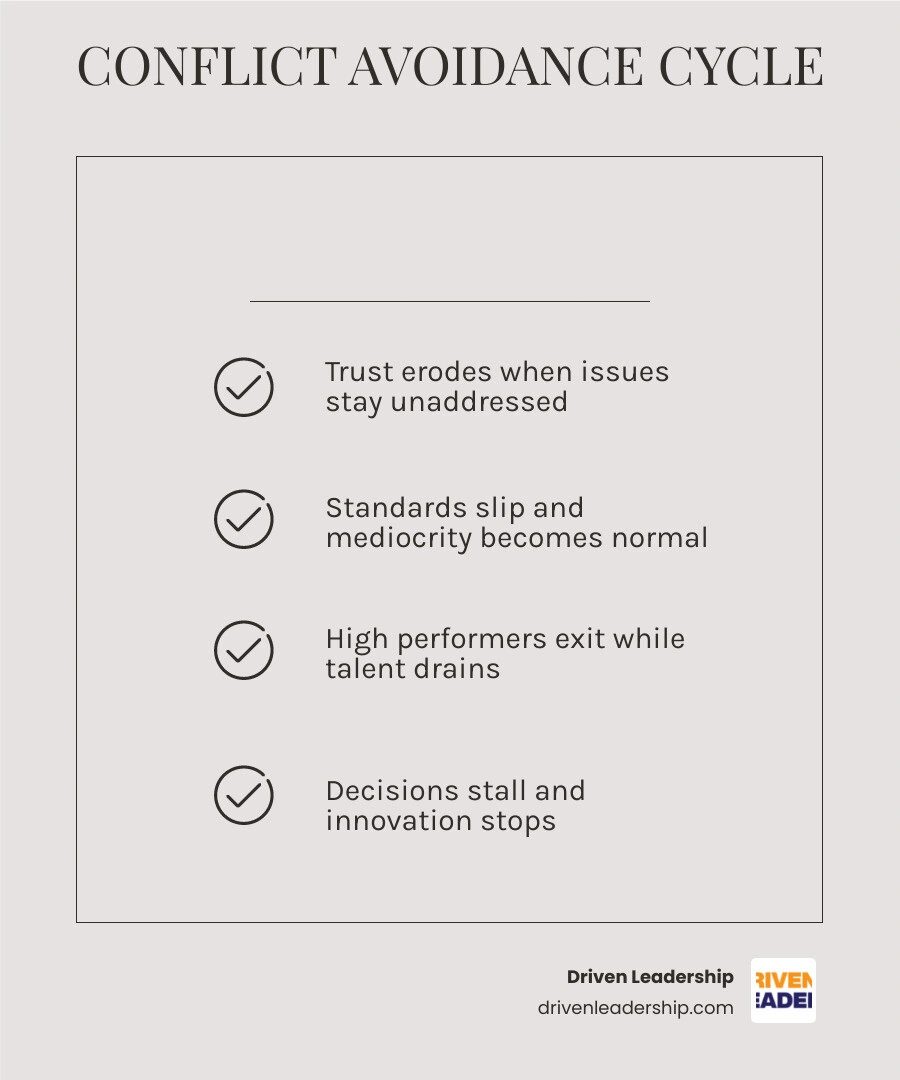
Here is a quick breakdown of how conflict avoidance damages team performance:
1. Trust erodes — When issues go unaddressed, team members stop believing leadership will act fairly.
2. Standards slip — Poor performance becomes the accepted baseline when nothing is said.
3. High performers leave — Top contributors grow resentful watching mediocrity go unchecked.
4. Decisions stall — Teams avoid debate, so choices get delayed or reversed later.
5. Emotional debt builds — Unspoken tension accumulates until it surfaces as sudden resignations or explosive conflict.
6. Innovation dies — People stop sharing ideas when they have learned that honesty carries a cost.
Research shows that unaddressed performance issues cause more employee turnover than the issues themselves. And the average manager already spends 20% of their time dealing with conflict — meaning the cost is being paid whether conflict is addressed or not. The only question is whether that cost buys resolution or just delays the damage.
The real threat to your team is not conflict. It is the absence of it.
The Anatomy of Avoidance: Why Leaders Choose Silence Over Action

To understand why avoiding conflict destroys team performance over time, we must first look at why we do it. Nobody wakes up in the morning wishing for a screaming match in the breakroom. Human brains are wired to view social friction as an existential threat. In fact, neuroscience shows that our brains process social pain and rejection in the exact same regions as physical pain. When we anticipate a difficult conversation, our amygdala fires up, releasing cortisol and triggering a stress response.
This reaction often manifests as a "fawn" response—an attempt to appease, accommodate, or please others to keep the peace. In a corporate environment, this biological survival mechanism translates into behavioral silence. We tell ourselves we are being "compassionate" or "keeping the peace," but in reality, we are just avoiding discomfort.
This feedback hesitancy is rarely a lack of courage; it is a lack of skill. When leaders do not have structured frameworks to initiate hard conversations, they imagine worst-case scenarios: defensive outbursts, tears, or HR complaints. Rather than risking these emotional landmines, they choose silence. However, this silence is not neutral. It is an active choice that signals to the entire team that accountability is optional. To break this cycle, organizations must invest in structured Conflict Management training that replaces biological fear with conversational competence.
Common Types of Workplace Conflict Leaders Avoid
In our work with leadership teams across California and Washington, we see managers consistently dodge three specific types of conflict:
• Performance Issues: Delaying feedback on missed deadlines or poor work quality because we don't want to hurt someone's feelings.
• Attitude Problems: Ignoring passive-aggressive behavior, negativity, or subtle bullying, often rationalizing it as "just their personality."
• Interpersonal Tension: Hoping that two bickering team members will simply "work it out themselves" rather than stepping in to mediate.
When these issues go unaddressed, they don't disappear. Instead, they warp the team's dynamics. Understanding How to Manage Conflict in a Leadership Team is the first step toward stopping this erosion before it spreads to the rest of the organization.
Warning Signs of a Conflict-Avoidant Team Culture
How do you know if your team has fallen into the trap of false harmony? Look for these classic warning signs:
1. The "Meeting After the Meeting": Everyone nods in agreement during the official call, but the real debates and complaints happen in private Slack channels or hallway huddles afterward.
2. Artificial Unanimity: Decisions are approved instantly with zero pushback, questions, or healthy debate.
3. Passive Resistance: Team members agree to projects but miss deadlines or deliver subpar work because they never actually bought into the plan.
4. Sarcasm and Gossip: Behind-the-back venting replaces direct feedback.
If you suspect your team is suffering from these symptoms, taking a diagnostic step like using our Conflict Effective Intake Questionnaire can help pinpoint where communication is breaking down.
Why Avoiding Conflict Destroys Team Performance Over Time
When we ignore a problem, we aren't resolving it—we are just deferring the payment with high interest. This is what we call accumulating "emotional debt." Just like financial debt, emotional debt builds up over time, compounding quietly until the team's performance eventually goes bankrupt.
Every time a leader avoids a necessary confrontation, they leave behind "emotional residue." This residue is the lingering tension, unspoken frustration, and lack of trust that colors every future interaction. Over time, this constant undercurrent of friction erodes the team's foundation, making even simple tasks feel exhausting. If you want to dive deeper into how to break this cycle, read our guide on Navigating Conflict Resolution Strategies for Maintaining Harmony and Productivity.
The Compounding Effect: Why Avoiding Conflict Destroys Team Performance Over Time
The compounding negative effect of conflict avoidance follows a predictable, destructive pattern:
It starts when a supervisor notices an employee missing quality standards or exhibiting a toxic attitude but says nothing. The rest of the team notices this silence. They ask themselves: "If they don't have to work hard or treat people with respect, why should I?"
Slowly, the team's baseline standards drop to match the lowest common denominator. The supervisor's credibility erodes entirely. What began as a minor performance issue has now escalated into a cultural norm of mediocrity. This is why avoiding conflict destroys team performance over time; it systematically lowers the bar for everyone. Leaders must undergo Conflict Resolution Training for Leaders to learn how to address these tiny fractures before they shatter the entire team structure.
The Role of Perceived Team Performance in Task vs. Relationship Conflict
To manage conflict effectively, we must understand the difference between task conflict (disagreements about the work itself, processes, or ideas) and relationship conflict (personal friction, animosity, and tension). While relationship conflict is always destructive, task conflict is actually essential for innovation and high performance.
However, academic research shows that task conflict and relationship conflict are highly correlated. Without the right environment, a debate about a project timeline can easily feel like a personal attack. Interestingly, longitudinal studies show that perceived team performance plays a massive role in whether this escalation happens.
According to Social Identity Theory, when a team perceives itself as highly successful, members experience high "team identification." This shared pride acts as an emotional buffer. Because they feel like they are on a winning team, they are much more likely to attribute task disagreements to a shared desire for excellence rather than personal malice. On underperforming teams, however, this buffer doesn't exist. Every task disagreement is quickly misattributed as a personal attack, escalating into toxic relationship conflict. Leaders can use tools like the TKI Assessment to help team members understand their default conflict styles and learn to separate the person from the problem.
Decision-Making Speed and Quality: Why Avoiding Conflict Destroys Team Performance Over Time
A conflict-avoidant team is a slow team. When people are afraid of disagreement, decision-making stalls. Meetings drag on as everyone talks around the real issues, searching for a comfortable consensus that doesn't exist.
Worse, when decisions are finally made without genuine buy-in, they don't stick. The lack of open debate means hidden flaws are never surfaced. Consequently, projects launch only to fail later, leading to frequent changes of direction and wasted resources. Without open, honest conflict, there is no true commitment—and without commitment, there is no accountability. Using a tool like the Thomas Kilmann Assessment helps teams measure and improve their ability to engage in the healthy, rapid debate required for fast, high-quality decision-making.
The Hidden Costs: How Conflict Avoidance Penalizes High Performers and Stifles Innovation
The most damaging consequence of conflict avoidance is who it hurts the most: your best people. When leaders tolerate mediocrity or toxic behavior to avoid a difficult conversation, they are actively penalizing their high achievers.
This dynamic often leads to the "missing stair" phenomenon. Just like a broken step in an old house that everyone learns to jump over rather than fix, a conflict-avoidant team will simply work around a toxic or underperforming colleague. High performers will quietly pick up the slack, routing projects around the "missing stair" to ensure things get done. But this workaround comes at a massive cost. It drains your best employees' energy, stifles their innovation, and destroys their psychological safety. To protect your top talent, you must empower everyone on the team with Conflict Management for Employees so they can address peer-to-peer issues directly and constructively.
High Performers vs. Underperformers: The Retention Crisis
When conflict is avoided, high performers and underperformers react in completely opposite ways:
• High Performers: They watch mediocrity go unpunished and realize their extra effort isn't truly valued. Resentment builds. Eventually, they don't complain; they just leave. They exit for organizations where performance is measured fairly and standards are maintained.
• Underperformers: They receive vague, positive, or non-existent feedback because their manager wants to avoid an awkward conversation. They assume they are doing great, settle in, and stay forever.
This is how avoiding conflict completely reverses your talent pool. It drives away your stars and retains your slackers. If you are operating in highly competitive talent markets, implementing targeted Conflict Resolution Training Los Angeles CA can be the single most effective retention strategy you deploy this year.
The Indirect Costs That Don't Show Up on KPIs
While direct turnover is expensive, the indirect, hidden costs of conflict avoidance are often even higher. These costs don't show up on a traditional profit-and-loss statement, but they quietly eat away at your margins.
• Innovation & Ideas — Healthy Conflict Environment: Diverse perspectives are shared; ideas are pressure-tested and improved. — Conflict Avoidance Environment: People stay silent; valuable ideas are never voiced to avoid pushback.
• Execution Speed — Healthy Conflict Environment: Real alignment means rapid execution and clear accountability. — Conflict Avoidance Environment: Passive resistance, delayed projects, and constant second-guessing.
• Employee Energy — Healthy Conflict Environment: Focused on solving problems, creating value, and hitting goals. — Conflict Avoidance Environment: Wasted on managing office politics, gossiping, and navigating tension.
• Risk & Compliance — Healthy Conflict Environment: Early warning signs are called out immediately; risks are mitigated. — Conflict Avoidance Environment: Serious issues (like inappropriate behavior) are ignored until they become legal liabilities.
From False Harmony to Healthy Friction: A Leader's Framework for Constructive Conflict
How do we turn things around? The goal is not to create a workplace full of screaming matches. The goal is to move your team from false harmony (where everyone is polite but resentful) to healthy friction (where people can disagree passionately about ideas while maintaining deep mutual respect).
This transition requires building psychological safety. Psychological safety is not about being nice or comfortable; it is about creating an environment where people can take interpersonal risks—like speaking up, admitting a mistake, or challenging a decision—without fear of retaliation or humiliation. Leaders can learn to cultivate this environment by enrolling in our Conflict Management Training Course Essential Strategies for Leaders.
Distinguishing Constructive vs. Destructive Conflict
As a leader, you must learn to read the room and distinguish between the friction that builds teams and the conflict that breaks them:
• Constructive Conflict: Focuses entirely on the task, process, or idea. It is characterized by curiosity, active listening, and mutual respect. The goal is to find the best solution for the organization.
• Destructive Conflict: Focuses on personalities, intentions, and personal attacks. It is characterized by defensiveness, blame, and a desire to "win" the argument at the expense of others.
To help your team understand where they fall on this spectrum, we highly recommend taking a Free Thomas Kilmann Assessment to benchmark your baseline conflict behaviors.
Actionable Frameworks for Courageous Communication
To help your supervisors stop avoiding and start leading, give them this simple, four-step framework for difficult conversations:
1. State Specific Observations (Not Judgments): Start the conversation with objective facts, not emotional labels. Instead of saying, "You have a bad attitude," say, "I noticed you rolled your eyes and sighed when we discussed the new timeline in yesterday's meeting."
2. Lead with Curiosity, Not Certainty: Ask questions to understand their perspective before jumping to conclusions. Try: "Can you help me understand what was on your mind when that happened?"
3. Name the Impact: Clearly explain how their behavior affects the team and the business. For example: "When you express frustration that way, it makes the rest of the team hesitant to share their timelines, which slows down our planning."
4. Focus on Future Improvement: Collaborate on a clear, actionable agreement for the future. "Moving forward, if you have concerns about a timeline, can we agree to raise them as specific questions during the meeting?"
By structuring conversations around facts, curiosity, and future growth, you take the emotional sting out of feedback. For teams looking to build these muscles together, our Understanding Conflict Resolution Mediation Training provides hands-on practice to make these frameworks second nature.
Frequently Asked Questions About Workplace Conflict Avoidance
Why do managers avoid difficult performance conversations?
Most managers avoid these conversations because of a skill gap, not a lack of courage. Without proper training, their brains treat the anticipated social friction as actual danger. They fear emotional outbursts, defensive reactions, or damaging the relationship. Providing them with structured frameworks and targeted Conflict Resolution Training Seattle WA gives them the confidence and language they need to step into these discussions constructively.
What percentage of organizational conflict stems from personality clashes?
Surprisingly, very little. Research shows that approximately 70% of organizational conflict actually stems from systemic issues, poor structure, or lack of cultural clarity—not personalities. When roles are poorly defined, goals are misaligned, or accountability structures are weak, conflict is inevitable. Addressing these structural issues through programs like Conflict Resolution Training Anaheim CA is often the fastest way to resolve seemingly "personal" disputes.
How does conflict avoidance impact employee retention?
Conflict avoidance is a massive driver of turnover. High performers become deeply resentful when they have to carry the load for unaddressed underperformers, eventually leaving for healthier cultures. Meanwhile, unaddressed interpersonal tension creates a toxic environment that wears people down emotionally. Investing in Conflict Resolution Training Tacoma WA helps build a transparent, high-performing culture where your best talent actually wants to stay.
Conclusion: Close the Emotional Authority Gap Today
Avoiding conflict is not a strategy for keeping the peace; it is a recipe for slowly destroying your team's performance, trust, and talent pool. The cost of silence is simply too high to ignore.
At Driven Leadership, we specialize in helping organizations close the gap between avoidance and action. Through our immersive leadership development programs, EOS implementation, and hands-on workshops, we deliver the measurable, lasting behavioral change your business needs to thrive.
If you are ready to build a conflict-capable team that turns tension into a tool for growth, we invite you to explore our TKI Live Conflict Management Workshops Driven Leadership. We host training sessions across Southern California and the Pacific Northwest, including dedicated programs like our Conflict Resolution Training Long Beach CA.
Don't let silence quietly sabotage your success. Contact us today to learn more about our comprehensive Conflict Management Training Course and take the first step toward a healthier, high-performing team.