
A Practical Guide to How to Become a Better Leader as a Business Owner

Why Learning How to Become a Better Leader as a Business Owner Changes Everything
If you want to know how to become a better leader as a business owner, here are the core steps:
1. Assess yourself - Identify your leadership strengths and blind spots through honest self-reflection and team feedback
2. Know your style - Understand which leadership approach fits your team and business stage
3. Communicate clearly - Set expectations, listen actively, and follow through on your word
4. Delegate deliberately - Hand off tasks so your team grows and you stop being the bottleneck
5. Build emotional intelligence - Develop empathy, manage conflict, and connect with your people as individuals
6. Set a clear vision - Give your team direction and purpose beyond daily tasks
7. Keep learning - Seek feedback, study leadership, and treat development as ongoing
You built a business. You wear every hat, solve every problem, and push things forward when no one else does. But at some point, what got you here stops working.
The team feels misaligned. Communication breaks down. Growth stalls. And somewhere in the back of your mind, you know the problem isn't the market or the team — it's how you're leading.
That's not a flaw. It's a turning point.
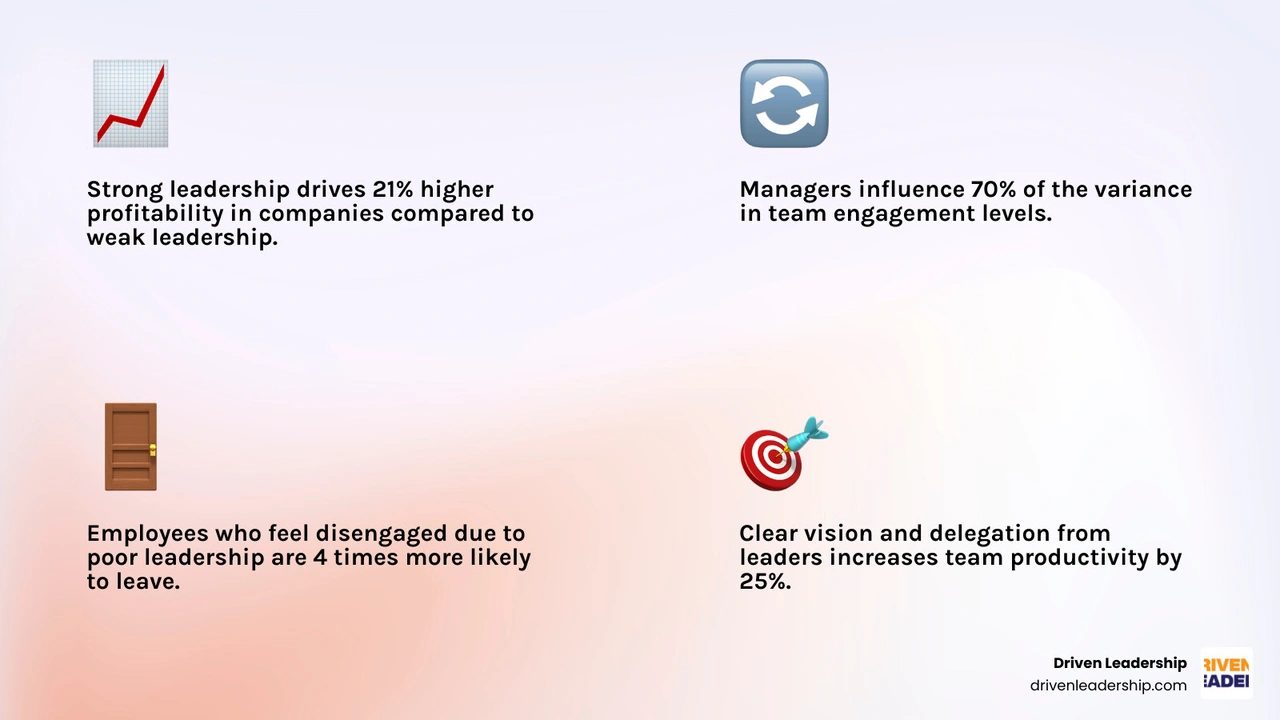
Research from Gallup shows that managers account for 70% of the variance in team engagement. Poor leadership doesn't just hurt morale — it drives up turnover, kills productivity, and quietly caps your revenue. In contrast, businesses with strong leadership grow significantly faster and retain better people.
The good news is that leadership is a skill, not a fixed trait. Most of it can be learned, practiced, and improved — starting today.
Leadership vs. Management: The Critical Distinction for Business Owners

Many business owners use the terms "leader" and "manager" interchangeably. However, conflating the two is one of the primary reasons growing companies hit a ceiling. While both roles are essential to a thriving business, they require entirely different mindsets, skill sets, and behaviors.
Management is about order, systems, and predictability. A manager's primary job is to execute a defined plan, maintain processes, organize resources, and ensure daily tasks are completed on time and within budget. Their authority typically stems from their formal title or position on the organizational chart.
Leadership, on the other hand, is about direction, alignment, and inspiration. A leader’s authority does not come from a title; it is earned through personal qualities, trust, and influence. Leaders look beyond the immediate horizon to define where the company is going and, more importantly, why it matters. They focus on motivating, empowering, and developing people so they can achieve those long-term goals.
At Driven Leadership, we work with business owners across Washington, California, and Nashville, TN, who struggle to balance these two identities. To scale successfully, you must understand how to transition between them. You can explore this dynamic further in our guide on Small Business Leadership.
To help clarify the differences, consider this side-by-side comparison:
• Source of Authority — The Manager: Formal title, rank, and position — The Leader: Earned trust, respect, and personal influence
• Primary Focus — The Manager: Systems, processes, and daily execution — The Leader: Vision, alignment, and human potential
• Approach to Goals — The Manager: Optimizes current workflows to hit targets — The Leader: Paints a compelling picture of a better future
• Communication Style — The Manager: Instruction-heavy, tactical, and top-down — The Leader: Dialogue-driven, transparent, and collaborative
• View of Failure — The Manager: An error to be minimized and corrected — The Leader: A learning opportunity that fuels innovation
• Team Relationship — The Manager: Directs subordinates and monitors activities — The Leader: Coaches individuals and builds mutual trust
Why the Distinction Matters for SMB Growth
When you first launch a startup, you have to be a manager. You are the "doer" who manages the inventory, answers the emails, and keeps the lights on. But as your team grows, continuing to operate solely as a manager creates an invisible wall that stops growth cold.
If you try to control every detail, you quickly become the ultimate bottleneck. Your team will stop thinking for themselves and start waiting for your permission to make even the smallest decisions. This hands-on micromanagement stunts company growth, drains your energy, and breeds a culture of dependency and fear.
Learning how to become a better leader as a business owner means learning to step back from daily operations so you can focus on strategic planning and team development. Instead of solving every problem yourself, you must transition to a coaching mindset — teaching your team how to solve problems on their own. This shift empowers your people, frees up your time, and allows your business to scale past revenue plateaus that trap mediocre managers.
Choosing the Right Leadership Style for Your Business
There is no single "correct" way to lead. The most effective business owners do not rely on a one-size-fits-all approach. Instead, they understand that different business cycles, team dynamics, and challenges require different leadership behaviors.
By understanding the distinct Types of Leadership Styles That Transform Business Success, you can learn to adapt your approach to match your company's immediate needs:
• Transformational Leadership: This style focuses on inspiring massive change and growth by rallying the team around a bold, shared vision. It works incredibly well for competitive, growth-focused businesses looking to disrupt a market.
• Servant Leadership: Here, the leader’s primary goal is to serve their employees, ensuring they have the tools, resources, and emotional support they need to succeed. This approach builds immense trust and is highly effective in customer-centric industries or organizations recovering from low morale.
• Situational Leadership: This highly adaptive style requires you to assess the competence and commitment of individual team members and adjust your style accordingly. For example, a brand-new employee may need highly directive, manager-like guidance, while a seasoned veteran thrives under a hands-off, supportive style.
• Democratic/Participative Leadership: This style invites team members into the decision-making process. It fosters deep collaboration, breaks down organizational silos, and is excellent for resolving complex problems that require diverse perspectives.
• Charismatic Leadership: Driven by the leader's personal energy and passion, this style is incredibly powerful for motivating teams during difficult turnarounds or reputational crises. However, leaders must be careful not to let the business rely solely on their personality.
Matching Leadership Styles to Business Situations
To maximize organizational performance, you must learn to read the room. If your business is navigating a period of rapid market disruption in California or SoCal, a transformational and situational approach will help your team remain agile and resilient. If you are integrating a new, complex software system across your offices, a democratic approach will ensure your team feels heard and bought into the change.
Conversely, applying the wrong style can be disastrous. Using a highly directive, authoritative style with an experienced, high-performing team will lead to frustration and high turnover. On the flip side, being purely democratic when a swift, critical financial decision is required will paralyze your business. Truly great leaders do not change who they are; they change how they lead based on the situation at hand.
How to Become a Better Leader as a Business Owner: A Step-by-Step Guide
Becoming an exceptional leader doesn't happen overnight. It is a deliberate, 90-day tactical sprint that evolves into a lifelong habit. If you are ready to transition from a hands-on manager to a visionary leader, follow this practical, step-by-step roadmap.
Assess Your Strengths: How to Become a Better Leader as a Business Owner
You cannot improve what you do not measure. The first step on this journey is to conduct a brutal, honest audit of your current leadership capabilities.
Start by performing a personal SWOT (Strengths, Weaknesses, Opportunities, Threats) analysis of your leadership skills. Rate yourself on a scale of 1 to 10 in core areas such as communication clarity, delegation, emotional intelligence, and decision-making.
Next, gather external feedback. Because there is often a massive gap between how leaders perceive themselves and how their teams actually experience them, you must seek regular, anonymous feedback. Ask three trusted team members or peers to identify your primary leadership blind spots. Ask them: “What is one thing I do that helps you succeed, and what is one thing I do that blocks your progress?”
Additionally, we highly recommend utilizing strengths-based frameworks like CliftonStrengths. Rather than spending all your energy trying to fix weaknesses you don't naturally have, focus on identifying your dominant strengths across four core domains:
1. Executing: How you make things happen.
2. Influencing: How you sell ideas and take charge.
3. Relationship Building: How you nurture connections and hold the team together.
4. Strategic Thinking: How you analyze information and plan for the future.
By understanding your natural wiring, you can lead authentically and surround yourself with team members who complement your gaps. To dive deeper into the core competencies you should develop, read our article on the 7 Traits of a Great Leader.
Practical Steps on How to Become a Better Leader as a Business Owner Daily
Once you have assessed your baseline, you can implement small, measurable daily habits that yield massive behavioral changes over time:
• Practice Active Listening: True leadership thrives in dialogue, not dashboards. When a team member speaks, resist the urge to formulate your response or offer immediate solutions. Ask open-ended questions like, "What is blocking you on this project?" or "What do you think the best solution is here?" This builds critical problem-solving skills in your team and shows you genuinely value their expertise.
• Set SMART Goals and Clear Expectations: People cannot hit targets they cannot see. Ensure every project and role has specific, measurable, achievable, relevant, and time-bound (SMART) goals. Put expectations and deadlines in writing to prevent confusion and eliminate the need for micromanagement.
• Align Decisions with Core Values: Define three non-negotiable core values for your business. Before every major meeting or decision, ask yourself: "Which of our values is being tested here, and how do we uphold it?" Modeling these values consistently builds immense trust and establishes a healthy, predictable company culture.
• Master the Art of Delegation: Most business owners hoard work like dragons because they fear mistakes. Start small: delegate low-risk administrative tasks first. If a team member can do a task at least 80% as well as you, hand it off completely. Resist the urge to swoop in and "fix" minor mistakes; instead, use them as coaching moments to help the employee grow.
• Build a Learning Ritual: A great leader never stops learning. Block out one hour every single week specifically for personal development. Read leadership essays, listen to industry podcasts, or seek out structured Executive Coaching to gain fresh, objective perspectives on your business challenges.
Frequently Asked Questions About Business Leadership
What is the difference between a leader and a boss?
The difference lies in how they motivate people. A "boss" relies on granted authority, fear, and control. They tell people what to do, demand respect because of their title, and focus heavily on pointing out mistakes.
A true leader relies on earned trust, empathy, and inspiration. They adopt a coaching mindset, working alongside their team to help them succeed. Leaders don't just give orders; they explain the "why" behind those orders, share credit for wins, and take accountability when things go wrong.
How does effective leadership influence employee retention?
Poor leadership is incredibly expensive. Gallup research indicates that poor leadership costs U.S. businesses upwards of $550 billion annually in employee turnover, toxic cultures, and lost productivity. When employees feel micromanaged, ignored, or unappreciated, they disengage and eventually walk out the door.
In contrast, effective leadership directly improves morale and engagement. When leaders communicate transparently, invest in employee growth, and build a culture of open feedback, trust flourishes. High-engagement teams experience significantly lower turnover and enjoy 23% higher profitability compared to those with disengaged workforces.
Can leadership skills be learned or are they inherent?
While some individuals are born with natural charisma or communication talents, leadership is fundamentally a set of behaviors and skills that can be learned, practiced, and mastered.
Real, lasting behavioral change requires structured training, self-awareness, and consistent execution. If you want to accelerate your growth, consider Choosing the Right Leadership Courses for Growth to build a solid foundation of practical skills that you can apply directly to your business.
Conclusion
Becoming a better leader is the single most impactful investment you can make in the future of your business. When you transition from a hands-on manager who controls tasks to an inspiring leader who empowers people, you break through growth ceilings, eliminate operational bottlenecks, and build a business that can thrive even when you step away.
But reading about leadership isn't enough — execution is what truly matters.
At Driven Leadership, we specialize in delivering measurable, lasting behavioral change that transforms business performance. Through our immersive workshops, executive coaching, and team training programs across Washington, California, Nashville, and SoCal, we help business owners build the practical habits required to lead with clarity and confidence.
Are you ready to stop managing the grind and start leading your vision? Explore our professional Leadership Courses today, or Take the next step with Driven Leadership's Leadership Development and Coaching to unlock your team's true potential.