
A Practical Guide to Vulnerability and Challenge in Leadership

Why Vulnerability and Challenge Are the Real Drivers of Leadership Growth
Understanding how vulnerability and challenge lead to stronger leadership starts with one uncomfortable truth: the leaders who appear the most in control are often the least effective at building teams that actually perform.
Here is the short answer:
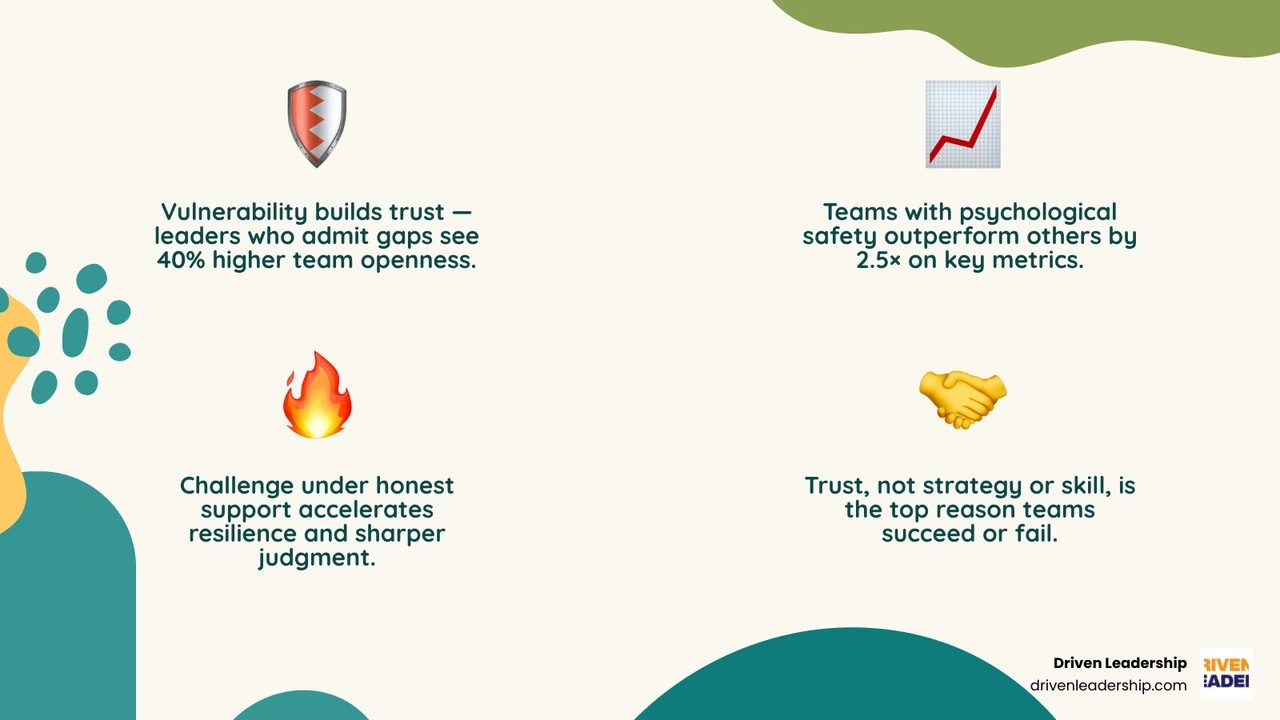
• Vulnerability builds trust. When leaders admit mistakes, ask for help, or share what they don't know, team members feel safe doing the same.
• Challenge drives growth. Difficulty — when met with honesty and support — develops resilience, sharper judgment, and stronger teams.
• Together, they create psychological safety. Research shows teams with high psychological safety are 2.5 times more likely to be high-performing.
• The result is better leadership outcomes. Higher engagement, lower turnover, more innovation, and stronger communication.
Most managers are taught to project confidence, have the answers, and stay composed under pressure. That instinct is understandable. But it quietly kills trust, shuts down honest communication, and leaves teams feeling disconnected from the person leading them.
According to research with more than 500 global CEOs, the number-one reason teams fail is not a lack of strategy or skill — it is a lack of trust. And trust, it turns out, is built not by appearing invincible but by being real.
If your team feels misaligned, communication feels strained, or growth has stalled, this guide will show you exactly how embracing vulnerability and challenge can turn those struggles into your strongest leadership assets.
Redefining Strength: How Vulnerability and Challenge Lead to Stronger Leadership
For decades, business culture equated leadership with stoicism, unwavering certainty, and an air of invincibility. If you were the boss, you were expected to rule from on high, issue directives, and never let them see you sweat. But trying to live up to this myth of perfectionism is exhausting. Even worse, it is counterproductive. When we try to build an unreachable tower of personal perfection, we isolate ourselves and make it impossible for our teams to connect with us.
Vulnerability, as research pioneer Brené Brown famously defined it, is not about weakness. It is about uncertainty, risk, and emotional exposure. In a workplace setting, vulnerability means having the courage to show up as your authentic self, admit when you do not have all the answers, and acknowledge your limitations.

When we step away from the exhausting game of "perception management" and choose to Stand in Your Truth, we transform how our teams view us. It turns out that people do not actually want to follow a flawless robot. They want to follow a human being. By revealing our imperfections and seeking support when necessary, we invite collaboration and cooperation. We make success feel attainable to our teams rather than like a distant, unrealistic standard.
When you look closely at the data, the business case for this shift is undeniable:
• Companies that cultivate environments of trust and vulnerability experience 50% lower employee turnover compared to those that do not.
• Leaders who embrace vulnerability and create psychologically safe spaces report up to 76% higher team engagement and collaboration.
• Authenticity in leadership directly boosts employee morale, creativity, and long-term retention.
The Science of Growth: Why Pressure and Discomfort Build Antifragility
To understand how vulnerability and challenge lead to stronger leadership, we have to look at how human beings actually grow. Think about physical fitness: you do not build stronger muscles by lifting weights that feel light and comfortable. You build them through micro-tears created by lifting heavier weights that challenge your current capacity.
The same biological and psychological principles apply to leadership development. In neuroscience, this adaptive response to mild, controlled stress is called hormesis. Just as a small dose of stress triggers adaptive growth in our physical cells, taking on challenges that push us past our comfort zones triggers cognitive and emotional growth.
Psychologists also refer to this as desirable difficulties. When learning requires effort, retrieval, adjustment, and active engagement, it sticks. Growth rarely feels polished or comfortable while it is happening. Readiness is built through action, not before it.
By practicing stress reappraisal — a technique where we interpret physical signs of stress (like a racing heart or butterflies) as our body preparing to meet a challenge rather than as evidence of failure — we can shift our mindset from threat to challenge. A landmark 2025 meta-analysis covering 62 studies found that leaders and teams who operate in "challenge states" consistently achieve stronger performance outcomes than those trapped in "threat states."
But we can go even further than simple resilience. While resilience is the ability to bounce back to where you were before a crisis, antifragility is the ability to actually get stronger, smarter, and better because of stress, uncertainty, and disruption.
To help visualize this, let’s look at how resilience compares to antifragility:
• Response to Stress — The Fragile Leader: Shatters, panics, or avoids the issue — The Resilient Leader: Absorbs the shock and bounces back to baseline — The Antifragile Leader: Absorbs the shock, learns, and grows stronger
• View of Mistakes — The Fragile Leader: A sign of failure to be hidden or blamed on others — The Resilient Leader: A temporary setback to be overcome — The Antifragile Leader: Valuable data and an upgrade mechanism
• Handling Uncertainty — The Fragile Leader: Seeks immediate, rigid closure; over-prepares — The Resilient Leader: Holds the line and maintains current operations — The Antifragile Leader: Adapts quickly, experiments, and finds new opportunities
• Core Goal — The Fragile Leader: Maintaining a perfect, safe facade — The Resilient Leader: Getting back to normal as quickly as possible — The Antifragile Leader: Bouncing forward and evolving the system
Developing this mindset is the core of Resilient Leadership. When you treat unexpected disruptions as data instead of damage, you stop trying to protect a fragile status quo and start using every challenge as a stepping stone to your next level of capability.
Building Trust and Psychological Safety Through Authenticity
At its core, leadership is about relationships. And the foundation of any healthy relationship is trust. According to organizational research, the number-one reason teams fail is a lack of trust. So, how do we build it?
We build it by modeling the very behaviors we want to see in our teams. When a leader acts as though they are infallible, they inadvertently send a dangerous message: "Mistakes are not allowed here." In response, team members protect themselves by hiding errors, withholding creative ideas, and staying silent when they see problems.
When you choose to lead with authenticity, you dismantle these barriers. Admitting your own challenges and showing vulnerability humanizes you. It signals to your team that it is safe to speak up, ask questions, and take calculated risks. This is the very definition of psychological safety.
By prioritizing open communication and emotional connection, you build an environment where people feel valued for who they are, not just what they produce. This shift is essential for Building and Maintaining Trust: The Foundation of Impactful Leadership.
Overcoming the Fear of Failure: How Vulnerability and Challenge Lead to Stronger Leadership in Teams
When teams fear failure, innovation dies. People stick to the safe, predictable paths, even when those paths lead to stagnant results. To foster a culture of continuous learning and breakthrough innovation, leaders must normalize mistakes and feedback.
Think of it this way: putting frosting on a mud pie and calling it a cake doesn't change it from a mud pie. When things go wrong in your organization, trying to sugarcoat the situation or pretend everything is fine only breeds skepticism. Top performers will see right through the facade, lose trust, and eventually leave the organization.
Instead, vulnerable leaders face reality head-on. They openly acknowledge breakdowns, frame setbacks as learning opportunities, and actively involve their teams in finding solutions. By treating failure as a natural part of the growth process rather than a punishable offense, you spark creativity and collective intelligence. You turn the workplace into a safe testing ground where your team can step into the Fear and Fire of challenge and come out stronger on the other side.
Developing Emotional Intelligence: How Vulnerability and Challenge Lead to Stronger Leadership Under Pressure
You cannot practice vulnerability without self-awareness. To show up authentically, you must first do the inner work to understand your own emotional landscape, your triggers, and your defense mechanisms.
Many leaders fall into the trap of reacting defensively when their authority is questioned or when a project fails. This reaction usually stems from deep-seated patterns of conflict avoidance or a need to always be right. Developing high emotional intelligence (EQ) allows you to recognize these emotional triggers in real-time, pause, and choose a conscious, constructive response instead of a reactive one.
By cultivating empathy and self-regulation, you learn to listen deeply to your team's concerns without taking them as personal attacks. This empathetic approach is a cornerstone of Developing Emotional Intelligence: The Key to Empathetic Leadership. It enables you to navigate high-pressure crises with a sense of grounded calm that naturally reassures and stabilizes your entire team.
Practical Steps for Leaders to Embrace Vulnerability and Challenge
Transitioning from a traditional, protective leadership style to a vulnerable, adaptive one does not happen overnight. It is a learnable skill that requires deliberate, daily practice.
Here are five practical, actionable steps you can start taking today to bring vulnerability into your daily leadership:
1. Admit when you don't know. The next time a team member asks a complex question you do not have the answer to, resist the urge to guess or deflect. Instead, say: "I don't know the answer to that, but let's figure it out together." This simple shift invites collaboration and shows that you value truth over ego.
2. Share personal stories of challenges and failures. When onboarding new employees or launching a difficult project, share a story of a time you struggled, made a mistake, and what you learned from it. This makes you relatable and sets a realistic standard for growth.
3. Ask for feedback regularly — and act on it. Do not wait for annual reviews. Ask your team members: "What is one thing I could do to better support you right now?" or "How did that meeting go from your perspective?" When they give you constructive feedback, thank them sincerely and make visible adjustments.
4. Identify your emotional triggers. Keep a private journal to track times when you felt defensive, anxious, or frustrated during the workday. Uncover the underlying beliefs driving those reactions, and work on responding with curiosity rather than self-protection.
5. Keep a "To Be" list alongside your "To Do" list. While your to-do list focuses on tasks and metrics, your to-be list should focus on character and behavior. Write down how you want to show up each day — such as "patient," "curious," "transparent," or "courageous."
By focusing on these daily practices, you learn to direct your energy toward what is truly within your influence. This is the heart of The Power of Focusing on What You Can Control: A Path to Empowered Leadership.
Balancing Vulnerability with Authority and Influence
A common concern among executives is: "If I show my team my struggles and unknowns, won't I lose their respect? Will they think I'm incompetent?"
This is a valid question. The key is understanding that vulnerability without competence is not leadership — it is oversharing. There is a distinct line between being authentic and dumping your anxieties onto your team (often called "Too Much Information" or TMI).
To maintain respect and influence, you must balance your vulnerability with professional boundaries, competence, and a forward-looking focus. You do not need to share every passing worry or personal detail. Instead, share your challenges in a way that is constructive and focused on solutions.
For example, compare these two approaches:
• Unfiltered Oversharing: "I have no idea how we are going to hit our Q3 goals. The market is a mess, I'm completely stressed out, and I'm losing sleep over this." (This creates panic and erodes confidence.)
• Healthy Vulnerability: "Hitting our Q3 goals is going to be a major challenge because of these recent market shifts. I don't have all the answers yet, but I have complete confidence in this team's ability to figure it out. Let's look at the data we have and brainstorm our next steps." (This acknowledges reality, shows humility, and points the team toward action.)
True vulnerability is not about losing control; it is about having the inner strength to stand in your truth while remaining a steady, reliable anchor for others. Making this transition is what we call The Shift.
Navigating Uncertainty and Leading Through Change
In today’s volatile business landscape, change is the only constant. Whether you are leading a team in Seattle, managing operations across SoCal, or scaling an organization in Nashville, you will inevitably face disruptions that force change before you feel fully prepared.
When uncertainty hits, the temptation is to double down on control, micromanage, and demand immediate results. But this rigid approach only increases stress and stifles the adaptability your organization needs to survive.
Vulnerable leaders handle change differently. They openly communicate what they know, what they do not know, and what they are doing to find out. By acknowledging the discomfort of transition, they validate their team's feelings and build a shared sense of resilience. If you want to build an agile, forward-thinking organization, you must master the art of Embracing Change in the Workplace: Strategies for Leading Through Uncertainty.
Frequently Asked Questions About Vulnerable Leadership
Is showing vulnerability in leadership a sign of weakness?
Absolutely not. In fact, showing vulnerability is one of the greatest demonstrations of leadership courage. It is incredibly easy to hide behind a mask of perfectionism, issue top-down orders, and avoid difficult conversations. It takes immense inner strength, self-awareness, and confidence to admit when you are wrong, ask for help, or say, "I don't know." Far from looking weak, leaders who show vulnerability build deeper connections, command greater respect, and foster highly resilient teams.
How does leader vulnerability improve team performance?
When a leader demonstrates vulnerability, they lay the groundwork for psychological safety. Team members feel secure taking calculated risks, sharing innovative ideas, and speaking up about potential issues because they know they won't be punished or humiliated for doing so. This open, high-trust environment leads to a 2.5x increase in performance, up to 76% higher team engagement, and 50% lower employee turnover.
How can a leader balance being vulnerable with maintaining respect?
The balance lies in pairing your honesty with competence, professional boundaries, and a forward-looking focus. Vulnerability should never be used to vent aimlessly or dump emotional burdens onto your team. Instead, share your challenges and mistakes constructively to highlight learning opportunities, build shared mutual knowledge, and invite collaborative problem-solving. Always maintain your role as a steady guide who is committed to finding a path forward.
Conclusion: Elevate Your Leadership Journey
At Driven Leadership, we believe that true leadership is not about having a flawless facade or a perfect set of answers. It is about having the courage to show up authentically, face challenges head-on, and build high-performing teams rooted in trust and psychological safety.
We specialize in delivering immersive training programs, workshops, and EOS implementation for executives and teams across Washington, California, Nashville, TN, and SoCal. Unlike programs that offer short-term inspiration that fades within a week, our focus is on delivering measurable, lasting behavioral change that directly improves your business performance.
If you are ready to stop managing perceptions and start driving real, sustainable growth for yourself and your organization, we invite you to take the next step. Explore our immersive Advanced Leadership Program and discover how you can transform vulnerability and challenge into your greatest competitive advantages.