The Pre-Q4 Tune-Up: Aligning Your Leadership Team Before the End-of-Year Push

The High Cost of Q4 Misalignment
Executing The Pre-Q4 Tune-Up: Aligning Your Leadership Team Before the End-of-Year Push is often the deciding factor between a record-breaking final quarter and total operational chaos. According to Harvard Business Review, 67% of well-formulated strategies fail due to poor execution and lack of accountability. Entering the final quarter of the year with ambiguous accountability inevitably leads to misaligned priorities, dropped responsibilities, and widespread frustration across departments.
When an executive team lacks a unified direction, the entire organization feels the impact. Projects stall, decisions are deferred, and the end-of-year sales push becomes an exercise in crisis management rather than strategic execution. At Driven Leadership, the concrete problem we see many organizations face is that their leaders are operating in silos, making assumptions about who is handling which critical tasks. To prevent this, executives need a structured decision point to finalize priorities before the heavy operational load hits.
We always tell our clients to think of their executive leadership dynamics like a complex, high-performance engine. Before a long, grueling race, you do not just hope the engine holds together; you perform a comprehensive mechanical tune-up. The September pre-Q4 transition serves as this exact tune-up window for your leadership team. It is the moment to tighten loose bolts, address grinding gears, and ensure every component is firing in sequence. If your organization is struggling to maintain this level of internal cohesion, exploring comprehensive leadership training programs can provide the foundational tools necessary to get everyone operating from the same playbook.
Why the September Pre-Q4 Transition is Your Crucial 'Tune-Up' Window
For most businesses, the fourth quarter represents both the highest revenue potential and the highest operational stress of the entire year. Holiday schedules compress the working calendar, budget finalizations demand immediate attention, and end-of-year targets loom large. Waiting until October to align the team guarantees operational friction and lost momentum. By the time you realize your executives are out of sync, you are already weeks behind.
During the September pre-Q4 transition, the business environment is uniquely positioned for proactive recalibration. Here in Puyallup and across the Pacific Northwest, just as our climate transitions from the relaxed, sunnier pace of late summer into the brisk, darker fall months, leaders must intentionally shift their teams into a highly focused, resilient Q4 mindset. The relaxed management style that may have sufficed in July will fail under the pressure of November. You must establish peak efficiency proactively.
The Mechanics of Proactive Team Alignment
A leadership team operates through interconnected dependencies. If the sales director pushes a new initiative without aligning with operations, the entire system chokes. This is why a dedicated tune-up is non-negotiable. You must evaluate the structural integrity of your management team before the stress test begins. Establishing flawless team execution requires mapping out these dependencies and ensuring no department is operating blindly.
• Proactive (September) — Operational Impact: Smooth handoffs, clear capacity limits, bottleneck prevention. — Leadership Focus: Strategic execution and behavioral accountability.
• Reactive (October/November) — Operational Impact: Dropped tasks, duplicated efforts, widespread burnout. — Leadership Focus: Crisis management and putting out daily fires.
By utilizing the September window, you give your team the necessary runway to debate priorities, identify resource gaps, and commit to a unified strategy without the immediate pressure of an active Q4 crisis.
Diagnosing Operational Friction in Your Executive Team
Before you can align your team for the final quarter, you must honestly assess where the current system is failing. Gallup research reveals a startling reality: only 2 in 10 employees strongly agree that their leaders have a clear direction for the organization. If the executives are slightly misaligned, the teams below them are entirely lost.
Treat your executive dynamics like a mechanical system and look closely for areas where the "gears are grinding" between departments. In our years of coaching executive teams, we've learned that operational friction rarely announces itself with a massive failure; it usually starts as a series of small, ignored inefficiencies during the September pre-Q4 transition.
Identifying the Symptoms of Poor Alignment
To determine which operational systems need tightening before the end-of-year sales push, watch for these common symptoms of leadership friction:
• Vague Promises: Executives agreeing to broad goals without committing to specific, measurable deliverables.
• Siloed Decision-Making: Department heads launching initiatives that severely impact other teams without prior consultation.
• Deferred Accountability: Pointing fingers when a cross-functional project stalls, rather than taking ownership of the outcome.
• Meeting Paralysis: Endless discussions that result in zero actionable next steps or recorded decisions.
Diagnosing these issues requires an objective look at how your leaders interact under stress. Are they collaborating, or are they competing? Are they protecting their own departments, or are they prioritizing the health of the entire organization? For companies looking to systematically eliminate these friction points, utilizing an EOS implementation framework can provide the structured operating system needed to keep the leadership team moving in perfect synchronization.
Structuring the September Alignment Meeting Agenda
Identifying friction is only the first half of the process. The core of your September pre-Q4 transition strategy is the alignment meeting itself. This cannot be a standard weekly check-in or a casual brainstorming session. It must be a highly structured, intensive working session designed to lock in priorities and eliminate ambiguity.
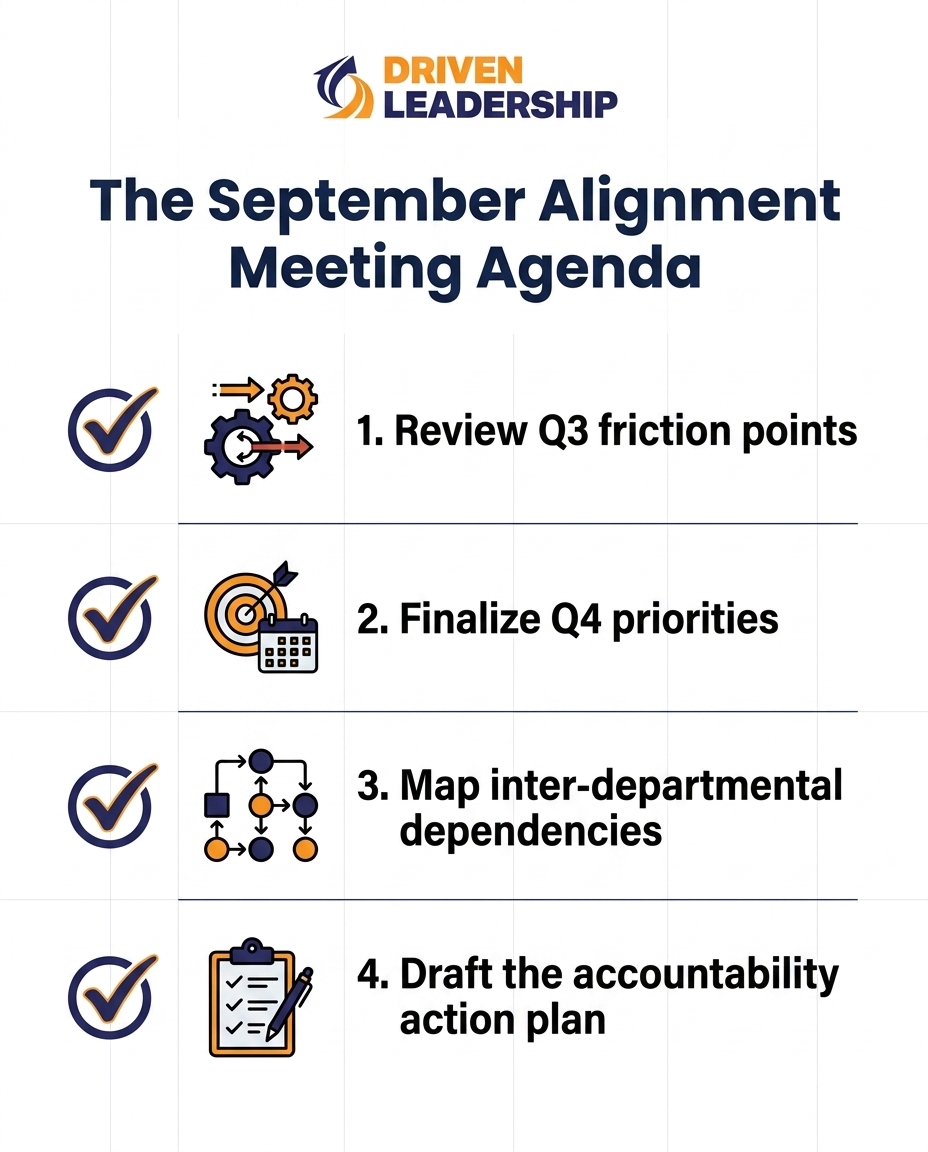
When our team at Driven Leadership facilitates these intensive working sessions, we ensure the meeting yields tangible results rather than just good intentions by following this specific, sequential agenda:
1. Review Q3 Performance Objectively: Begin by analyzing the previous quarter. Do not just look at the metrics; identify the specific friction points where execution stalled. Where did communication break down? Which departments struggled to collaborate? Acknowledge these failures openly so they are not repeated in Q4.
2. Finalize Top Q4 Priorities: Narrow the focus. The holiday schedule drastically reduces the number of usable working days in the fourth quarter. If your team has ten priorities, they have none. Force the executive team to agree on the three to five absolute most critical objectives that must be achieved before year-end.
3. Map Out Inter-Departmental Dependencies: Take each finalized priority and map exactly how it impacts every department. If marketing is launching a Q4 promotion, what exactly does operations need to fulfill it? Document these dependencies to prevent bottlenecks and ensure cross-functional alignment.
4. Draft the Initial Accountability Framework: Assign a single executive owner to every major initiative. There can be no co-owners. If two people are accountable, no one is accountable. Document exactly what success looks like for each owner.
5. Establish a Strict Cadence for Q4 Check-Ins: Determine exactly how and when the team will report on these priorities. Set the meeting schedule for the entire quarter, outlining what data must be brought to each check-in to maintain relentless momentum.
By strictly adhering to this agenda, you transform a typical planning session into a rigorous mechanical tune-up that prepares the entire organization for the demands ahead.
Building a Bulletproof Accountability Action Plan
The single most important deliverable from your September pre-Q4 transition meeting is the accountability action plan. A standard goal sheet merely lists what the company hopes to achieve. An accountability action plan dictates exactly who is responsible for specific outcomes, what metrics define success, and what the consequences are for missing the mark.
The root cause of most Q4 failures is not a lack of effort; it is the presence of ambiguity. When executives leave a meeting with overlapping responsibilities, the "bystander effect" takes hold. Everyone assumes someone else is handling the final details, leading to critical drops in execution. The solution is demanding actionable accountability over vague alignment promises. Every executive must leave the room knowing exactly what they own.
This level of rigorous accountability often requires leaders to push past their current limitations. For example, during one of our winter leadership intensives at Driven Leadership, we saw a professional realize they felt challenged both personally and professionally, creating an urgent need to "level up" their approach. By participating in an environment that tested and challenged their assumptions, they grew significantly and emerged as a more decisive, accountable leader. This is the exact transformation your team needs before Q4 begins.
Eliminating Overlapping Responsibilities
To build a bulletproof plan, you must ruthlessly eliminate overlap. Clarify exactly who owns the final decision on cross-functional projects. If a dispute arises between sales and marketing regarding a Q4 initiative, who has the ultimate authority to make the call? Documenting this chain of command in September prevents weeks of internal debate in November.
Require measurable outcomes rather than subjective effort metrics. "Improve customer communication" is a vague promise. "Reduce client response time to under two hours by November 15th, owned by the Director of Operations" is actionable accountability. Establish clear support systems for when targets are at risk, ensuring leaders raise their hands for help early rather than hiding failures until the end of the year.
Shifting from Vague Promises to Measurable Behavioral Change
The most brilliant Q4 strategy will fail if the behavior of your leadership team remains unchanged. Strategy is merely a concept; execution requires action. Transitioning through the September pre-Q4 transition means demanding true behavioral change and measurable execution as the standard for the remainder of the year.
You must challenge your executives to take absolute ownership of their specific domains. This means moving beyond cliché corporate training and focusing on the psychological and behavioral shifts required to lead under pressure. Leaders must transition from a relaxed, accommodating summer management style to a highly proactive, assertive leadership posture.
Moving from Relaxed to Proactive Leadership
Real alignment requires behavioral shifts. In another instance during our spring development cycle, our team worked with a leader who realized they needed to take full ownership of their life both personally and professionally. By participating in targeted courses, they were challenged to become the best version of themselves, shedding passive habits in favor of decisive action. Your executive team must undergo a similar shift.
When an executive commits to a Q4 goal, they must also commit to changing the behaviors that previously hindered their success. If a department head is known for micro-managing, their behavioral goal must be aggressive delegation. If a leader struggles with conflict avoidance, their behavioral goal must be addressing inter-departmental friction immediately. For managers needing to rapidly develop these assertive traits, an intensive executive manager program can force the necessary behavioral evolution before the Q4 chaos begins.
Fostering Resiliency for the End-of-Year Push
Even with a perfect accountability action plan and a fully aligned team, the fourth quarter is inherently exhausting. Acknowledge the high stress, the compressed holiday schedule, and the fatigue that often accompany budget finalizations and year-end reporting. Preparing for the September pre-Q4 transition means preparing your team mentally and physically for an operational marathon.
Working with teams throughout Puyallup and the Pacific Northwest, we know firsthand how the rapid decrease in daylight hours during autumn naturally impacts human energy levels. As the days get shorter and the pressure gets higher, maintaining executive focus requires intentional effort. Clear directives and a resilient mindset become critical survival tools. You cannot afford to have leaders burning out in mid-November.
Maintaining Energy Under Pressure
Resiliency is rarely built in isolation; it relies heavily on mutual reliance and cooperation among the leadership team. When crises inevitably arise during the end-of-year push, a resilient team leans on one another rather than fracturing into defensive silos. They trust that their peers will execute their portions of the accountability plan, allowing each leader to remain focused on their own domain.
To ensure the team is mentally prepared to execute without breaking down, leaders must foster an environment where asking for backup is viewed as a strength, not a weakness. Discuss strategies for maintaining energy, such as enforcing mandatory downtime during holiday weekends and strictly prioritizing high-impact tasks. Developing this deep level of internal reliance is essential, and focusing on building trust and cooperation now will pay massive dividends when the Q4 pressure peaks.
Frequently Asked Questions About Q4 Leadership Alignment
How do you prepare a team for Q4?
You prepare a team for Q4 by executing a comprehensive operational tune-up during the September pre-Q4 transition. This involves reviewing Q3 failures, finalizing a shortened list of critical priorities, mapping out cross-departmental dependencies, and assigning strict, single-owner accountability for every major end-of-year initiative.
What should be in a Q4 leadership meeting agenda?
A Q4 leadership meeting agenda must include an objective review of recent friction points, the finalization of top priorities, and the drafting of an accountability action plan. It should also explicitly define how inter-departmental bottlenecks will be handled and establish a rigid cadence for progress check-ins throughout the quarter.
How do you create an accountability action plan?
You create an accountability action plan by stripping away all overlapping responsibilities and ensuring every task has exactly one executive owner. The plan must replace subjective effort metrics with measurable outcomes, define specific deadlines, and outline clear consequences and support systems for missed targets.
How do leaders ensure end of year goals are met?
Leaders ensure end-of-year goals are met by demanding measurable behavioral change rather than accepting vague promises of alignment. They enforce strict adherence to the accountability plan, maintain high visibility on key metrics during weekly check-ins, and proactively address operational friction before it derails cross-functional projects.
Why is September the optimal time for an executive tune-up?
September is the optimal time for an executive tune-up because it provides a proactive window to recalibrate the team before the high-stress, high-revenue chaos of Q4 begins. Waiting until October means you are attempting to fix the engine while the car is already racing, leading to lost momentum and widespread burnout.
Finalize Your Q4 Strategy Before the Chaos Begins
A successful fourth quarter is rarely decided in December; it is decided by the clarity and discipline established during the September pre-Q4 transition. By executing a rigorous mechanical tune-up of your leadership dynamics, you eliminate the operational friction that typically derails end-of-year goals.
Do not settle for vague promises of teamwork. Demand a concrete accountability action plan with zero overlapping responsibilities. Formalize your team's execution strategy today, ensuring every executive leaves the room with absolute clarity and the unified focus required to conquer the end-of-year push.