What Happens When a Leadership Development Program Exposes Deep Operational Flaws

Is Your Leadership Training Exposing Hidden Structural Flaws?
In our years of helping companies throughout the Puyallup area, a pattern we see often is the harsh reality of what happens when a leadership development program exposes deep operational flaws within a company. You invest significant time and resources into upskilling your management team, expecting them to return with renewed energy and better communication skills. Instead, the rigorous training environment acts as a stress test, revealing that your current hierarchy is actually holding the business back. The sudden realization that you have a massive founder-to-middle-management bottleneck can be incredibly jarring, especially when you are relying on that team to execute your strategic vision.
When a training initiative pulls back the curtain on these structural issues, you are faced with a pivotal decision. Do you ignore the newly exposed friction and hope your team figures it out, or do you actively restructure your processes to support sustainable growth? Ignoring the problem usually leads to frustrated employees and stalled projects. The most successful founders understand that uncovering these roadblocks is an opportunity to rebuild a stronger, more resilient operational foundation. If you are navigating this critical transition, a strong foundation in organizational development can help you realign your team for long-term success.
Addressing a founder-to-middle-management bottleneck requires an objective, neutral approach. It is easy to view these exposed flaws as a failure of your hiring process or your team's dedication, but that mindset will only slow down your progress. By treating the training outcomes as valuable diagnostic data, you can step back, assess where the communication breakdowns are happening, and make the necessary structural changes before the end of the year.
Why Revealing Operational Flaws is a Diagnostic Success
It is natural to feel a sense of disappointment when an investment in your team highlights a broken hierarchy. However, uncovering a founder-to-middle-management bottleneck is actually the first and most crucial step toward scalable growth. When a business scales rapidly, the original processes and role definitions often become outdated. A high-quality training program will push your leaders out of their comfort zones, quickly demonstrating who has the capacity to adapt and who is struggling under the weight of poorly defined expectations. This is a massive diagnostic win for your company.
Unlike typical cliché corporate training that merely offers surface-level motivation, our intensive programs at Driven Leadership are designed to actively diagnose and expose hidden middle-management bottlenecks. Surface-level seminars might make everyone feel good for a few days, but they rarely translate into better daily operations. Intensive, diagnostic-focused programs provide deep insights that reveal your team's true operational capacity. This objective clarity helps founders make necessary structural changes without emotional bias.
• Focuses heavily on temporary motivational boosts and generic advice. — Diagnostic Leadership Programs: Stress-tests the organizational hierarchy to reveal hidden operational bottlenecks.
• Leaves existing structural issues untouched and completely unaddressed. — Diagnostic Leadership Programs: Provides objective, actionable data on management capabilities and skill gaps.
• Participants return to the exact same broken operational systems. — Diagnostic Leadership Programs: Forces a necessary realignment of role expectations and internal processes.
• Fails to measure how well leaders can execute complex company strategies. — Diagnostic Leadership Programs: Highlights exactly where the founder-to-middle-management bottleneck occurs.
Reassure yourself that this discovery is a completely normal phase of scaling a successful business. Every growing company eventually outgrows its initial management structure. By viewing the exposed flaws as a diagnostic success rather than a personal failure, you empower yourself to make objective, strategic decisions. This mindset shift is essential for founders who want to leverage their new insights to build a highly functional executive team. If you are ready to turn these diagnostic insights into actionable growth, exploring an executive manager program can provide the exact framework your leaders need to succeed.
Recognizing the Symptoms of a Middle-Management Bottleneck
Before you can fix a broken structure, you must be able to recognize the specific signs that your middle management is hindering daily operations. Our team at Driven Leadership typically sees that a founder-to-middle-management bottleneck rarely announces itself with a single catastrophic failure; instead, it manifests as a series of persistent, frustrating symptoms that slowly drain your company's momentum. Identifying these symptoms early allows you to intervene before they impact your bottom line.
The most common symptoms to look for include:
• Delayed decision-making: Managers constantly escalate minor issues back to the founder because they lack the authority or confidence to make the call.
• Lack of proactive initiative: Teams wait to be told what to do rather than anticipating needs and driving projects forward independently.
• Poor cross-departmental communication: Information becomes siloed, leading to duplicated efforts, missed deadlines, and internal friction between departments.
• Constant firefighting: Leaders spend all their time reacting to daily emergencies instead of focusing on long-term strategic execution.
Intensive training forces leaders out of their standard daily routines, highlighting exactly who can adapt to new challenges and who cannot. During a rigorous winter session, one professional found their personal and professional identity profoundly challenged. Because the experience was far from a cliché corporate training seminar, it involved unexpected surprises and challenges that tested their limits, ultimately helping them grow into a better overall leader. This kind of pressure reveals the true strength of your management tier.
The impact of these bottlenecks on a founder's daily life is profound. When middle management fails to execute, founders are pulled back into the weeds of daily operations, completely destroying their ability to focus on high-level strategy. Resolving these roadblocks is not just about improving company efficiency; it is a vital opportunity for profound professional elevation. By clearing the founder-to-middle-management bottleneck, you empower your leaders to take true ownership, which in turn elevates your entire team execution and frees you to focus on scaling the business.
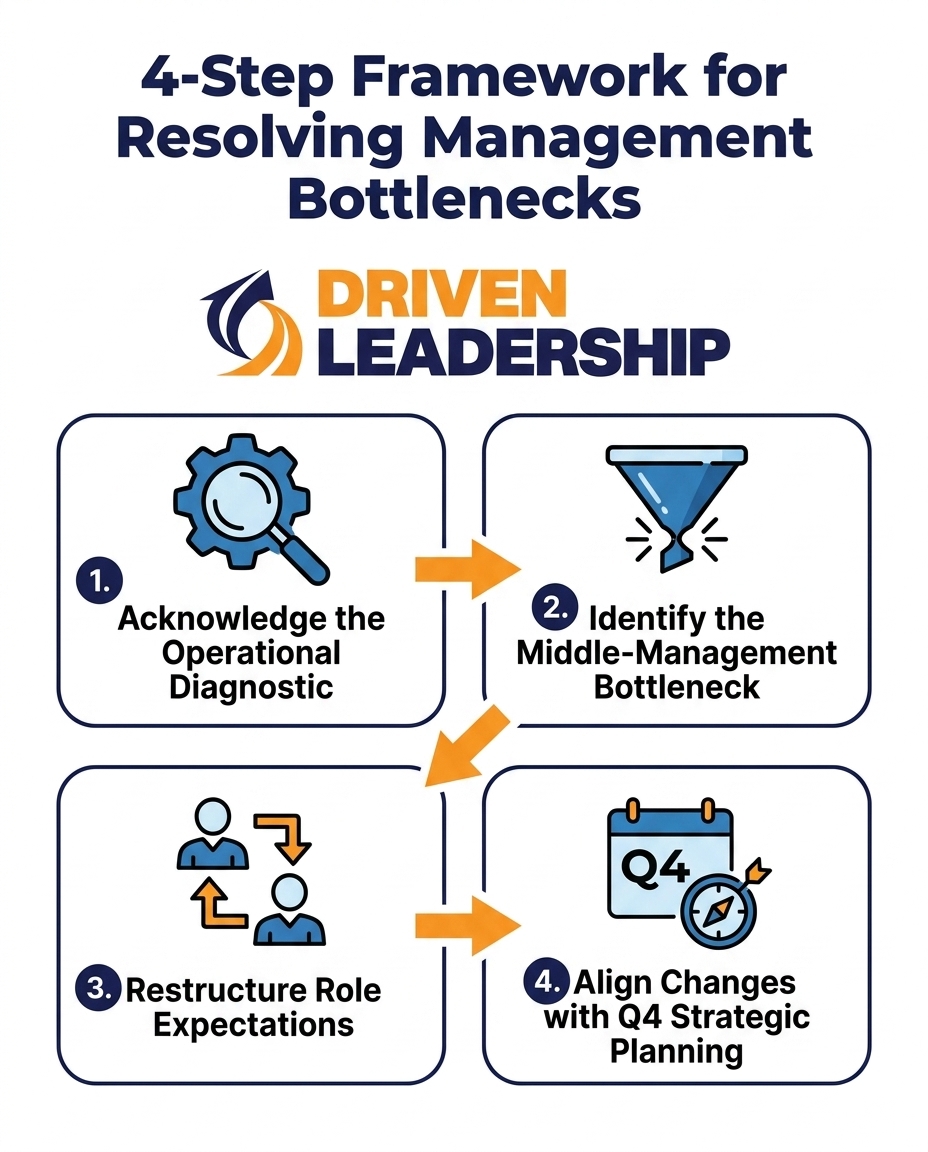
A 4-Step Framework for Founders: Fixing Structural Flaws
When a leadership initiative exposes deep cracks in your organizational foundation, you need a methodical approach to repair them. Much like the rapidly shifting, overcast early fall weather typical of the Pacific Northwest, the sudden realization of deep structural flaws requires immediate navigation and preparation. You cannot simply wait for the turbulence to pass; you must actively steer the company toward stability. We recommend this 4-step framework to our clients to address the operational fallout and ensure your team is ready for the upcoming Q4 strategic planning transition.
1. Acknowledge the Operational Diagnostic
The first step is to accept the training outcomes as objective, highly valuable data. It is crucial to remove personal blame from the equation. Your managers are likely doing the best they can within a flawed system. Acknowledge that the current structure is no longer serving the company's goals. By focusing on structural realities rather than individual shortcomings, you set a professional, solution-oriented tone for the entire restructuring process. This neutral acknowledgment prevents defensiveness and opens the door for honest conversations about operational capacity.
2. Identify the Middle-Management Bottleneck
Once you have accepted the data, you must pinpoint exactly where communication and execution are stalling. Map out your current workflows and identify the specific points where decisions are delayed or information is lost. Assess your current management capabilities against the actual requirements of their roles. Are you asking a highly skilled technician to perform as a strategic manager without providing the right support? Identifying the exact location and cause of the bottleneck is essential for crafting a targeted, effective solution.
3. Restructure Role Expectations
With the bottlenecks identified, it is time to redefine job descriptions to align with the company's actual needs. This often means clarifying who holds the final decision-making authority for specific processes. Implement new, transparent accountability metrics for your management tier. When expectations are clear and measurable, managers are much more likely to step up and take ownership. Ensure that every leader understands exactly what success looks like in their newly defined role, and provide them with the resources necessary to achieve those metrics.
4. Align Changes with Q4 Strategic Planning
Timing is everything when implementing structural changes. Use the upcoming Q4 strategic planning transition to roll out these updates. Aligning your restructuring efforts with the end-of-year fiscal transition allows you to set fresh goals and expectations simultaneously. This ensures that the next year starts with a fully aligned management tier, ready to execute your vision without the drag of legacy bottlenecks. Swift, methodical action in September prevents the exposed flaws from causing critical failures during your most important quarter.
Restructuring Roles Without Losing Company Momentum
One of the biggest fears we hear from founders confronting a founder-to-middle-management bottleneck is that restructuring will cause daily operations to grind to a halt. However, it is entirely possible to execute necessary changes and realign expectations while keeping the company moving forward. The key is implementing intentional change management strategies that minimize disruption and prioritize transparent communication.
Building a strong foundation of communication during transitions is non-negotiable. Your team needs to understand why changes are happening and how those changes will ultimately benefit their daily work lives. When leaders are kept in the dark, rumors spread, and momentum dies. By clearly articulating the new structural vision, you replace anxiety with a shared sense of purpose. Implementing robust operating systems can effectively bridge the gap between a founder's high-level vision and middle management's daily execution. If you are struggling to create this bridge, focusing on EOS implementation can provide the structured discipline your team needs to thrive during a transition.
Equipping managers with the right educational tools to succeed in their newly defined roles is equally critical. You cannot simply change a job title and expect immediate results. For example, one participant who sought to elevate their growth and leadership skills during a recent course described the experience as life-changing. By taking the newly acquired tools and sharing them directly with their teams and family, they successfully elevated their entire department's performance without stalling daily operations. Providing ongoing support ensures that your restructuring efforts lead to sustainable, long-term momentum.
Leveraging the Q4 Strategic Planning Transition
As early fall approaches here in Puyallup, the window to address operational diagnostics begins to close. We consistently advise our clients that September presents the optimal time to tackle these structural issues head-on, leveraging the Q4 strategic planning transition to your advantage. If you wait too long, the unresolved bottlenecks from Q3 will inevitably compound during the high-pressure end-of-year push, leading to missed targets and exhausted teams.
The Q4 strategic planning transition is the critical deadline for resolving exposed structural flaws. During this time, companies are naturally evaluating past performance and setting goals for the upcoming fiscal year. By aligning your structural fixes with this natural transition period, you ensure a clean slate for the new year. It is much easier to introduce new role expectations and accountability metrics when they are tied directly to the upcoming year's strategic objectives. This approach makes the changes feel like a natural evolution rather than an abrupt, disruptive overhaul.
Founders must act decisively to lock in their new management expectations before holiday-season distractions take over. Once November and December arrive, bandwidth shrinks, and implementing major structural changes becomes nearly impossible. By utilizing the early fall months to clear out bottlenecks, you position your leadership team to enter the new year with absolute clarity, deep alignment, and the operational capacity required to hit your most ambitious growth targets.
Sustaining Operational Clarity Post-Training
As we often remind the leaders we train, fixing a founder-to-middle-management bottleneck is not a one-time event; it requires ongoing maintenance and a commitment to continuous improvement. Once you have restructured roles and aligned your team, you must put systems in place to sustain that operational clarity long after the initial training program has concluded. Without deliberate effort, companies easily slip back into old, comfortable habits that recreate the very bottlenecks you just worked so hard to eliminate.
Continuous challenge is vital for leadership growth. You must consistently challenge your leaders to take full ownership of their roles and decisions. This means resisting the urge to step in and solve problems for them when things get difficult. By holding them accountable to their new metrics, you reinforce the structural changes and build their confidence. When leaders know they are trusted to execute, they are far more likely to take proactive initiative and drive the company forward.
Ongoing trust and cooperation exercises are incredibly beneficial for maintaining a resilient management structure. As new challenges arise and the market shifts, your team must be able to rely on one another without hesitation. Regular, structured exercises keep communication channels open and prevent departments from becoming siloed. To keep your team sharp and aligned, incorporating BOLD training exercises into your regular quarterly rhythms can help sustain the momentum you have built. Ultimately, sustaining this clarity achieves both profound personal development for your leaders and massive organizational growth for your business.
Frequently Asked Questions About Leadership and Operational Structure
What happens when a leadership development program exposes organizational flaws?
When a program exposes flaws, it acts as a powerful diagnostic tool that highlights exactly where your company's hierarchy is failing. Instead of just teaching soft skills, intensive training stress-tests your management tier, revealing a founder-to-middle-management bottleneck if one exists. Founders must then use this objective data to restructure role expectations and improve internal processes. Ultimately, this exposure is a positive event that allows a business to fix hidden issues before they cause critical operational failures.
Why do leadership development programs fail?
Leadership development programs typically fail when they focus solely on surface-level motivation rather than addressing deep structural realities. If a program does not challenge participants or expose operational friction, leaders return to the same broken systems without the tools to fix them. Programs also fail when founders do not support the training with actual changes to the company's operating systems. Sustainable success requires both individual skill development and a supportive organizational structure.
How do founders fix middle-management bottlenecks?
Founders fix middle-management bottlenecks by first acknowledging the operational diagnostic data without assigning personal blame. The next step is to pinpoint exactly where communication and decision-making are stalling within the hierarchy. Founders must then restructure role expectations, clearly defining accountability metrics and decision-making authority for each manager. Finally, equipping the management team with robust operating systems ensures they can execute the founder's vision independently.
How do you identify organizational bottlenecks?
You identify organizational bottlenecks by looking for persistent symptoms such as delayed decision-making, constant firefighting, and poor cross-departmental communication. A major indicator is when a founder is continually pulled into minor, daily operational issues instead of focusing on high-level strategy. Intensive leadership training often accelerates this discovery by forcing leaders out of their routines and highlighting who struggles to adapt. Tracking workflow delays and communication breakdowns will pinpoint the exact location of the bottleneck.
What is the role of middle management in organizational structure?
The primary role of middle management is to bridge the gap between a founder's strategic vision and the frontline team's daily execution. They are responsible for translating high-level goals into actionable, measurable steps for their departments. Effective middle managers handle routine decision-making, facilitate cross-departmental communication, and resolve operational friction independently. When they perform well, they completely eliminate the founder-to-middle-management bottleneck, allowing the executive team to focus on scaling the business.
Why is leadership training a good diagnostic tool for businesses?
Leadership training is an excellent diagnostic tool because it removes leaders from their standard daily routines and places them in high-pressure, challenging environments. This shift quickly reveals a team's true communication styles, problem-solving abilities, and capacity to handle stress. It provides objective data on who is ready to take ownership and who is heavily reliant on the founder for direction. Using training as a diagnostic tool allows businesses to identify and address structural weaknesses proactively.
How do you fix a broken management structure before Q4?
To fix a broken management structure before Q4, you must act swiftly during the early fall months to redefine role expectations and accountability metrics. Use the upcoming Q4 strategic planning transition as a natural deadline to roll out these structural updates. By aligning the new management expectations with the upcoming fiscal year's goals, you create a seamless transition. Locking in these changes before the holiday season ensures your team enters the new year fully aligned and ready to execute.
Take Decisive Action on Your Operational Diagnostic Today
Discovering that your company suffers from a founder-to-middle-management bottleneck can be daunting, but it is ultimately a massive opportunity for growth. Uncovering these hidden structural flaws through intensive training is a diagnostic victory, not a defeat. It provides you with the exact objective clarity needed to rebuild a resilient, highly capable executive team.
With the Q4 strategic planning transition rapidly approaching, now is the time to take decisive action. Do not let the insights gained from your leadership initiatives go to waste by returning to comfortable, broken systems. Consult with our structural experts at Driven Leadership, redefine your role expectations, and implement the necessary operating systems today. By addressing these bottlenecks head-on, you will ensure your leadership team is fully equipped to handle whatever challenges the next fiscal year brings.
