
How to Plan a Leadership Development Retreat for Your Team

Why Planning a Leadership Development Retreat for Your Team is Critical
If your executive team is struggling with constant misalignment and unspoken conflict, learning how to plan a leadership development retreat for your team in California, Washington, or Nashville, Tennessee is the best way to get everyone back on the same page. Many mid-level managers and business owners feel completely overwhelmed when team communication breaks down and company growth stalls out. It is easy to watch high performers disengage while critical projects stall within thirty days of launch. A custom leadership development retreat in California, Washington, or Nashville, Tennessee helps you step away from daily firefighting so you can rebuild trust, establish psychological safety, and align on strategic goals.
Ready to transform your company culture? Explore our Driven Leadership Off-Site Retreats and schedule a strategy call with our team today.
Quick Steps to Plan a High-Impact Retreat:
• Define 90-Day Outcomes: Focus on the behavioral changes and strategic alignment you must see three months after the event.
• Pick the Right Venue: Choose a distraction-free location 60 to 90 minutes from the office to allow for deep reflection.
• Use the 70/30 Rule: Balance your agenda with 70% focused strategy work and 30% relationship building and rest.
• Hire an External Facilitator: Bring in a neutral expert so you can step out of leader mode and participate fully.
• Maintain Post-Retreat Momentum: Schedule 30, 90, and 180-day follow-ups to track commitments and progress.
In 2026, building authentic trust and alignment is more critical than ever. Too many organizations make the mistake of treating these offsites like dry, presentation-heavy conferences. To get real results, you must understand the impact of leadership development training as an active intervention rather than a passive event. True alignment happens when your leaders have the space to speak honestly, solve real business challenges, and connect as human beings.
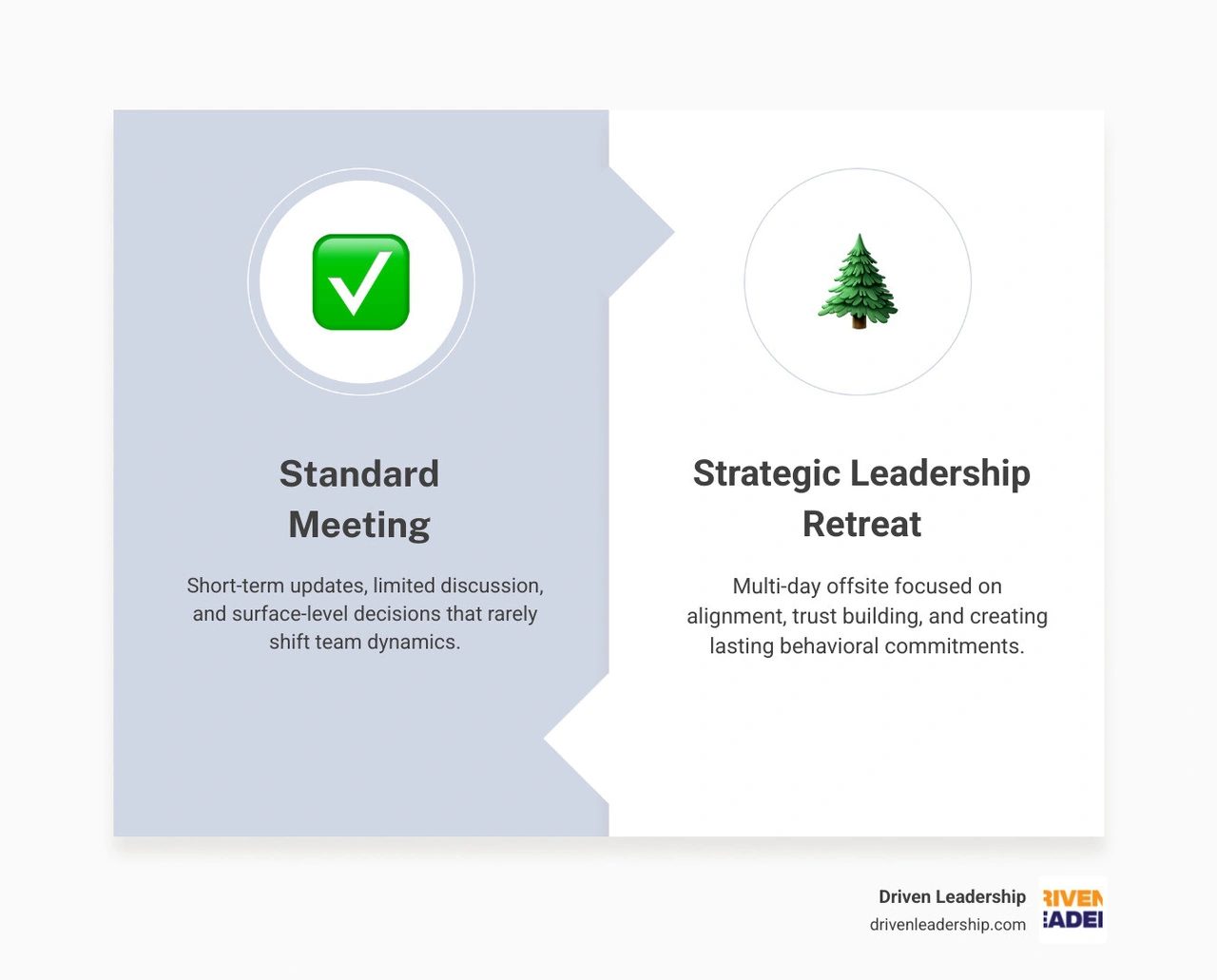
Why a Leadership Retreat is a Strategic Intervention (Not Just a Meeting)
A common mistake business owners and HR teams make is treating a leadership retreat as an extended, slightly fancier staff meeting. If your retreat consists of sitting in a windowless room for eight hours while looking at slide decks, you are running a conference, not a retreat.
A leadership retreat is a strategic intervention. It is designed to disrupt daily operational habits, break down functional silos, and reset team dynamics. This is incredibly important when you consider the data: 3 out of every 4 companies believe that leadership could be improved, and 50% of employees cite bad leadership and poor management as one of the main reasons for leaving a job.
When executive teams are misaligned, the consequences ripple down through the entire organization, resulting in dropped balls, low morale, and stagnant growth. Conversely, the business case for alignment is undeniable: companies with aligned leadership teams are 2.5 times more likely to outperform their peers on revenue growth.
Taking the time to step away pays dividends for your team's mental well-being too. Research shows that 34% of team members say that having executive retreats positively affects their mental health, noting that they had their best, most innovative ideas after stepping out of the office.
By prioritizing this dedicated time, you show your team that leadership development makes a difference in how the company operates. Retreats offer a rare opportunity to transition from "performance mode"—where leaders feel pressured to always have the right answers—to a collaborative, growth-oriented space where they can solve real organizational challenges together.
The Strategic Blueprint: How to Plan a Leadership Development Retreat for Your Team
To pull off a seamless, high-impact retreat, you cannot rely on last-minute planning. Successful corporate leadership development requires a structured, multi-month timeline that aligns key stakeholders long before anyone packs a bag.
Here is a realistic planning timeline to keep your team on track:
• 6 to 9 Months Before: Define the primary objectives, interview key executives to uncover friction points, and draft a formal Retreat Charter.
• 5 to 6 Months Before: Select and book a distraction-free venue, establish a realistic budget, and secure your external facilitator.
• 3 to 4 Months Before: Design the detailed agenda, map out session formats, and select experiential activities.
• 2 Months Before: Manage logistics, coordinate travel, collect dietary and accessibility needs, and send out initial calendar hold updates.
• 10 to 14 Days Before: Distribute curated pre-reading materials, strategic financials, and individual reflection prompts to set expectations.
• During the Retreat: Execute the program, protect transition buffers, document commitments, and maintain high engagement.
• Post-Retreat: Synthesize notes within 48 hours, integrate commitments into your operational framework, and execute 30, 90, and 180-day follow-ups.
Phase 1: Aligning Objectives on How to Plan a Leadership Development Retreat for Your Team
Before looking at locations or choosing team activities, you must determine why you are gathering. If you skip this step, you risk planning a beautiful event that fails to deliver a measurable return on investment.
To establish clear objectives, we recommend conducting individual diagnostic interviews with your key leadership stakeholders 6 to 9 months in advance. Ask open-ended, honest questions to uncover hidden friction points:
1. What three to five strategic decisions must we make before the next fiscal year?
2. Where is our executive team currently misaligned or struggling to agree?
3. Which key business initiatives have stalled, and why?
4. What critical conversations have we been actively avoiding in our weekly meetings?
Once you have gathered this feedback, summarize the findings into a one-page Retreat Charter. This document outlines the retreat's core purpose, primary strategic goals, and clear success criteria. Clarifying these expectations early ensures that your leadership development training directly addresses the real-world operational challenges your business is facing.
Phase 2: Logistics and Venue Selection for How to Plan a Leadership Development Retreat for Your Team
The physical environment of your retreat plays a massive role in your team's ability to think creatively and interact authentically. If you host your retreat at your regular office or a hotel right down the street, it is too easy for leaders to slip back to their desks to handle "urgent" daily tasks.
For the best results, book an off-site venue that is located 60 to 90 minutes away from your primary office. This distance is the sweet spot: it is far enough to create a psychological separation from daily routines, but close enough to avoid travel fatigue and complex flight logistics.
When planning a retreat in our core regions—such as California (including SoCal), Washington, or Nashville, Tennessee—look for venues that offer:
• Abundant Natural Light: Avoid dark, basement-style hotel conference rooms. Natural light keeps energy levels high and prevents afternoon fatigue.
• Dedicated Breakout Spaces: Ensure the venue has comfortable indoor and outdoor breakout areas where small groups can collaborate.
• Reliable Technology and Wi-Fi: You need seamless AV setups and fast internet for strategic sessions, but you should also set expectations for "tech-free" periods during collaborative exercises.
• Access to Nature: Venues with walking paths, outdoor seating, or natural backdrops provide a proven 25% boost in creative problem-solving.
Designing the Agenda: Balancing Strategy, Team Development, and Rest
A common pitfall is overpacking the schedule. A retreat crammed with back-to-back presentations from 8:00 AM to 6:00 PM will leave your team exhausted, not inspired. To design an agenda that works, we use the 70/30 Rule: allocate 70% of the schedule to focused, strategic work, and reserve 30% for relationship building, physical wellness, and unstructured rest.
We also recommend structured session design with a 40% Plenary / 60% Application split. This means you limit passive listening (presentations) to less than half of your session times, dedicating the remaining 60% to hands-on application, debate, and collaborative problem-solving.
To build deep psychological safety, structure your agenda around the Trust Loop:
When leaders take a vulnerable leap (sharing a real challenge or admitting a mistake) and receive a respectful, supportive response from their peers, it builds a solid foundation of mutual respect. This allows your team to tackle tough strategic questions without fear of judgment.
To make the most of your retreat, it is also important to understand the difference between simple team bonding and deep team development:
• Primary Goal — Team Building (Bonding): Short-term morale boost and fun connection — Team Development: Long-term behavioral change and alignment
• Focus Area — Team Building (Bonding): Shared social experiences (e.g., bowling, golf) — Team Development: Self-awareness, communication, and trust
• Facilitation — Team Building (Bonding): Self-guided or activity-led — Team Development: Managed by a certified external facilitator
• Business Impact — Team Building (Bonding): Temporary energy and social familiarity — Team Development: Measurable improvements in execution and collaboration
To support your managers in developing these skills, incorporate targeted exercises from leadership training for managers. You can also run focused onsite workshops to practice new communication techniques in real-time.

Overcoming Common Pitfalls in Executive Retreat Planning
Even with a beautiful venue and a solid agenda, small planning mistakes can derail your retreat's impact. Here are the most common pitfalls we see, and how you can avoid them:
• Overloading the Agenda: Trying to solve every single company problem in two days is a recipe for burnout. Limit your retreat to two or three primary strategic objectives. Teams that focus on too many priorities experience a 25% lower satisfaction rate and rarely follow through on their commitments.
• Treating the Retreat as a "One-and-Done" Event: The true value of a retreat is won or lost after the event ends. If you do not have a clear follow-up plan, your team's post-retreat inspiration will evaporate within two weeks.
• Ignoring Psychological Safety: If your leaders do not feel safe sharing their real opinions, they will default to polite, surface-level conversations. You must establish clear ground rules regarding confidentiality and active participation on Day 1.
• Allowing Constant Distractions: Laptops and buzzing phones kill group focus. Encourage your team to leave their devices in their rooms during key collaborative sessions, planning dedicated "tech breaks" throughout the day instead.
To address these challenges directly, consider incorporating leadership development coaching that addresses communication gaps. This helps your leaders identify and resolve unspoken tensions in a constructive, supportive environment.
Frequently Asked Questions about Leadership Retreats
What is the primary purpose of a leadership retreat?
The primary purpose of a leadership retreat is to build deep strategic alignment, establish psychological safety, and develop authentic leadership skills. Unlike standard weekly status meetings, a retreat is designed to step away from daily operations so your team can focus on long-term organizational health. Many organizations utilize an executive leadership program framework during their retreats to ensure their senior leaders are aligned on company values and long-term strategic goals.
How do you measure the success of a leadership retreat?
Success is measured by the concrete behavioral changes and strategic alignment that happen after the retreat concludes. Before leaving the venue, your team must document clear commitments and assign ownership to specific action items. True ROI is determined by assessing progress at 30, 90, and 180-day milestones to ensure these commitments are actively improving daily operations. Utilizing professional role of leadership development and coaching support helps establish these accountability loops and keeps your team on track.
Should we hire an external facilitator for our retreat?
Yes. Approximately 70% to 80% of successful executive retreats utilize an external facilitator. When a business owner or internal HR leader tries to facilitate, they are forced to manage the room's energy, watch the clock, and direct the conversation. This makes it incredibly difficult for them to participate honestly. An external facilitator brings neutral authority, manages complex group dynamics, and asks the tough questions that internal employees might avoid. This allows your entire executive team to participate equally and focus fully on leadership development and coaching.
Conclusion
Planning a high-impact leadership retreat requires careful preparation, clear strategic goals, and a commitment to maintaining momentum long after the event ends. By stepping away from the daily grind and focusing on team development, you can build a highly aligned executive team that is ready to drive consistent business performance and revenue growth.
At Driven Leadership, we specialize in helping organizations design and execute custom off-site retreats that deliver lasting behavioral change. Whether you are looking to integrate EOS (Entrepreneurial Operating System) principles, run immersive management workshops, or resolve deep communication gaps, our experienced facilitators are here to guide your team in California, Washington, SoCal, and Nashville, TN.
Ready to plan a retreat that delivers real, measurable results? Discover how we can help you build a stronger, more aligned team by exploring our Off-Site Retreats with Driven Leadership today.