Bold Leadership vs Safe Management: Knowing When to Take the Risk

The Myth of Perpetual Stability: Why Playing It Safe Stalls Growth
A common misconception in business is that minimizing operational friction automatically protects your company's trajectory, but mastering Bold Leadership vs Safe Management: Knowing When to Take the Risk reveals that safety is often your biggest liability. If you are leading a team through the late summer Q3 to Q4 transition, you might assume that keeping things steady is the best way to secure the gains you made earlier in the year. You protect your existing workflows, avoid rocking the boat, and focus purely on administration. But avoiding risk does not prevent failure—it simply guarantees stagnation.
True business growth requires recognizing the critical decision point where you must choose between maintaining the administrative status quo and actively disrupting your own operations. When a company hits a plateau, the natural instinct is to tighten controls and manage the decline. However, a defensive posture rarely inspires a team to push through seasonal slumps or market challenges. To force new growth, you have to recognize that playing it safe is no longer a viable strategy. If you want to explore structured ways to break out of this cycle, our leadership trainings provide the exact frameworks needed to transition from a cautious manager to a dynamic leader.
The Illusion of the Status Quo
Many executives fall into the trap of believing that if a system is not actively breaking down, it is working perfectly. The reality is far different: optimizing existing processes eventually yields diminishing returns. You can only streamline a mediocre workflow so much before you hit a hard ceiling on your output and profitability.
There are hidden costs to avoiding necessary operational friction. When you refuse to challenge your team or dismantle outdated procedures, you inadvertently signal that compliance is more valuable than innovation. Employees stop bringing forward new ideas because they know those ideas will be met with administrative resistance. Over time, this illusion of stability erodes your competitive edge, leaving your organization highly vulnerable to competitors who are willing to take the calculated risks you avoid.
Diagnosing the Q3 Plateau: When Safe Management Becomes a Liability
The Problem: By the time August rolls around, the initial yearly momentum that carried your team through the first two quarters has often faded. You begin to notice plateaued quarterly growth KPIs, but instead of treating this as a symptom of a larger cultural issue, you might mistakenly attribute it to market conditions or a slow season.
The Cause: This stagnation usually stems from an over-reliance on safe management. Safe management is an essential baseline—it ensures payroll is met, schedules are kept, and basic compliance is maintained. However, it turns toxic when it becomes the only operational mode your leadership team utilizes. An administrator protects what already exists; a driven leader forces new growth by asking uncomfortable questions and pushing the team beyond their current capacity.
The Solution: To break the plateau, you must shift your mindset from preservation to calculated disruption. You have to actively look for the areas in your business that have become too comfortable and introduce new, challenging milestones that force your team to elevate their performance.
Reading the Signs of Stagnation
Analyzing plateaued quarterly growth KPIs requires you to look beyond the spreadsheet and examine the daily behaviors of your workforce. Are your people driving the mission forward, or are they merely executing tasks? Here are the most common signs that your management style has become a liability:
• Meetings are purely informational: Your team gathers to share status updates rather than debating ideas, solving complex problems, or making strategic decisions.
• Zero operational friction: Everyone agrees too quickly. A lack of healthy, professional conflict usually means people have stopped caring enough to fight for better outcomes.
• Incremental goal setting: Your targets for the upcoming quarter are only marginally higher than the last, reflecting a desire to hit easy metrics rather than stretch the organization's capabilities.
• High compliance, low initiative: Employees do exactly what they are told, but no one steps up to volunteer for new projects or take ownership of unexpected challenges.
Environmental Lethargy and the Need for Artificial Momentum
Business cycles do not exist in a vacuum; they are deeply influenced by the physical environment and the natural rhythms of the calendar year. In regions like the Pacific Northwest, the onset of long, overcast seasons natively drains team energy. The transition from bright, active summers into extended periods of gray weather often triggers a psychological slump across the workforce. If you rely solely on passive management during these long transition periods, that environmental lethargy will quickly settle into your company culture.
This is precisely why leaders must artificially inject momentum when natural enthusiasm wanes. You cannot wait for the weather to improve or for the market to magically energize your staff. You have to manufacture urgency. Disrupting daily routines, changing up meeting structures, and setting aggressive, short-term targets are all highly effective ways to re-engage a disconnected workforce. If you are struggling to execute these shifts, focusing on team execution can help you build the operational muscle required to drive results regardless of the season.
Combating the Seasonal Slump
There is a direct correlation between environmental shifts and decreased workplace initiative. When the environment naturally encourages a retreat into comfort, your leadership must provide the counter-force. Breaking the cycle of low-energy compliance requires intentional, visible action from the executive team.
Strategies to inject energy:
• Restructure the physical or virtual environment: Change where and how your team meets to physically break them out of their passive routines.
• Introduce short-sprint projects: Replace long, dragging quarterly goals with intense, two-week initiatives that require immediate focus and collaboration.
• Celebrate micro-wins loudly: When natural energy is low, public recognition of small victories provides the dopamine hit your team needs to keep pushing forward.
• Model high energy: As a leader, your personal energy sets the baseline. You must consistently demonstrate the drive and enthusiasm you expect from your staff.
Bold Leadership vs Safe Management: A Side-by-Side Comparison
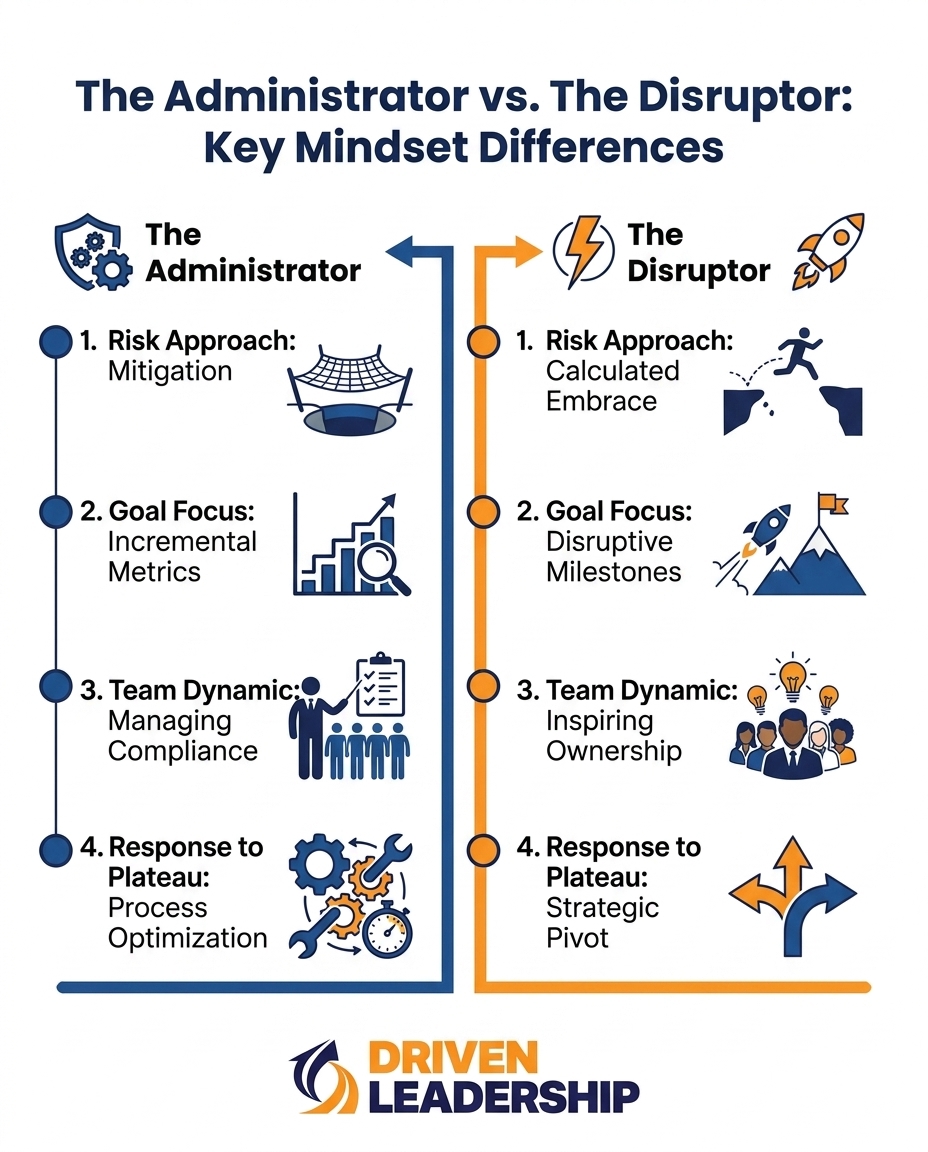
To accurately diagnose your current approach, you need a clear framework that separates administrative maintenance from true leadership. The table below outlines the stark differences between a safe management mindset and a bold leadership mindset. Understanding these distinctions is the first step toward transforming your organizational culture. If you want to see how these principles are applied in real-world scenarios, exploring BOLD training exercises that build trust can provide actionable insights.
• Risk Tolerance — Safe Management (The Administrator): Focuses entirely on mitigation and avoiding failure at all costs. — Bold Leadership (The Disruptor): Embraces calculated risk as a necessary vehicle for rapid growth.
• Goal Setting — Safe Management (The Administrator): Aims for incremental, predictable improvements based on past data. — Bold Leadership (The Disruptor): Sets disruptive milestones that force the team to build new capabilities.
• Team Engagement — Safe Management (The Administrator): Manages compliance, ensuring everyone follows established rules. — Bold Leadership (The Disruptor): Inspires deep ownership, encouraging the team to solve problems independently.
• Conflict Resolution — Safe Management (The Administrator): Avoids friction to maintain a superficial sense of workplace peace. — Bold Leadership (The Disruptor): Utilizes healthy friction to uncover better ideas and forge stronger alignment.
• Response to Plateaus — Safe Management (The Administrator): Attempts to optimize existing, broken processes to squeeze out minor gains. — Bold Leadership (The Disruptor): Executes a strategic pivot, dismantling outdated workflows to build better ones.
The Mechanics of Calculated Disruption
There is a massive difference between reckless gambling and calculated, strategic disruption. Reckless risk-taking ignores data, alienates the team, and puts the company's survival in jeopardy. Calculated disruption, on the other hand, is a highly structured process. It involves intentionally breaking down specific, underperforming areas of your business while fiercely protecting your core revenue drivers.
To transition from a safe mindset to a bold one, you need a formalized framework. The proprietary BOLD methodology provides exactly this structure, giving executives the tools to actively disrupt the status quo safely and effectively. One executive we worked with last spring realized they were relying too heavily on safe routines and needed to step out of their comfort zone to reach their full potential. By participating in the BOLD leadership program, they transformed their approach, ultimately becoming a much stronger leader and a highly effective risk-taker for their organization.
Evaluating the Risk-to-Reward Ratio
Before you dismantle a functional but stagnant process, you must accurately measure the potential upside. This requires a systematic approach to evaluating risk.
1. Isolate the bottleneck: Identify the specific workflow, meeting, or policy that is currently capping your team's output. Do not attempt to change everything at once.
2. Define the worst-case scenario: Ask yourself what actually happens if the new approach fails. Often, the worst-case scenario is simply returning to the current, stagnant baseline.
3. Establish a safety net: Formalize disruption structures. Give your team explicit permission to try the new method for a set period, knowing that failure will not result in punishment.
4. Model the behavior: You must step out of your own executive comfort zone first. When your team sees you taking calculated risks and owning the outcomes, they will feel empowered to do the same.
5. Treat failure as data: Create a culture where calculated failures are debriefed objectively. Extract the lessons, adjust the strategy, and deploy the next iteration quickly.
Building the Courage to Pivot Your Strategy
The transition from an administrator to a disruptor is rarely easy. It requires overcoming significant psychological barriers. There is a natural, deeply ingrained hesitation to pursue aggressive challenges when your current systems seem to "work fine." Human nature craves predictability, and as a leader, the pressure to maintain a steady ship can be overwhelming. However, "working fine" is the enemy of excellence.
Overcoming these debilitating professional roadblocks almost always requires external support and fresh perspectives. You cannot read the label from inside the jar. Another professional we worked with over the summer had spent years dreaming about tackling bigger challenges but felt paralyzed by the fear of destabilizing their department. After attending an immersive training experience, they gained the courage and confidence necessary to tackle new challenges head-on, creating lasting results. The transition to bold leadership is an active, ongoing practice, not a one-time decision. When you commit to this path, the lasting impact on both your career trajectory and your company's growth is profound. If you are ready to make this shift, an advanced leadership program can provide the environment needed to break through your internal barriers.
Overcoming the Administrator's Mindset
The first step in building courage is identifying the internal narratives that justify your excessive caution. We often tell ourselves that we are being "responsible" or "prudent" when, in reality, we are simply afraid of the friction that comes with change.
Reframing the narrative:
• Acknowledge the fear: Recognize that feeling hesitant about disrupting a working system is a normal psychological response, not a permanent limitation.
• Calculate the cost of inaction: Shift your focus from what you might lose by changing to what you are definitely losing by staying the same.
• Seek external accountability: Surround yourself with other driven leaders who will challenge your assumptions and refuse to let you settle for mediocrity.
• Reframe disruption: View operational disruption not as a chaotic event, but as a necessary, highly controlled tool for long-term survival and market dominance.
Frequently Asked Questions About Risk and Leadership
What is the difference between leadership and management?
The short answer is that management focuses on maintaining existing systems, while leadership focuses on driving change and growth. Managers ensure that tasks are completed efficiently, compliance is met, and schedules are followed. Leaders, however, challenge the status quo, inspire their teams to take ownership, and set visionary goals that force the organization to evolve beyond its current capabilities.
What is bold leadership?
Bold leadership is the active practice of making calculated, disruptive decisions to force organizational growth, even when it feels uncomfortable. It involves stepping out of the executive comfort zone, embracing healthy friction, and prioritizing long-term market dominance over short-term administrative peace. A bold leader is willing to dismantle a "good enough" process to build a truly exceptional one.
When does safe management become a liability?
Safe management becomes a liability the moment it transitions from a necessary operational baseline into the company's only mode of operating. If you notice plateaued growth metrics, a lack of team initiative, and meetings that consist only of passive updates, your safety-first approach is actively suffocating innovation. At this point, avoiding risk guarantees long-term decline.
How do leaders take calculated risks for Q4 growth?
Leaders take calculated risks by identifying specific, stagnant workflows and intentionally disrupting them while protecting core revenue drivers. They set aggressive, short-term milestones, artificially inject energy into the team during seasonal slumps, and create an environment where minor, controlled failures are treated as valuable data rather than punishable offenses.
How do you balance risk and safety in business?
You balance risk and safety by using structured frameworks to evaluate the potential upside of any disruption against its worst-case scenario. Safety should be applied to compliance, payroll, and core deliverables, while risk should be aggressively applied to strategy, process improvement, and market expansion. The goal is never to gamble recklessly, but to push boundaries within a secure, formalized structure.
Take the Next Step Toward Disruptive Growth
To break out of a seasonal growth plateau, you must be willing to shift from administrative risk-mitigation to active, calculated disruption. Maintaining the status quo may feel comfortable, but it ultimately starves your organization of the momentum needed to thrive in competitive markets. By distinguishing between the cautious habits of an administrator and the dynamic mindset of a disruptor, you can begin to make the hard, necessary decisions that drive real progress. We encourage you to evaluate your current approach, challenge your internal narratives, and seek out structured programs designed to develop your bold leadership capabilities. Embracing this clear framework for distinguishing between necessary administrative risk-mitigation and bold, disruptive leadership is exactly what will satisfy your drive for lasting company growth.