
Run to the Roar: Confronting the Reality of a Failing Business Partnership

The Silent Killer of Shared Visions
When you realize your business partnership is failing, the only way to save the organization is to run to the roar—confronting the friction directly instead of avoiding it. Two co-founders who once shared a unified dream often wake up years later to find their long-term business visions and daily operational values no longer align. One partner might want aggressive, rapid scaling, while the other prefers a stable, risk-averse lifestyle business. This divergence rarely happens overnight. It is a slow, quiet drift that eventually creates a toxic bottleneck for the company's growth and the team's morale.
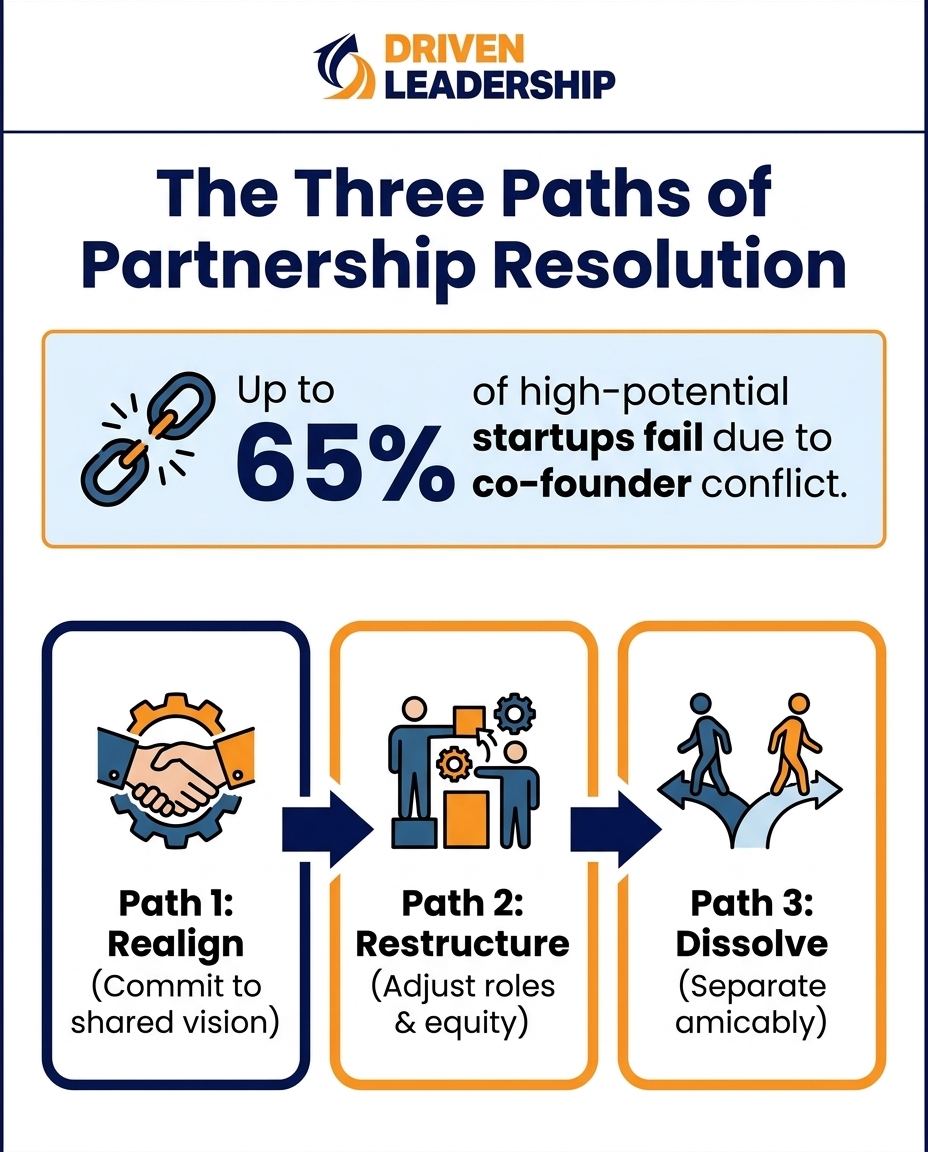
The statistics behind this dynamic are startling. According to Harvard Business Review data, up to 65% of high-potential startups fail due to co-founder conflict. The failure isn't usually caused by a sudden, dramatic blowout; it is caused by the silence that precedes it. When leaders stop communicating honestly, the business begins to bleed. You reach a critical decision point: continue hiding behind busywork while the foundation crumbles, or address the misalignment head-on.
Signs your shared vision is fracturing:
• Strategic paralysis: Major decisions regarding hiring, spending, or expansion are repeatedly delayed because neither partner wants to trigger an argument.
• Siloed operations: You and your partner begin managing entirely separate halves of the business without consulting one another, effectively running two different companies under one roof.
• Value drift: Daily operational choices reflect entirely different core values, confusing employees about what the company actually stands for.
• Meeting avoidance: One-on-one leadership meetings are frequently canceled, rescheduled, or kept strictly to superficial updates.
Understanding foundational leadership development principles is the first step toward recognizing these symptoms. The longer founders wait to address the growing divide, the more entrenched the dysfunction becomes. Acknowledging the problem is not an admission of defeat; it is the necessary first step in protecting the organization you have worked so hard to build.
How Conflict Avoidance Creates a Toxic Bottleneck
Avoiding necessary conflict does not preserve a partnership. It actively destroys the business from the inside out. Many leaders mistakenly believe that by keeping the peace and ignoring interpersonal friction, they are protecting the company. In reality, unresolved leadership conflict directly correlates to decreased employee morale, operational bottlenecks, and stalled company growth. When the top tier of leadership is misaligned, the entire organizational structure suffers the consequences.
A typical pattern we see is reflected in a spring scenario where a management team and their associates noticed a distinct lack of confidence, taking charge, and effective communication in executive meetings. The hidden friction between leaders had bred visible uncertainty among the staff. It wasn't until the leadership participated in immersive training to learn active listening and confidence-building techniques that they were able to demonstrate greater initiative and a more driven attitude. This shift had a massive positive impact on both their work environment and their family lives.
Honest confrontation is a protective measure. By tackling the friction, you are prioritizing the health of the company culture over the temporary comfort of avoidance. If you are struggling with this dynamic, focusing on building trust and cooperation can help bridge the communication gap before the bottleneck becomes permanent.
The Ripple Effect on Team Morale
Employees take their cues from the top. They are highly perceptive and can easily detect when founders are at odds, even if the arguments happen behind closed doors. This hidden friction breeds visible uncertainty throughout the ranks.
The downstream impact of leadership avoidance:
• Paralyzed middle management: Stalled decision-making at the founder level forces managers to guess which direction to take, often resulting in conflicting instructions.
• Loss of top talent: High performers quickly lose faith in an organization that lacks a clear, unified direction, prompting them to seek stability elsewhere.
• Eroded accountability: When founders avoid holding each other accountable for poor performance or bad behavior, it becomes impossible to enforce standards for the rest of the team.
Why the Early Fall Transition Forces Misalignment to the Surface
Timing plays a significant role in when partnership friction reaches its breaking point. The early fall / Q4 transition (when end-of-year strategic planning typically forces misaligned visions to the surface) is a notorious catalyst for conflict. During the summer, it is often easier to hide behind vacations, flexible schedules, and the general hum of daily operations. But as September arrives and organizations pivot toward the upcoming year, the demand for concrete goal-setting removes the ability to hide.
Much like navigating the Pacific Northwest overcast and rainy seasons, where leaders must steer through literal fog and storms to find their way, guiding a company through Q4 planning requires navigating limited visibility and heavy turbulence. The process of budgeting, establishing hiring projections, and setting revenue targets demands absolute clarity. If one partner envisions a conservative year of consolidation while the other plans for aggressive market expansion, the resulting collision is inevitable.
Why Q4 planning exposes the cracks:
• Budget Allocation — What It Requires: Agreement on where capital yields the best return. — How Misalignment Manifests: Fights over marketing spend vs. operational reserves.
• Hiring Goals — What It Requires: Consensus on organizational structure and capacity. — How Misalignment Manifests: Refusal to approve new headcount, stalling growth.
• Market Strategy — What It Requires: A shared definition of the target customer. — How Misalignment Manifests: Confused messaging and disjointed sales efforts.
• Exit Planning — What It Requires: Honesty about long-term personal timelines. — How Misalignment Manifests: One partner secretly preparing to sell while the other builds.
This seasonal friction should not be viewed as a disaster. Instead, view it as a necessary catalyst for finding clarity. The pressure of the early fall transition forces the conversations that have been delayed for months, providing a structured environment to finally address the underlying issues.
The Courage to 'Run to the Roar' in Business
The concept of "running to the roar" originates from the behavior of lions in the wild. When hunting, the older, weaker lions are positioned on one side of the prey, while the younger, stronger lionesses wait in ambush on the opposite side. The old lions let out a terrifying roar. The prey's natural instinct is to run away from the sound—straight into the trap. The only way the prey survives is to do the counterintuitive thing: run directly toward the roar.
In business, the roar is the uncomfortable confrontation you have been avoiding. The psychological barrier of conflict avoidance is powerful, but stepping into the discomfort is a strategic imperative. Confronting reality directly, rather than relying on passive mediation or hoping the problem resolves itself, is the core of taking BOLD action. This proactive approach distinguishes effective leaders from those who merely manage the status quo.
Consider a summer scenario where a professional realized they needed to gain the courage and confidence to tackle mounting personal and career challenges. By attending an immersive BOLD leadership training program, they experienced significant changes in their approach to friction, ultimately gaining the courage to pursue their goals directly. Stepping into the discomfort increases overall leadership confidence and positively impacts every facet of your career.
How to build the courage for confrontation:
• Acknowledge the cost of inaction: Calculate the actual financial and cultural cost of continuing to avoid the conversation.
• Separate the person from the problem: Frame the confrontation around the business's needs, not personal grievances.
• Prepare without over-scripting: Know your key points and desired outcomes, but remain open to genuine dialogue.
• Embrace the discomfort: Accept that the conversation will be tense, and commit to staying in the room until clarity is achieved.
Replacing Emotion with Structured Operating Systems
Courage alone isn't enough to fix a failing partnership. Founders need an objective language to discuss their business foundation, removing the sting of personal attacks from the conversation. When emotions run high, every critique feels like an insult. Implementing a clear, structured framework transforms subjective arguments into objective data reviews.
This need for structure was evident in a spring 2020 scenario where two partners decided to build a new business together. They recognized early on that they needed to build a strong foundation as leaders and great communicators to survive the pressures of a startup. By participating in advanced leadership and management programs, they gained the educational tools necessary to develop into effective communicators, allowing them to build the business together successfully.
One of the most effective ways to replace emotion with structure is through EOS implementation. An Entrepreneurial Operating System provides a shared vocabulary and a rigid meeting cadence that forces issues to the surface in a healthy, productive way.
Benefits of a structured operating system:
• Data-driven decisions: Arguments over "who works harder" are replaced by reviews of measurable scorecards and KPIs.
• Clear accountability: The accountability chart eliminates confusion over who owns which processes, stopping the overlap that causes friction.
• Structured tension: Weekly tactical meetings provide a designated space to raise and resolve issues before they fester into resentment.
When navigated correctly, this structured tension actually forges great leaders. It allows co-founders who want to work hand-in-hand to rebuild their foundational communication without relying on guesswork or emotional appeals.
Realign, Restructure, or Amicably Dissolve
Once you have run to the roar and initiated the difficult conversation, you need a clear path forward. A successful confrontation will ultimately lead to one of three actionable outcomes. The goal is not necessarily to save the partnership at all costs, but to find the healthiest resolution for the organization.
1. Realign: This path involves using conflict resolution techniques to get back on the same page and recommit to a shared vision. It requires both partners to acknowledge their role in the drift and agree to new terms of engagement. Realignment is possible when the core values are still intact, but the operational execution has strayed. It often requires adopting a new operating system or committing to ongoing leadership development to ensure the old habits do not return.
2. Restructure: Sometimes, the friction is caused by partners occupying the wrong seats on the bus. Restructuring involves adjusting roles, equity, or operational duties to better fit the current reality of each partner's strengths. For example, a visionary founder who is terrible at daily management might step out of the CEO role and become the head of product development, allowing a more operationally minded partner to take the helm. This path requires checking egos at the door and making decisions based purely on what the company needs to thrive.
3. Dissolve: Recognizing when the partnership has run its course is a form of leadership in itself. If the visions are fundamentally incompatible, taking steps to separate amicably without destroying the company is the best outcome. This might involve a buyout, a structured exit plan over several months, or selling the business entirely. The key is to manage the dissolution professionally, protecting the team, the clients, and the financial health of the organization during the transition.
Frequently Asked Questions About Partnership Conflict
What does it mean to run to the roar in leadership?
Running to the roar means moving directly toward the source of your fear or discomfort rather than avoiding it. In leadership, it is the counterintuitive instinct to confront difficult conversations, toxic dynamics, or operational failures head-on. By addressing the "roar" immediately, leaders prevent small frictions from destroying the organization.
What are the early signs of a failing business partnership?
Early signs include avoiding one-on-one meetings, making siloed decisions without consulting each other, and experiencing a drift in core values. You may also notice strategic paralysis, where major choices regarding hiring or budgeting are continually delayed to prevent an argument. These quiet symptoms often precede major operational breakdowns.
How do you tell a business partner the current dynamic is not working?
You must approach the conversation with objective data rather than emotional accusations. Frame the discussion around the health of the business and the specific bottlenecks the dynamic is creating. Using a structured framework helps keep the focus on solving the organizational problem rather than attacking personal character.
How can co-founders resolve deep vision misalignment?
Resolving deep misalignment requires a dedicated, structured planning session, often facilitated by an external framework like an Entrepreneurial Operating System. Co-founders must honestly evaluate whether their end goals can be reconciled. If they cannot, the partnership must be restructured or amicably dissolved to protect the company.
Can a broken business partnership be fixed without mediation?
Yes, but it requires an immense amount of self-awareness, discipline, and a willingness to embrace structured tension. Founders must be capable of separating their egos from the business's needs. Implementing rigid operational frameworks and communication scorecards can often replace the need for passive third-party mediation.
Why is Q4 strategic planning a common time for partnership conflict?
Q4 strategic planning forces leaders to set concrete goals for budgets, hiring, and market expansion. This process removes the ability to hide behind daily busywork. When partners are forced to put their long-term visions on paper, any underlying misalignment in values or strategy is immediately exposed.
Take the First Step Toward Clarity
Confronting a failing partnership is the only way to protect the future of your business. Ignoring the friction will not make it disappear; it will only deepen the divide, stall your growth, and fracture your team's morale. The decision to run to the roar is difficult, but it is the defining characteristic of a resilient leader.
If you are struggling to initiate these high-stakes conversations, seeking structured training can provide the tools you need. Exploring options like TKI conflict training offers a clear, actionable framework for navigating the tension. By building the necessary skills to address the reality of your partnership, you can determine whether to realign, restructure, or dissolve—ensuring the organization you built continues to move forward.
