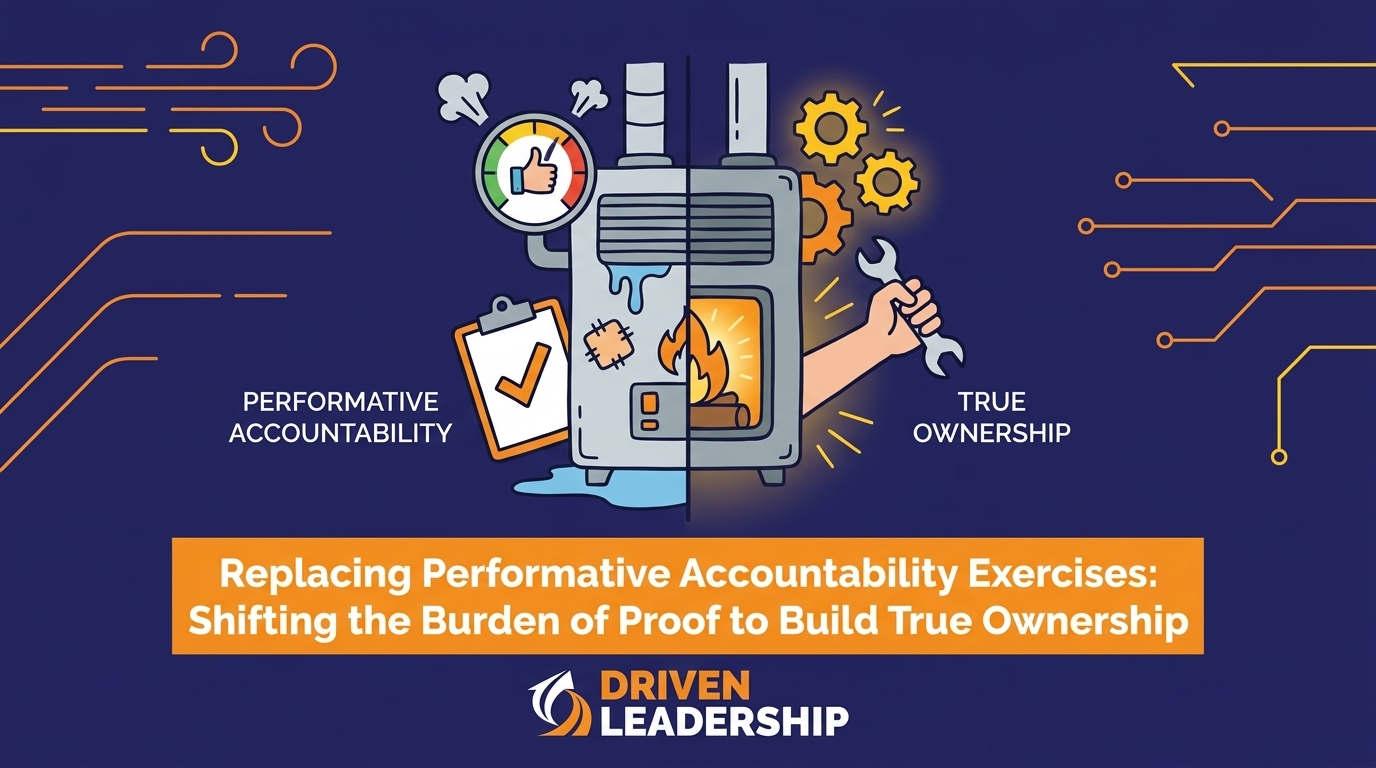
Replacing Performative Accountability Exercises with True Ownership

Are Your Team Check-Ins Creating Ownership or Just Exhaustion?
Are you spending more time dragging status updates out of your team than actually strategizing for the future? Replacing performative accountability exercises with true ownership is often the missing link between a struggling group and a self-sufficient, high-performing team. A typical pattern we see is leaders who are completely exhausted by check-ins that feel like they are constantly chasing employees for answers. If you are tired of playing detective, the solution lies in a fundamental structural shift: moving the burden of proof from the manager to the employee. When the individual is responsible for proving their progress, the entire dynamic of your meetings changes.
When you prioritize leadership development, you can replace these exhausting routines with systems that foster genuine autonomy.
The Hidden Trap of Performative Accountability Exercises
The problem: Many leaders search for answers on how to hold employees accountable without micromanaging, only to end up implementing systems that make the problem worse. Performative accountability occurs when employees simply say what the boss wants to hear during a check-in without taking actual responsibility for the outcome. They show up, report on their tasks, and wait for the next set of instructions. This creates an illusion of progress, but it lacks the intrinsic drive required to overcome real obstacles.
The Root Cause of Meeting Exhaustion
The cause: Traditional KPI tracking and standard status updates often place the entire administrative burden on the manager. In this flawed dynamic, the leader has to ask the questions, dig for the data, identify the roadblocks, and suggest the solutions. The employee merely reacts. This degrades into micromanagement because the manager is forced to control the process to ensure results. The psychological impact is twofold: employees who feel micromanaged disengage and stop thinking critically, while managers burn out from constantly playing detective. It is a structural flaw in the check-in dynamic, not necessarily a character flaw in your team.
Restoring Autonomy Through Better Structure
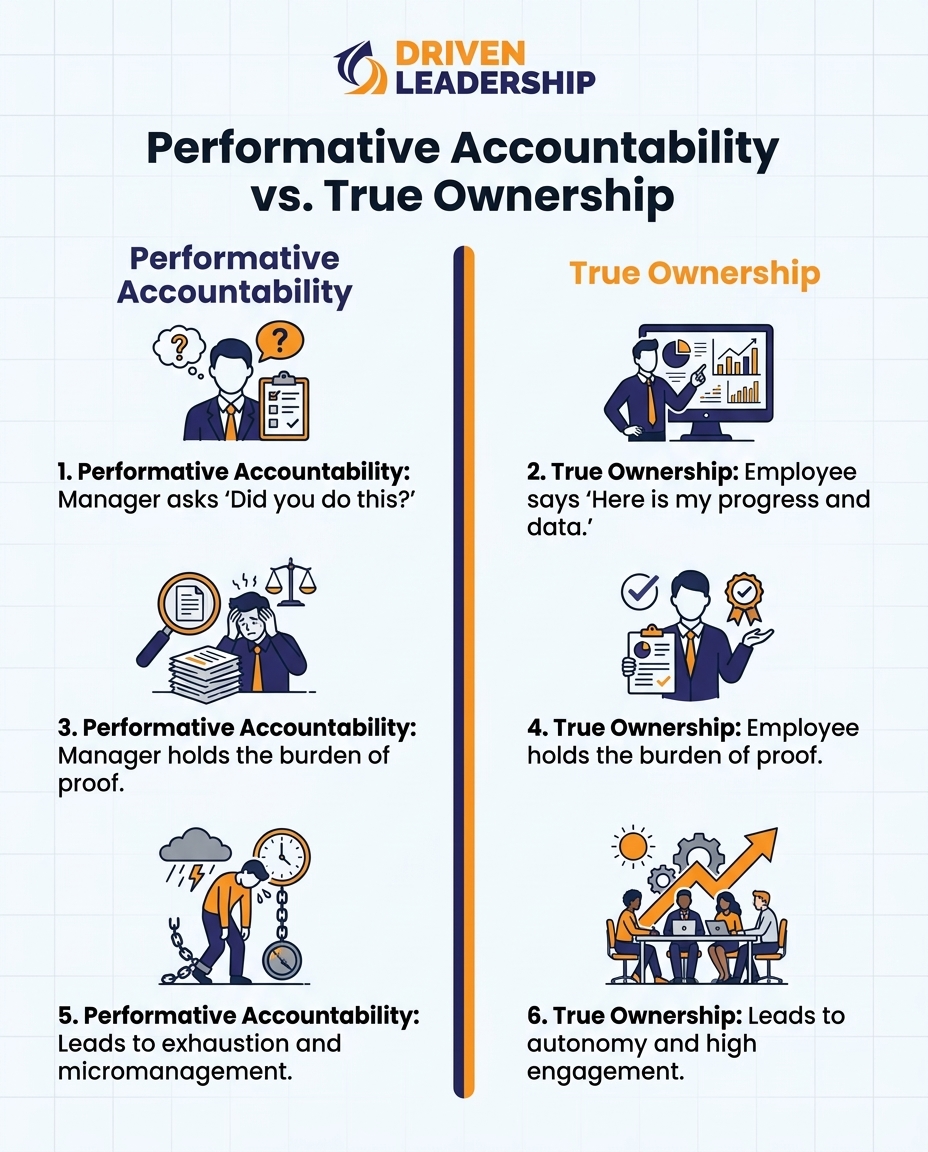
The solution: To break this cycle, you have to fundamentally change what happens before the meeting even starts. The goal is to move away from a culture of compliance and toward a culture of commitment. When you implement effective team execution strategies, you stop asking "did you do this?" and start expecting your team to arrive with the data already prepared. This shifts the focus from task completion to outcome achievement, freeing you to act as a coach rather than an interrogator.
Shifting the Burden of Proof: A Structural Leadership Change
The "burden of proof" concept is a profound shift in organizational behavior. Instead of the manager digging for updates, the employee must arrive at the meeting ready to prove their progress. They own the data, they own the narrative, and they own the results. This simple structural change forces individuals to step out of their comfort zones, challenge themselves, and become the best version of themselves.
How the Elevate Framework Changes the Dynamic
Leveraging the Elevate framework principles helps shift this burden entirely to the employee, freeing the manager from micromanagement. By establishing clear expectations and giving the employee the tools to measure their own success, you remove the need for constant oversight. The framework empowers the individual to identify their own performance gaps and propose solutions before the leader even has to ask. This builds a robust foundation of trust.
We see the impact of this foundational shift frequently. In one instance last spring, leaders of a new business realized they needed to build a stronger foundation as communicators and managers. By engaging in the BOLD: Advanced Leadership program and a 12-week virtual Leadership For Managers course, they gained the exact tools and techniques needed to shift this dynamic. They learned how to listen effectively and empower their teams, fundamentally changing how their new organization operated.
Comparing the Two Approaches
• Agenda Setting — Manager-Led (Performative): Manager creates the list of topics to cover. — Employee-Led (True Ownership): Employee sets the agenda based on their goals.
• Data Gathering — Manager-Led (Performative): Manager pulls reports to check on the employee. — Employee-Led (True Ownership): Employee brings their own metrics to prove progress.
• Problem Solving — Manager-Led (Performative): Manager identifies roadblocks and dictates fixes. — Employee-Led (True Ownership): Employee highlights challenges and proposes solutions.
• Follow-Up — Manager-Led (Performative): Manager chases the employee for the next update. — Employee-Led (True Ownership): Employee schedules the next milestone check-in.
Designing an Employee-Led Accountability Action Plan
To make the burden of proof a reality, you need a structured approach. An accountability action plan is a roadmap that the employee owns and manages. Implementing this is especially critical during periods like the early fall Q4 performance push, when execution must be flawless and managers do not have the bandwidth to micromanage.
1. Step 1: The employee defines the success metrics and timeline.
Instead of handing down a list of tasks, work with the individual to define what success looks like. The employee must articulate the specific, measurable outcomes they intend to achieve and the deadlines they will commit to. This creates immediate psychological ownership because they wrote the rules of their own success.
2. Step 2: The employee schedules the milestone check-ins.
The administrative task of putting meetings on the calendar should fall to the person doing the work. The employee determines how often they need to report back to prove they are on track. If they are falling behind, it is their responsibility to schedule an earlier intervention.
3. Step 3: The employee presents data and proposes solutions.
When the meeting begins, the leader's job is to listen. The employee presents their progress against the metrics they defined. If there is a roadblock, the employee must present at least one viable solution before asking for help. This eliminates the habit of dumping problems on the manager's desk.
4. Step 4: The manager validates and coaches.
With the burden of proof satisfied, the leader can finally do their actual job: coaching. You can provide feedback on their proposed solutions, offer resources, and help them refine their strategy.
Structured programs, like the Engage Elevate Program, can help teams learn these proactive habits and transition smoothly into this new way of working.
Sustaining Team Ownership During Seasonal Energy Dips
Forced, manager-led accountability is exhausting to maintain year-round. It relies entirely on the leader's energy output to keep the momentum going. When the leader's energy dips, the team's productivity plummets. This is why intrinsic motivation is vital for long-term success.
Navigating the Fall Transition
Seasonal transitions heavily impact focus and morale. In the Pacific Northwest, the transition into darker, rainier fall months naturally impacts team energy. External motivation becomes incredibly difficult to sustain when the weather turns gloomy and fatigue sets in. If your accountability system requires you to constantly push your team forward, you will all burn out before the year ends.
An employee-led system is vastly more resilient during these critical periods, such as the early fall Q4 performance push. Because the system does not rely solely on the manager's energy, progress continues even when morale takes a natural dip. True ownership means the team pushes forward and honors their commitments even when conditions are less than ideal. They are driven by their own internal standards, not by the fear of a manager's reprimand.
The Real-World Impact of Proactive Initiative
When you successfully shift from performative reporting to proactive ownership, the observable changes in your team are profound. Employees who once sat passively in meetings, waiting to be called upon, suddenly step up as active contributors. This shift increases individual confidence and drastically improves overall team communication.
Building Confidence Through Ownership
Another common pattern is the individual who hesitates to take charge. One spring, a professional struggling with a lack of confidence and poor communication in meetings participated in immersive BOLD: Advanced Leadership training. By learning to communicate effectively and taking ownership of their own growth, they experienced increased confidence, began taking charge more often, and vastly improved their communication in both meetings and their personal life. When people are trusted to carry the burden of proof, they rise to the occasion.
Freeing Up Leadership Bandwidth
Eliminating performative exercises does more than just help the individual; it transforms the company. When you are no longer spending hours each week chasing down status updates, your bandwidth opens up. You can finally dedicate time to higher-level strategic planning, forecasting, and organizational development. Individual growth directly fuels broader structural improvements, turning a group of task-doers into a cohesive, forward-thinking organization.
Frequently Asked Questions About True Team Ownership
If you are wondering how team accountability exercises actually work in practice, review these common questions about navigating the transition to an employee-led culture.
How do you hold employees accountable without micromanaging?
The most effective way to avoid micromanaging is to shift the burden of proof to the employee. Instead of dictating their every move, you focus entirely on the final outcomes.
• Require the employee to bring the data and progress updates to you.
• Focus on the results rather than dictating step-by-step methods.
• Act as a coach who removes roadblocks rather than a detective who looks for flaws.
• Set clear expectations up front so the employee knows exactly what they need to prove.
What is an accountability action plan?
An accountability action plan is a structured agreement where the employee outlines their goals, metrics, and check-in cadence. It serves as a roadmap that the employee owns and manages from start to finish.
• It replaces vague promises with concrete, trackable milestones.
• The employee writes the plan, ensuring they have psychological ownership of the details.
• It clearly defines what success looks like and how it will be measured.
• It establishes a timeline for when the employee will report back with their proof of progress.
How do you shift from accountability to ownership?
Accountability is often seen as external (what happens if I fail), while ownership is internal (I am responsible for the success). You foster ownership by giving employees autonomy over how they achieve the agreed-upon results.
• Celebrate proactive problem-solving rather than just basic task completion.
• Allow employees to fail safely and learn from their mistakes without immediate punishment.
• Encourage them to connect their daily tasks to the broader mission of the company.
• Stop providing immediate answers; ask them what they think the best course of action is.
What are good accountability exercises for teams?
Good accountability exercises force the team to look inward and take responsibility for their collective outcomes, rather than looking to the leader for direction.
• Peer-to-peer review sessions where team members present their progress to each other, not just the boss.
• "Start, Stop, Continue" evaluations led entirely by the team members.
• Pre-mortem meetings where the team identifies potential failures before a project starts and takes proactive responsibility for mitigating them.
• Cross-departmental presentations where teams must prove their value to other sectors of the business.
How does the 'burden of proof' change a performance review?
When the burden of proof shifts, the performance review turns from a backward-looking critique into a forward-looking strategy session. The dynamic is completely inverted.
• The employee presents their achievements and areas for growth first, leading the conversation.
• The manager acts as a validator and a resource rather than an interrogator.
• The discussion focuses on how the leader can support the employee's future goals.
• It eliminates the element of surprise, as the employee has been tracking their own data all year.
What happens when an employee pushes back on leading their own updates?
It is incredibly common for employees to push back when you first stop telling them what to do. Acknowledge that this is a growing pain when shifting away from performative check-ins.
• Hold firm on the expectation and do not revert to doing the work for them.
• Provide coaching on exactly how to structure their updates so they feel supported.
• Explain the "why" behind the change—that this is about empowering them, not punishing them.
• Be patient, as it takes time to break the habit of passive reporting.
Transform Your Performance Reviews from Check-Ins to Strategy Sessions
True ownership eliminates the exhaustion of micromanagement and transforms how your business operates. When you stop dragging updates out of your team, you create space for genuine innovation and growth. Shifting the burden of proof is the single most effective way to change the dynamic of your check-ins, moving your team away from performative accountability exercises and toward real, self-driven results.
Take the next step in your leadership journey: If you are ready to develop an autonomous, high-performing team, it is time to change the structure of your meetings. Consult with our experts today to learn how a practical application of the "burden of proof" can revolutionize your check-in dynamic and empower your employees to lead their own updates.