
Beginner's Guide to Transformational Leadership Styles

Why Understanding Transformational Leadership Can Change the Way You Lead
What transformational leadership is and how it is different comes down to one core idea: instead of managing people through rewards and rules, you inspire them to care deeply about a shared goal and grow in the process.
Here is a quick breakdown:
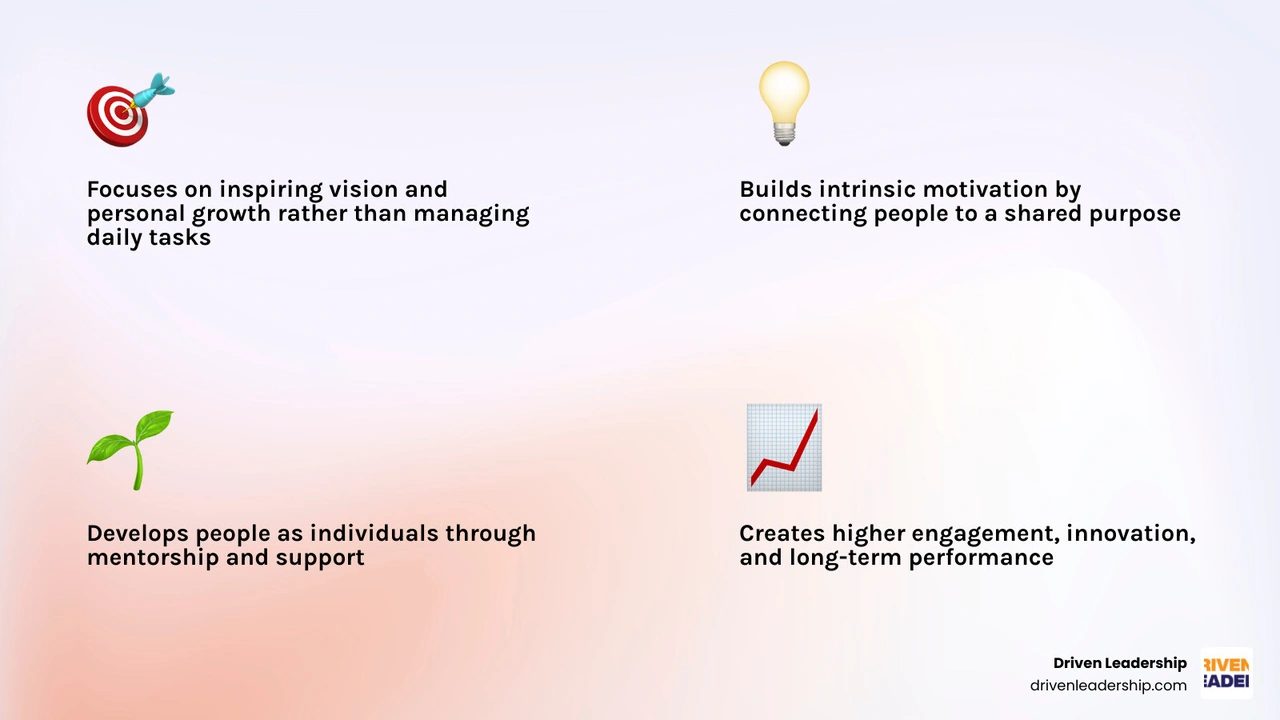
• Core focus — Transformational Leadership: Inspiring people through vision and personal growth
• Motivation type — Transformational Leadership: Intrinsic — people are driven by purpose, not just pay
• Leader's role — Transformational Leadership: Mentor, role model, and visionary
• Key outcome — Transformational Leadership: Higher engagement, innovation, and long-term performance
• How it differs — Transformational Leadership: Focuses on changing mindsets, not just managing behavior
If your team feels disconnected, communication keeps breaking down, or growth has stalled, the problem may not be your strategy — it may be your leadership approach.
Most managers default to what feels familiar: set expectations, reward results, correct mistakes. That is transactional leadership, and it has its place. But it rarely builds the kind of trust, creativity, or commitment that moves organizations forward.
Transformational leadership does something different. It connects people to a bigger purpose, treats them as individuals worth developing, and builds cultures where great work happens naturally — not just when someone is watching.
This guide breaks down exactly what transformational leadership means, how it compares to other styles, and how you can start developing it as a practical skill.
What Is Transformational Leadership and How Is It Different?

To truly grasp the power of this style, we have to look at how it entered the modern business landscape. The term was first coined in 1973 by sociologist James V. Downton. However, it was leadership expert and historian James MacGregor Burns who popularized the concept in 1978, defining it as a process where leaders and followers raise one another to higher levels of morality and motivation.
In 1985, researcher Bernard M. Bass expanded on Burns’s ideas to create what we now call Bass’s Transformational Leadership Theory. Bass wanted to know how this looked in everyday business settings. He integrated these behaviors into the "full range leadership model," which positions leadership along a spectrum—from passive laissez-faire approaches to active, highly structured transactional management, and finally to the peak of leadership: transformational behaviors.
At Driven Leadership, we teach that Elevating Leadership: The Key to Unlocking Organizational Potential requires moving past basic oversight and actively reshaping how teams think and collaborate. It is not about wielding authority; it is about cultivating a self-sustaining ecosystem of shared accountability.
Defining What Is Transformational Leadership and How Is It Different
At its core, what is transformational leadership and how is it different is defined by its target: the human heart and mind. Traditional management styles target external behaviors—they want to make sure a checklist gets completed on time. Transformational leadership, on the other hand, targets intrinsic motivation.
Instead of asking, "How do I get this person to do their job?" a transformational leader asks, "How do I help this person realize their own potential while achieving our shared vision?"
This approach relies heavily on creating a compelling, shared vision of the future. When a team understands why their work matters on a grander scale, they are no longer just putting in hours; they are actively driving organizational change. By tapping into human potential, transformational leaders build a culture where employees feel valued, heard, and trusted. To explore how to craft this kind of direction for your team, take a look at our guide on The Power of Visionary Leadership: Crafting and Communicating a Compelling Vision.
The Four I's of Transformational Leadership
Bernard Bass organized transformational leadership into four distinct, interconnected pillars. We call these the "Four I's," and they function best when practiced together:
1. Idealized Influence (Role Modeling): Transformational leaders do not operate on a "do as I say, not as I do" basis. They lead with high ethical standards, transparency, and personal accountability. Because they walk the talk, they earn the trust, respect, and admiration of their team.
2. Inspirational Motivation (Shared Vision): These leaders communicate a clear, compelling vision that makes the daily grind feel meaningful. They use optimism, enthusiasm, and direct communication to build team spirit and align individual goals with organizational objectives.
3. Intellectual Stimulation (Creative Freedom): If you want innovation, you have to let your team challenge the status quo. Transformational leaders encourage critical thinking, welcome contrasting perspectives, and view failure not as a punishable offense, but as valuable data for learning.
4. Individualized Consideration (Coaching and Empathy): No two team members are exactly alike. Transformational leaders practice active listening and deep empathy, treating each person as an individual with unique strengths, developmental needs, and career goals. They act as mentors, offering personalized support rather than a one-size-fits-all management style.
Comparing Transformational Leadership to Other Styles
To understand what is transformational leadership and how is it different, it helps to see it side-by-side with other common management frameworks.
• Transformational — Primary Motivation: Intrinsic (Purpose & Growth) — Time Horizon: Long-term — Handling of Failure: Learning opportunity & data — Relationship with Rules: Bends/rewrites rules to innovate
• Transactional — Primary Motivation: Extrinsic (Contingent Rewards) — Time Horizon: Short-term — Handling of Failure: Predetermined consequences — Relationship with Rules: Strictly adheres to established rules
• Democratic — Primary Motivation: Shared Decision-Making — Time Horizon: Medium-term — Handling of Failure: Collaborative problem-solving — Relationship with Rules: Values group consensus on rules
• Laissez-Faire — Primary Motivation: Autonomy (Hands-off) — Time Horizon: Short-term — Handling of Failure: Left to the team to resolve — Relationship with Rules: Rules are highly flexible or ignored
How Transactional and Transformational Styles Diverge
The contrast between transactional and transformational leadership is one of the most practical comparisons in modern organizational development.
Transactional leadership operates on a system of contingent rewards and management by exception. The leader sets clear performance goals, monitors progress, and intervenes only when things go wrong (management by exception) or when it is time to distribute bonuses (contingent rewards). It is highly reactive and focused on maintaining the status quo.
Consider the difference in real-world business figures. Jack Welch, the legendary former CEO of General Electric, was a master of transactional and tactical execution. He set strict metrics, rewarded top performers, and systematically let go of underperformers. It was highly effective for short-term financial performance.
In contrast, Satya Nadella of Microsoft took a transformational approach. When he took over in 2014, he shifted the company's culture from a competitive, "know-it-all" environment to a collaborative, "learn-it-all" culture centered around growth. He focused on empathy, long-term vision, and personal development, completely revitalizing Microsoft's innovation pipeline.
Transactional leadership asks for compliance; transformational leadership asks for commitment.
What Is Transformational Leadership and How Is It Different from Laissez-Faire and Democratic Styles
People sometimes confuse transformational leadership with democratic or laissez-faire styles because all three offer employees more freedom than authoritarian management. However, the differences in active guidance are profound.
• Laissez-Faire Leadership is a completely hands-off approach. The leader abdicates responsibility, leaving the team to make decisions and solve problems on their own. While this can work with highly self-directed experts, it often leads to a lack of direction, confusion, and low organizational commitment. Transformational leadership is not hands-off; it is highly active. The leader provides a strong guiding vision and individual coaching, ensuring autonomy never turns into abandonment.
• Democratic Leadership focuses heavily on shared decision-making and group consensus. While transformational leaders value input, they do not manage by committee. They hold the ultimate responsibility for steering the ship toward the long-term vision. They delegate responsibilities to empower their team, but they remain actively involved as mentors and guides.
The Impact, Benefits, and Drawbacks of Transformational Leadership
When applied correctly, transformational leadership changes more than just the daily mood of an office—it reshapes business outcomes. However, like any approach, it is not without its challenges. True success requires Resilient Leadership to navigate the complexities of organizational change without burning out your team.
Key Benefits for Modern Organizations
The data supporting the transformational style is clear. Decades of organizational research and meta-analyses show that this approach yields tangible, bottom-line results:
• Boosted Engagement and Retention: Transformational leadership is associated with a 25% increase in employee engagement and a 15% lower employee turnover rate compared to transactional models. When people feel seen as individuals, they stay.
• Elevated Performance: Teams led by transformational leaders achieve 21% higher profitability and 17% higher productivity. Furthermore, employees under this style are 2.5 times more likely to report high job satisfaction and 40% more likely to exceed their performance expectations.
• Rapid Innovation: Organizations with transformational leaders report 30% higher innovation rates. By encouraging intellectual stimulation, these leaders create a safe environment for creative risk-taking.
Potential Drawbacks and Pitfalls
Despite its many benefits, transformational leadership has potential pitfalls that leaders must actively manage:
• Burnout Risk: Because transformational leaders inspire passion and set high expectations, team members can feel pressured to maintain a state of constant, high-energy effort. Without clear boundaries, this can lead to severe exhaustion.
• Charismatic Overdependence: If the entire organization's momentum relies solely on the charismatic vision of a single leader, progress can stall if that leader departs.
• Decision-Making Complexity: Because this style values individualized consideration and feedback, leaders can sometimes get bogged down in consensus-gathering, slowing down critical decisions in times of crisis.
• Cultural Resistance: In highly traditional, rigid, or hierarchical industries, a sudden shift toward transformational methods can meet resistance from team members who prefer clear, transactional boundaries ("just tell me what to do and what I get for doing it").
How to Develop Transformational Leadership Skills
The good news is that transformational leadership is not an innate personality trait. You do not have to be born with a magnetic, larger-than-life personality to practice it. It is a set of behavioral skills that can be learned, practiced, and refined over time.
Developing these skills begins with emotional intelligence (EQ). If you want to connect with what drives your team, you must first understand what drives you. Self-awareness allows you to regulate your emotions, practice active listening, and respond to stressful situations with empathy rather than reactivity.
To dig deeper into how EQ serves as the foundation for this style, check out our resources on how to Unlock Leadership Potential Through Emotional Intelligence and explore our guide on Developing Emotional Intelligence: The Key to Empathetic Leadership.
The Role of Coaching and Continuous Learning
True behavioral change rarely happens overnight from reading a book or attending a single lecture. It requires structured, intentional practice. This is where professional leadership development and mentorship play an essential role.
At Driven Leadership, we focus on delivering measurable, lasting behavioral change through immersive training and workshops. We believe that understanding the Role of Leadership Development and Coaching is vital for any organization looking to scale.
Our programs are specifically designed to bridge the gap between theory and execution. For example, we offer targeted Leadership Development Coaching That Addresses Communication Gaps, helping managers learn how to deliver inspirational messages that actually resonate with diverse teams.
If you are looking to build a structured path for your managers, we recommend Exploring Effective Leadership Coaching Programs that emphasize experiential learning. Underpinning all of this is the personal commitment of the leader to maintain a growth mindset. You can read about this journey in our article on Cultivating a Growth Mindset: Lessons From My Journey as a Lifelong Learner.
Building Trust and Leading by Example
You cannot transform a team that does not trust you. Trust is the currency of transformational leadership. It is built slowly through daily actions, consistent accountability, and ethical decision-making.
To practice idealized influence, you must hold yourself to the exact same standards—if not higher—that you set for your team. When leaders take ownership of their own mistakes, communicate transparently during tough times, and prioritize the team's needs over their own ego, they build an unshakeable foundation of respect. For a deeper look at this process, read our guide on Building and Maintaining Trust: The Foundation of Impactful Leadership.
Frequently Asked Questions about Transformational Leadership
Can a leader be both transformational and transactional?
Yes, and in fact, the most effective leaders are. This is what Bernard Bass described as the Full Range Leadership Model. Transactional leadership provides the clear structure, boundaries, and baseline accountability that a team needs to feel secure. Transformational leadership then layers in the inspiration, vision, and personal development that drives people to exceed their basic goals.
Without transactional baseline structures, transformational leadership can produce plenty of enthusiasm but very few concrete results. Without transformational inspiration, transactional leadership leads to a disengaged team that only does the bare minimum. The key is reading the situational context and balancing both approaches.
What are real-world examples of transformational leaders?
• Steve Jobs (Apple): Challenged conventional wisdom and pushed his engineering teams to think entirely differently about consumer technology, resulting in industry-disrupting innovations like the iPhone.
• Oprah Winfrey (Harpo Productions): Built a massive media empire by leading with deep empathy, authenticity, and a consistent focus on personal growth and empowerment for both her employees and her audience.
• Jeff Bezos (Amazon): Fostered a culture of long-term vision, customer obsession, and relentless intellectual stimulation, encouraging his teams to experiment and fail quickly to build innovations like AWS.
• Reed Hastings (Netflix): Transformed traditional media consumption by building a high-performance culture that gives employees immense freedom and responsibility, challenging the industry's status quo.
How does transformational leadership affect employee burnout?
Because transformational leaders are highly inspiring and push for continuous improvement, there is a risk that employees feel a constant pressure to perform. To prevent burnout, transformational leaders must use their individualized consideration. This means actively listening to team members, recognizing when someone is overworking, encouraging work-life balance, and providing the necessary mental wellness support and resources to keep the team healthy and resilient over the long haul.
Conclusion
Understanding what is transformational leadership and how is it different is the first step toward building a more engaged, innovative, and high-performing organization. True leadership is not about managing tasks; it is about inspiring people to grow, adapt, and work together toward a vision they genuinely care about.
At Driven Leadership, we do not believe in short-term inspiration that fades a week after a seminar. We focus on delivering measurable, lasting behavioral change that transforms how executives and teams show up every single day. Operating across Washington, California, Nashville TN, and SoCal, we provide the immersive training, workshops, and coaching your organization needs to thrive.
Ready to take your team's performance to the next level? Unlock your team's potential with Driven Leadership's management training programs and start building a culture of true transformation today.