Why Sending Your Business Partner to BOLD Training Changes the Company Dynamic

The Hidden Cost of Co-Founder Friction During Strategic Planning
At Driven Leadership, a pattern we see often is that late-summer planning sessions drag on, but the real issue preventing progress isn't the numbers on the spreadsheet—it's the unspoken tension across the table. Understanding why sending your business partner to BOLD training changes the company dynamic begins with recognizing that operational silos and entrenched resentment cannot be solved with standard boardroom logic. When co-founders fall out of alignment, the entire organization feels the fracture. In our experience, addressing this foundational relationship is the single most critical step a leadership team can take before finalizing year-end goals.
For leaders looking to break the cycle of miscommunication, experiencing BOLD training together provides the shared framework needed to move forward and reset the organizational compass.
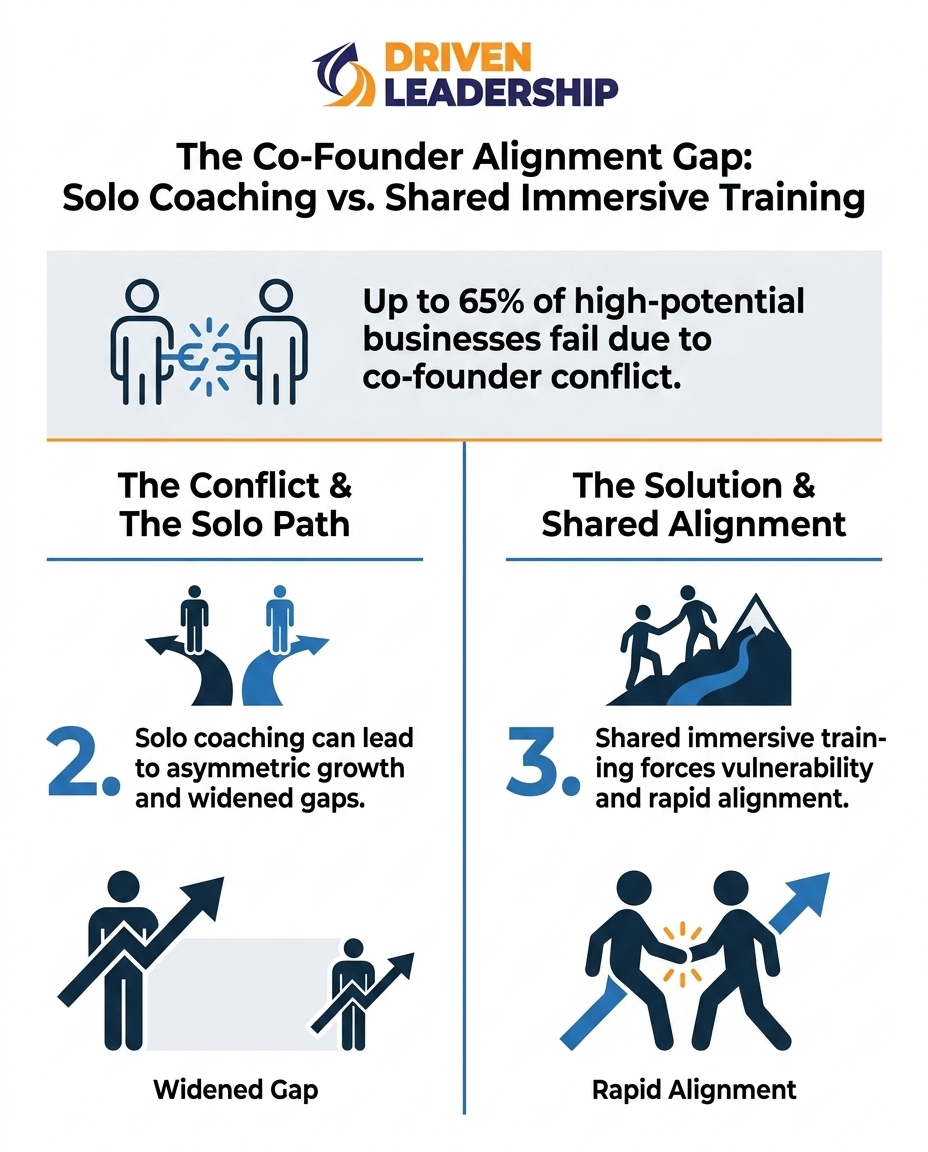
Co-founder relationships are the undisputed bedrock of any company. Yet, according to industry data, up to 65% of high-potential businesses fail due to partnership conflict rather than market forces or financial missteps. This friction rarely presents as shouting matches; instead, it manifests as quiet resentment, passive-aggressive decision-making, and departments that refuse to collaborate. These operational silos often peak during the critical August / Q3 strategic planning period. As the pressure to finalize fourth-quarter execution mounts, the cracks in the foundational partnership become impossible to ignore.
The atmosphere between misaligned partners can be metaphorically compared to the shifting, overcast climates of the Pacific Northwest. A dense "fog" of miscommunication settles over the executive suite, making it impossible to see the business vision clearly. Traditional boardroom meetings, status updates, and weekly check-ins do nothing to clear this weather system. In fact, our team typically observes that sitting across a conference table often reinforces defensive postures.
Common Symptoms of Co-Founder Friction:
• The "Veto" Culture: One partner consistently shoots down the other's initiatives without offering constructive alternatives, leading to organizational paralysis.
• Departmental Tribalism: Employees align themselves with one founder over the other, creating rival factions within the company.
• Avoidance of Crucial Conversations: Important strategic decisions are endlessly delayed because neither partner wants to trigger a confrontation.
• Information Hoarding: Financial data, marketing metrics, or operational realities are kept siloed to maintain control and leverage.
Breaking these entrenched patterns requires a radical departure from the status quo. The decision point for many business owners we work with is realizing that tackling these issues demands a shared, immersive experience rather than separate coaching tracks. To clear the fog, leaders must step out of the environment that created it.
Why Solo Executive Coaching Often Falls Short for Partnerships
When partnership friction reaches a boiling point, the instinct is often to seek outside help. However, a common misstep we see is for partners to pursue individual development independently. While solo executive coaching has immense value for personal growth, it can inadvertently widen the gap between co-founders if they are not evolving together. If you want to repair a fractured dynamic, both leaders need to be operating from the same playbook.
The core problem with separate development paths is the creation of asymmetric growth. When one partner engages in intensive coaching, they adopt new vocabularies, new frameworks for conflict resolution, and new standards for accountability. If the other partner remains stagnant—or is learning an entirely different methodology from a different coach—the original friction is compounded by a language barrier. The evolving partner may feel held back, while the stagnant partner may feel alienated or judged.
Standard classroom theory and traditional personality tests often fail to resolve deep-seated resentment because they remain purely intellectual exercises. Knowing that your partner is an "introverted analytical type" does not alleviate the frustration of a missed product launch. Intellectual understanding does not automatically translate into behavioral change. When co-founders pursue separate paths, they might learn how to manage their own triggers, but they miss the opportunity to rebuild trust with each other in real-time.
To truly reset the dynamic, a shared framework is an absolute necessity. This is exactly why our team at Driven Leadership developed programs like the Advanced Leadership Program, which provides a unified language for navigating conflict and executing strategy.
• Solo Executive Coaching — Impact on Co-Founder Dynamics: Creates asymmetric growth; partners develop different communication frameworks. — Long-Term Organizational Result: Widens the gap; can inadvertently reinforce operational silos as leaders drift further apart.
• Traditional Boardroom Mediation — Impact on Co-Founder Dynamics: Keeps conflict intellectual; focuses on immediate symptoms rather than root causes. — Long-Term Organizational Result: Temporary peace; unresolved resentment inevitably resurfaces during the next high-pressure quarter.
• Shared Immersive Training — Impact on Co-Founder Dynamics: Forces mutual vulnerability; establishes a single, unified operational playbook. — Long-Term Organizational Result: Rapid alignment; breaks down silos and creates a cohesive front that trickles down to all departments.
Separate development paths can inadvertently reinforce the very operational silos they were meant to dismantle. If the CEO is learning one method of strategic delegation while the COO is learning another, their respective departments will quickly fall out of sync. A shared experiential framework ensures that when the pressure mounts, both leaders default to the same established principles, rather than retreating to their individual corners.
The Power of an Immersive, Experiential Crucible
Standard boardroom conflict resolution often relies on passive listening, theoretical white-boarding, and surface-level compromises. In contrast, an immersive, experiential crucible forces authentic vulnerability in a way that typical corporate environments simply cannot replicate. An "experiential crucible" in the context of leadership development is a high-stakes, highly structured environment where leaders are pushed out of their comfort zones, requiring them to rely on each other to overcome tangible challenges.
This hands-on approach is a stark departure from cliché corporate training. Passive listening in a hotel conference room allows participants to keep their defensive walls intact. They can nod along to the curriculum while privately maintaining their resentments. An experiential crucible, rooted in the BOLD training framework, strips away those defenses. By stepping completely outside the standard office environment, co-founders lose the safety nets of their titles, their corner offices, and their established egos.
One leader we worked with at Driven Leadership sought personal and professional development specifically because they needed something far beyond cliché corporate training. By engaging in our experiential process, they were able to challenge their own self-perception, grow significantly, and emerge with a fundamentally altered view of their leadership capabilities. This type of breakthrough is only possible when the environment demands total engagement.
Shared vulnerability acts as a powerful catalyst for breaking down years of unspoken resentment in a matter of days. When business partners are forced to navigate complex, unfamiliar challenges together, they cannot rely on their usual passive-aggressive coping mechanisms. They must communicate directly, ask for help, and trust one another's judgment. This process of building trust and cooperation in an active setting rewires the partnership dynamic far faster than months of weekly mediation sessions.
Moving Beyond Personality Tests
Many organizations attempt to solve co-founder friction by administering personality profiles. While assessments are useful for identifying inherent traits and communication preferences, we frequently remind our clients that they are inherently limited: assessments identify traits, but experiences change behaviors.
Knowing that a partner is naturally risk-averse is helpful information, but it does not bridge the gap when a critical financial decision needs to be made. Shared challenges require active cooperation, proving trust rather than just discussing it theoretically. When partners successfully navigate a difficult experiential exercise together, they build a new reservoir of mutual respect. They return to the office not just with a binder full of personality profiles, but with lived proof that they can rely on each other when the pressure is on.
Breaking Down Operational Silos Through Shared Vulnerability
In our years of facilitating corporate breakthroughs, we've found that the psychological shift that occurs when partners align through shared immersive experiences does not stay confined to the executive suite. It creates a profound ripple effect throughout the broader organization. The "trickle-down" effect of leadership is an undeniable reality of business: when co-founders operate in silos, their respective departments will inevitably do the same.
If the head of sales and the head of operations are quietly at odds, their teams will quickly adopt an "us versus them" mentality. Sales will blame operations for fulfillment delays, and operations will blame sales for overpromising. This departmental tribalism destroys efficiency and erodes company culture. However, when those same leaders engage in shared vulnerability and return as a unified front, the organizational friction begins to dissolve.
The Organizational Benefits of a Unified Front:
• Transparent Communication: Leaders who have shed their defensiveness can discuss failures and setbacks without assigning blame, encouraging their teams to do the same.
• Accelerated Execution: When co-founders are aligned on the overarching vision, projects are no longer stalled by conflicting executive directives.
• Improved Morale: Employees are highly perceptive; when the tension at the top evaporates, the daily working environment becomes significantly less stressful for everyone.
• Resource Optimization: Siloed departments often duplicate efforts or hoard budgets. Aligned leadership ensures resources are deployed where they serve the whole company best.
Resolving friction at the executive level streamlines decision-making across the entire company. Managers no longer have to guess which founder's priorities take precedence, and cross-departmental collaboration becomes the norm rather than the exception. For companies focused on serious organizational development, repairing the co-founder dynamic is the ultimate prerequisite for scaling successfully. A company can only grow as fast as its leadership team can make cohesive decisions.
Realigning Your Vision During Crucial Planning Periods
Timing plays a critical role in addressing partnership friction. The push toward year-end goals often acts as a stress test for the company, exposing cracks in the foundation that might have been ignored during slower seasons. At Driven Leadership, we consistently recommend the late-summer planning window—specifically the August / Q3 strategic planning period—as the ideal time to hit the reset button on the partnership dynamic as executives transition out of summer vacations and back into a focused, back-to-school mindset.
During Q3, leaders are tasked with analyzing the year's performance, adjusting forecasts, and setting the strategic initiatives for the upcoming year. If unspoken resentment and misaligned visions are present, these planning sessions become battlegrounds. One partner may push for aggressive expansion, while the other advocates for conservative consolidation. Without a shared framework for resolving these differing viewpoints, the planning process stalls, and the company enters Q4 without a clear direction.
Attending an immersive program together during this critical window provides the clarity needed to finalize Q4 strategies without underlying friction. It forces both leaders to step away from the daily grind, clear their heads, and remember why they went into business together in the first place. Consider the trajectory of a professional we trained who was seeking growth beyond typical leadership development. By immersing themselves in the experience, they transformed their life and business trajectory, consistently applying the concepts years later. This level of lasting transformation is exactly what co-founders need before locking in their strategic goals.
A unified vision is a non-negotiable prerequisite for aggressive business growth. You cannot scale a company if the two people steering the ship are paddling in opposite directions. By addressing the friction head-on before the year-end sprint begins, co-founders ensure that their strategic planning sessions are focused on market opportunities rather than internal politics.
From the Crucible to Daily Operations: Sustaining the Change
The true measure of any leadership development initiative is what happens on Monday morning. The breakthroughs achieved during an immersive experiential crucible must be translated into daily operational rhythms; otherwise, they risk becoming nothing more than a temporary retreat high. Sustaining the change requires intentional effort, structural adjustments, and a commitment to holding each other accountable to the new standard of communication.
Our team emphasizes that translating personal breakthroughs into lasting business outcomes involves a deliberate integration process based on the BOLD training framework. Leaders must actively work to prevent old habits from creeping back in when the pressure of daily operations resumes.
Steps for Sustaining the Partnership Reset:
1. Establish a New Meeting Cadence: Replace the old, unstructured check-ins with highly focused alignment meetings. These should not be status updates on tasks, but rather dedicated time to discuss strategic alignment and air any emerging frustrations before they fester.
2. Implement the Shared Framework: Use the specific vocabulary and conflict-resolution tools acquired during the immersive training. When a disagreement arises, call out the behavior using the shared language, which removes personal attacks and keeps the focus on the issue.
3. Hold Each Other Accountable: Accountability is no longer about catching mistakes; it is about keeping each other aligned with the unified vision. If one partner begins to slip back into siloed behavior, the other must have the permission and the courage to point it out immediately.
4. Cascade the Principles to the Team: A realigned partnership should positively impact broader team meetings and execution. Introduce the new communication standards to the management team, ensuring that the transparency modeled at the top becomes the standard for the entire company.
When co-founders operate with mutual respect and clarity, the impact on team execution is profound. Meetings become shorter and more decisive. Projects move from concept to completion with fewer bottlenecks. The long-term ROI of a cohesive leadership team cannot be overstated—it is the difference between a company that plateaus due to internal friction and one that continuously adapts and thrives in a competitive market.
Frequently Asked Questions About Co-Founder Alignment and Training
Should business partners attend leadership training together?
Yes, we strongly recommend that business partners absolutely attend leadership training together whenever possible. Attending together ensures that both leaders develop a shared vocabulary and a unified framework for resolving conflict and making decisions. When partners attend separately, it often leads to asymmetric growth, where one evolves their leadership style while the other remains stagnant, potentially widening the gap and increasing friction.
How does leadership training help co-founders?
Leadership training helps co-founders by providing objective tools to navigate disagreements and align their strategic visions. It moves conflict out of the realm of personal emotion and into structured, productive dialogue. Additionally, immersive training strips away ego and forces partners to rebuild trust through shared challenges, which directly translates to smoother daily operations and less departmental siloing.
Why is shared vulnerability important for business partners?
Shared vulnerability is important because it is the fastest way to dismantle entrenched resentment and defensive posturing. When partners are vulnerable with one another, they stop hiding mistakes and start communicating transparently about their limitations and fears. This authentic connection rebuilds the foundational trust necessary to make high-stakes business decisions without second-guessing each other's motives.
What is the BOLD training framework?
The BOLD training framework is an immersive, experiential approach to leadership development that moves beyond traditional classroom theory and passive lectures. It utilizes high-impact, hands-on challenges to force authentic vulnerability, strip away corporate egos, and reveal true behavioral patterns. The framework is designed to create rapid, lasting changes in how leaders communicate, build trust, and execute strategy under pressure.
How do you resolve entrenched conflict with a co-founder?
Resolving entrenched conflict with a co-founder requires stepping completely outside of the daily business environment to break established passive-aggressive patterns. It involves moving past intellectual discussions and engaging in shared experiential challenges that force mutual reliance. By adopting a unified communication framework and committing to transparent, ego-free dialogue, co-founders can clear years of unspoken resentment and realign their vision.
Reset Your Partnership Dynamic and Lead with Clarity
The health of a company will never exceed the health of the relationship between its leaders. When operational silos and unspoken resentments take root, they choke out innovation and stall growth. However, shared vulnerability through an immersive experience is the fastest, most effective path to eliminating years of friction. By forcing authentic connection outside the boardroom, partners can rebuild trust from the ground up.
Taking this step is especially critical before the August / Q3 strategic planning period finalizes your trajectory for the upcoming year. If you are tired of circling the same arguments and watching your teams operate in silos, it is time to change the environment. Explore our immersive leadership options at Driven Leadership today to reset your company dynamic, realign your shared vision, and gain the practical tools necessary to lead with absolute clarity.