A Comprehensive Guide to How Five Behaviors Workshops Help Leadership Teams Improve Performance

Why Team Dysfunction Is Costing Your Leadership Team More Than You Think
Understanding how five behaviors workshops help leadership teams improve performance starts with an uncomfortable truth: most leadership teams are not as aligned as they think they are. According to research from Wiley, 97% of employees say team dysfunction has negatively impacted their well-being and job satisfaction. That is not a small problem — that is a crisis hiding in plain sight.
Here is a quick summary of how Five Behaviors workshops help leadership teams improve performance:
1. Build vulnerability-based trust — team members learn to be genuinely honest and transparent, creating the psychological safety needed for real collaboration
2. Engage in productive conflict — leaders practice debating ideas openly instead of avoiding hard conversations that stall progress
3. Secure real commitment — teams move from surface-level agreement to genuine buy-in on decisions
4. Embrace peer accountability — team members hold each other to shared standards, reducing reliance on top-down enforcement
5. Focus on collective results — the team shifts from individual wins to shared, measurable goals
The result? Research shows teams that go through this process see a 35% increase in performance, a 45% increase in trust, a 36% improvement in accountability, and a 34% boost in commitment to goals.
Built on Patrick Lencioni's bestselling book The Five Dysfunctions of a Team, the Five Behaviors model gives leadership teams a clear, sequential path from dysfunction to cohesion. If your team is stuck in misalignment, conflict avoidance, or stalled growth, this workshop was designed for exactly that situation.
How Five Behaviors Workshops Help Leadership Teams Improve Performance

True team cohesion does not happen by accident. In our years of facilitating corporate training across California, Washington, and Nashville, TN, we have observed that many executive teams operate as a group of highly talented individuals rather than a single, unified unit. This is where the true power of a structured framework comes into play.
By moving away from superficial "feel-good" team-building activities and focusing on core behavioral metrics, leadership teams can systematically unlock new levels of efficiency. The model achieves this by targeting the everyday habits, communication patterns, and decision-making processes of the executive suite. When a leadership team aligns on these foundational behaviors, the organization as a whole benefits from clearer communication, faster decision-making, and a massive 35% increase in team performance.
To explore how these high-level dynamics translate into operational success, we recommend reading about High Performance Teams Executive Development, which outlines how systemic behavioral shifts create a culture of excellence.
The Five Behaviors of a Cohesive Team™ Model
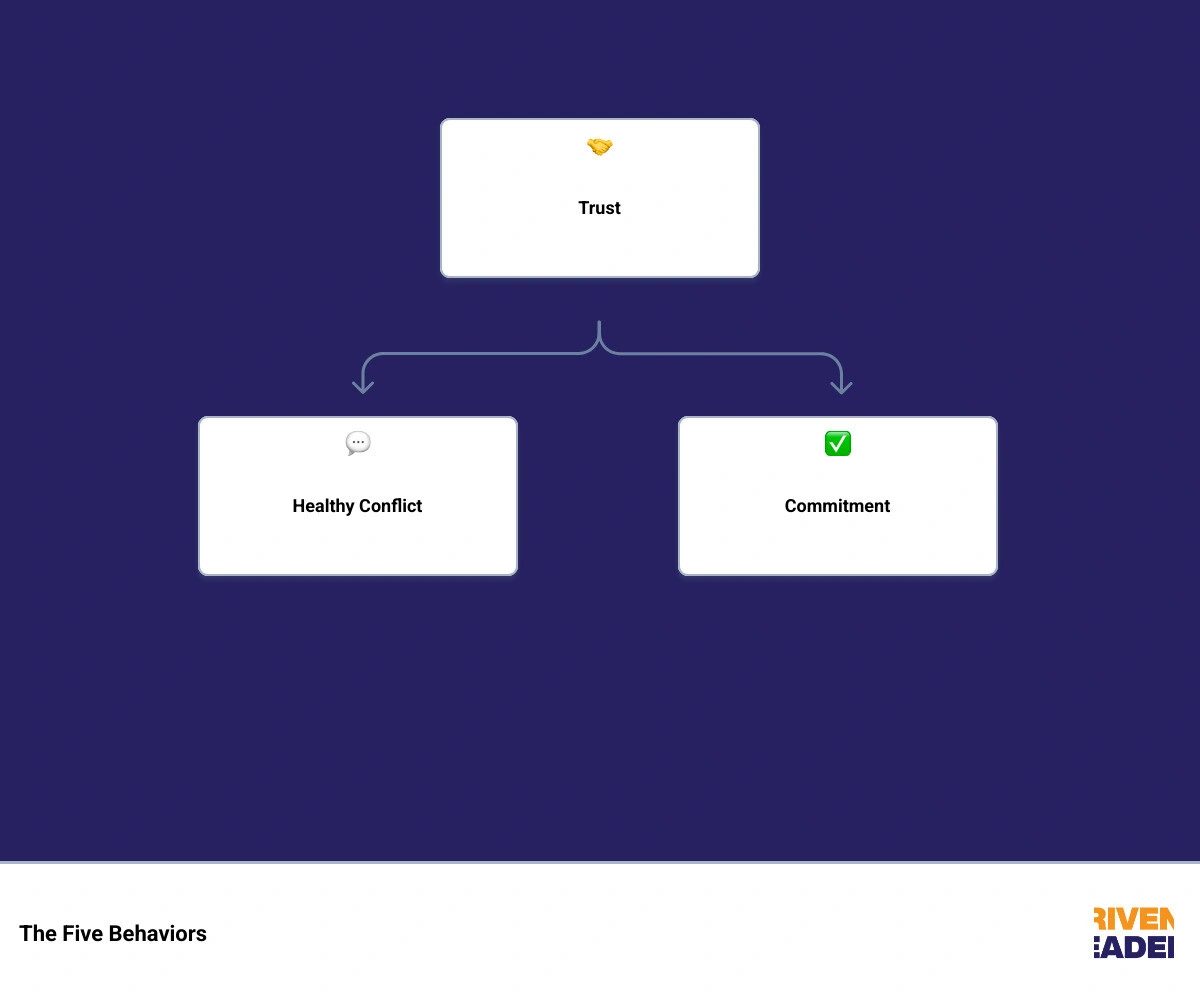
Developed in partnership with Patrick Lencioni, this model is based on his internationally acclaimed book, The Five Dysfunctions of a Team. Rather than looking at teamwork as an abstract concept, the model structures team development as a sequential pyramid:
• Trust: The foundation of the entire pyramid. Without it, the rest of the structure collapses.
• Conflict: Healthy, unfiltered debate around ideas, not personal attacks.
• Commitment: Buying into decisions and plans, even when there is initial disagreement.
• Accountability: Peers holding one another to high performance standards.
• Results: A relentless focus on collective, shared goals rather than individual agendas.
Because these behaviors build on top of one another sequentially, a team cannot skip a step. You cannot have genuine accountability if there is no clear commitment. You cannot secure commitment if the team avoids the healthy conflict required to hear everyone's voice. And you certainly cannot engage in productive conflict if team members do not trust one another.
How Five Behaviors Workshops Help Leadership Teams Improve Performance by Building Trust
In many corporate settings, "trust" is defined predictively — we trust that a colleague will deliver a report on time because they always do. While predictive trust is helpful, the Five Behaviors model relies on a much deeper, more transformative concept: vulnerability-based trust.
Vulnerability-based trust occurs when leaders are genuinely honest and transparent with one another. It means being comfortable saying, "I made a mistake," "I don't know the answer to this," or "Your department is doing this better than mine; I need your help."
When executives let down their guard, it creates a safe environment characterized by deep psychological safety. This shift is highly measurable, contributing to an average 45% increase in team trust. To understand how to cultivate this foundation within your organization, read our guide on Building and Maintaining Trust The Foundation of Impactful Leadership.
How Five Behaviors Workshops Help Leadership Teams Improve Performance through Peer Accountability
Most traditional corporate cultures rely solely on top-down accountability, where the team leader or CEO is the sole enforcer of standards. This dynamic is exhausting for the leader and creates a culture of compliance rather than commitment.
In a cohesive team, peer-to-peer accountability becomes the norm. Because the team has built trust, engaged in healthy debate, and committed to a clear course of action, team members feel comfortable calling out behaviors or performance that do not align with their shared goals.
When peer accountability is normalized, it demonstrates respect for the team's shared objectives rather than a desire to control or blame. This behavioral shift leads to a 36% improvement in peer accountability and a 34% boost in overall commitment to goals. For teams looking to build this level of operational discipline, implementing a robust framework for Team Execution is an essential next step.
What to Expect in a Five Behaviors Workshop
A Five Behaviors workshop is not a passive lecture series where participants sit and look at slides all day. Instead, it is a highly interactive, facilitated learning experience designed to bring real-world team dynamics to light.
Whether delivered as an intensive in-person offsite in Southern California or Washington, or broken down into highly engaging virtual sessions for hybrid teams, the workshop utilizes a mix of personalized data, video examples, and real-time practice to build cohesive habits. To learn more about how we structure these transformational events, check out our insights on how to Unlock Team Potential Leadership Sessions.
Pre-Workshop Assessments and Personalized Profiles
Before the workshop even begins, every participant completes a comprehensive pre-workshop assessment that takes approximately 20 to 30 minutes. This assessment measures both individual behavioral preferences and the team's overall performance across the five key areas.
The resulting personalized profile is built to the rigorous Wiley standard of excellence. It provides each executive with deep insights into how their unique communication style impacts the team's collective trust, conflict, and commitment. Even minor adjustments in how these assessments are introduced can yield massive returns; you can discover how in our article on Small Changes in Training Team Breakthroughs.
Interactive Activities and Facilitated Discussions
During the workshop, the team works directly with an expert facilitator to navigate their customized data. The experience incorporates:
• Breakout Activities: Intact teams work through real-world business scenarios to practice vulnerability and constructive debate.
• Video Case Studies: Participants analyze team behaviors in real-time to identify common pitfalls and healthy alternatives.
• Structured Disagreements: Leaders practice healthy conflict resolution techniques, replacing silent resentment with productive debate.
• Creating a Team Credo: The team co-creates a shared set of behavioral guidelines, or a "motto," to govern how they will interact, make decisions, and hold one another accountable moving forward.
How The Five Behaviors Framework Complements Other Development Tools
Organizations frequently ask how the Five Behaviors framework fits alongside other corporate development programs they may already have in place. The key is understanding the difference between individual personality assessments and collective team-behavior frameworks.
While many tools focus on individual self-awareness, the Five Behaviors model looks at the team as a single, living organism. It does not replace your existing tools; instead, it acts as the connective tissue that translates individual self-awareness into collective operational success. To see how this compares to other popular methodologies, read about Transforming Team Dynamics with Gallup.
Integrating Behavioral Insights with Team Dynamics
Standard personality assessments focus primarily on the "me" and the "we" — helping an individual understand their personal working style and how they interact with another colleague. The Five Behaviors framework, however, shifts the focus entirely to the "us" — how the team functions as a collective unit to drive performance.
By combining the behavioral insights of tools like Everything DiSC® with Lencioni's model, leaders gain a dual-layered understanding of their team. They learn not only what their teammates' individual styles are, but how those styles directly influence the team's collective trust, conflict, and accountability patterns.
For a deeper dive into using these individual styles to build a stronger culture, take a look at our guide on how to Enhance Team Morale with DISC Insights.
Sustaining the Change: The Leader's Role and Long-Term Implementation
A common pitfall of corporate training is the "honeymoon effect" — a team leaves a workshop feeling inspired, only to fall back into old habits within a few weeks. To achieve lasting behavioral change, the team leader must play an active, ongoing role in reinforcing the model daily.
The leader's primary responsibility is to champion and model the five behaviors. If the leader does not show vulnerability, encourage healthy debate, or accept peer feedback, the rest of the team will quickly revert to safe, defensive behaviors.
To maintain momentum, organizations can utilize follow-up comparison and progress reports to track behavioral changes over time. Leaders must also be prepared to actively manage any pushback that arises during this transition. For strategies on navigating these moments, read about how to Overcome Team Resistance During BOLD Training.
Integrating these habits into a comprehensive program like The Forge Team Execution ensures that the behaviors learned during the workshop become permanent fixtures of your corporate culture.
Frequently Asked Questions About Five Behaviors Workshops
How quickly can a leadership team expect to see results?
While deep, lasting cultural changes develop over time through consistent practice, teams typically experience immediate shifts during the workshop itself. Leaders walk away with a shared language and immediate clarity on their collective blind spots. In fact, 88% of participants who have taken part in the Five Behaviors experience report significant, noticeable improvements in their team's daily functionality within just a few weeks of the program.
Is this program effective for remote or hybrid leadership teams?
Yes. In today's hybrid work environment, physical distance can amplify team silos and miscommunication. The Five Behaviors framework is highly adaptable to virtual settings. Virtual facilitation utilizing interactive digital workspaces, video discussions, and online collaboration tools helps remote leaders build the same high levels of vulnerability-based trust and peer accountability as in-person teams.
How does this framework differ from standard team-building activities?
Traditional team-building activities (like ropes courses, escape rooms, or happy hours) focus on superficial harmony and temporary entertainment. While they can be fun, they rarely address the deep-seated dysfunctions that stall business performance.
The Five Behaviors workshop is a "team healing" experience. It uses personalized data and structured facilitation to address real-world business challenges, resulting in permanent behavioral changes. This is why 89% of learners say the program significantly improved their team's real-world effectiveness.
Conclusion
Building a high-performing leadership team is not about finding perfect personalities who never disagree. It is about equipping your leaders with a proven, structured framework to build vulnerability-based trust, engage in productive ideological conflict, commit to shared decisions, hold one another accountable, and focus relentlessly on collective results.
At Driven Leadership, we specialize in delivering measurable, lasting behavioral change that improves long-term business performance — not just short-term inspiration. Serving executives and intact leadership teams across California, Washington, and Nashville, TN, we are ready to help your team eliminate dysfunction and reach its full potential.
Are you ready to transform your executive team's dynamics and drive real organizational growth? Contact us today to learn more about hosting a customized Five Behaviors Workshop for your leadership team.