Navigating the 5 Conflict Management Styles During Q4 Budget Meetings

The Q4 Pressure Cooker: When Autumn Planning Meets Boardroom Friction
Early fall brings high-stakes deadlines, shrinking timelines, and intense competition for finite organizational resources, making navigating the 5 conflict management styles during Q4 budget meetings a critical skill for any leader. As departments vie for the headcount, software, and operational support they need for the upcoming year, the atmosphere inside the boardroom often shifts from collaborative to combative. What looks like a dispute over resource allocation on paper is almost always a behavioral collision in practice. Department heads are not just fighting for resources; they are reacting to the pressure of the season through their default behavioral patterns.
If your leadership team is struggling to align on organizational priorities, our team at Driven Leadership has found that professional conflict training and live conflict management workshops provide the neutral ground necessary to transform destructive arguments into strategic alignment.
The Reality of Early Fall Q4 Budget Planning
During early fall Q4 budget planning, facilitating leaders face a unique challenge. You must accurately identify the underlying conflict styles driving the tension to keep planning sessions productive. When a marketing director and an operations manager clash over project funding, the root cause is rarely just the numbers. It is a clash of assertiveness and cooperativeness. Introducing a structured behavioral framework provides a neutral vocabulary for mediation, allowing you to address the behavior without attacking the person.
• High-stakes deadlines: The ticking clock of year-end goals amplifies existing departmental anxieties.
• Finite resources: When one department gains, another often feels they are losing, triggering defensive postures.
• Behavioral blind spots: Leaders often default to their most comfortable communication style, regardless of whether it serves the current situation.
Why Budget Disputes Are Fundamentally Behavioral Collisions
As the Pacific Northwest transitions into the darker, cooler days of autumn, a similar psychological shift often occurs inside corporate conference rooms. The transition into high-stakes, stressful Q4 planning brings a heavier atmosphere. Financial constraints naturally trigger defensive or aggressive survival behaviors among department heads. When resources are tight, leaders instinctively protect their teams, their projects, and their departmental goals.
The Problem: Unstructured Power Struggles
Without a recognized framework to guide the conversation, budget meetings quickly devolve into unstructured power struggles. The loudest voice in the room tends to dominate the allocation process, while quieter leaders withdraw. This dynamic damages long-term team execution because resources are distributed based on volume and persistence rather than strategic organizational need. The friction feels chaotic and personal, leaving participants frustrated and misaligned.
The Cause: Unmanaged Psychological Weight
The psychological weight of year-end deadlines amplifies inherent conflict styles. When leaders feel their department's success is threatened by a lack of resources, their natural behavioral tendencies go into overdrive. Highly assertive leaders become demanding, while highly cooperative leaders may yield too quickly just to escape the uncomfortable tension of the boardroom.
The Solution: Channeling Predictable Friction
Recognizing that this friction is entirely predictable allows you to prepare targeted de-escalation strategies. By leveraging the 5 conflict management styles framework, you can anticipate how specific department heads will react under pressure. The goal is not to eliminate conflict—healthy debate is necessary for robust planning. The goal is to channel that conflict into strategic alignment, ensuring every decision serves the overarching mission of the company.
Mapping the 5 TKI Styles to Budget Allocation Behaviors
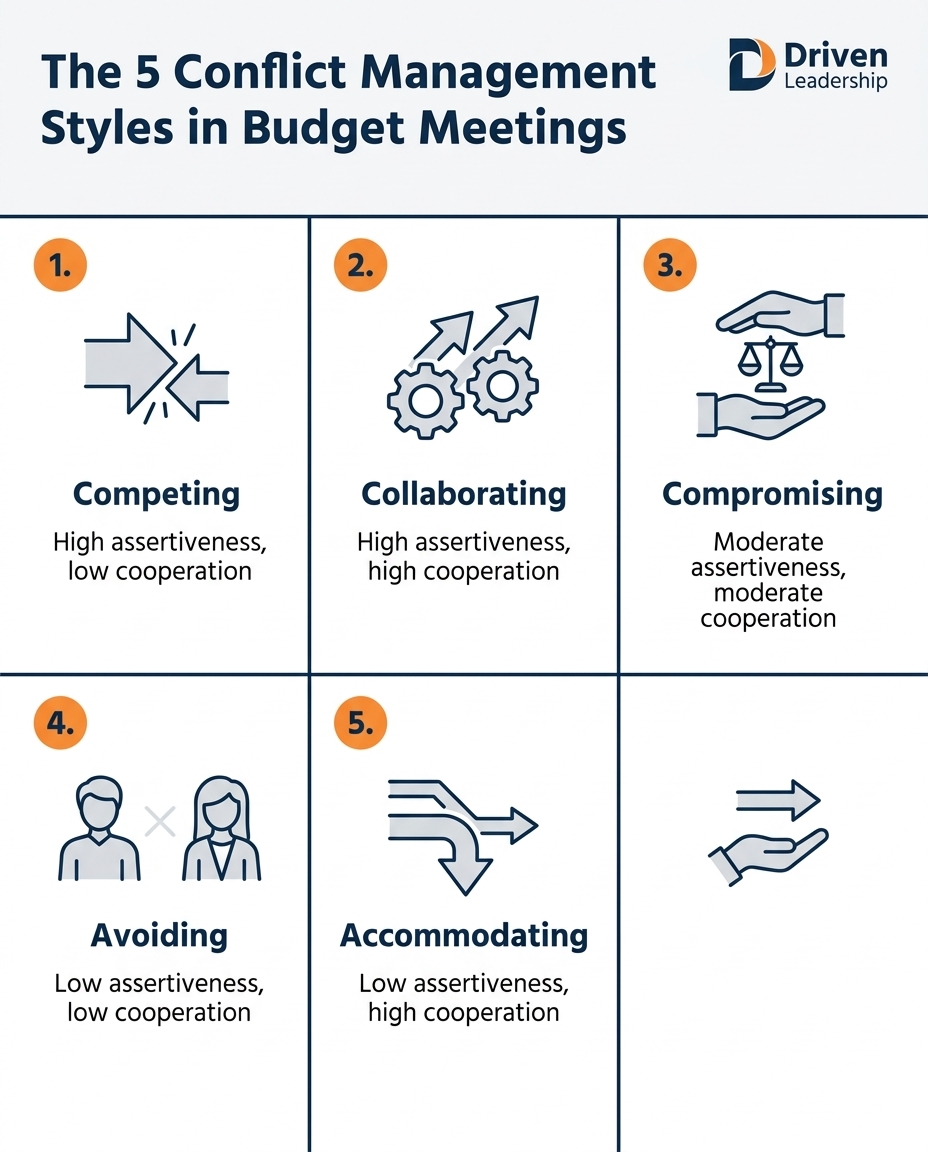
Most corporate advice relies on passive, theoretical HR concepts that fail to survive the heat of a real budget debate. In our years of coaching executives here in Puyallup and across the Pacific Northwest, our team at Driven Leadership focuses on practical, behavioral insights—specifically the TKI (Thomas-Kilmann Conflict Mode Instrument) methodology—to move beyond theory and actively resolve boardroom friction. The 5 conflict management styles framework categorizes behavior along two dimensions: assertiveness (how much you attempt to satisfy your own concerns) and cooperativeness (how much you attempt to satisfy the other person's concerns).
Understanding the Behavioral Matrix
When you understand where each leader falls on this matrix during a stressful meeting, you can tailor your facilitation approach. Here is how the five distinct styles typically manifest when organizational resources are on the line.
• Competing — Behavioral Drivers: High Assertiveness, Low Cooperation — Typical Budget Meeting Behavior: Demands maximum resources; dominates airtime; views the budget as a zero-sum game. — Facilitation Strategy: Require data-backed justifications; enforce strict time limits on speaking.
• Collaborating — Behavioral Drivers: High Assertiveness, High Cooperation — Typical Budget Meeting Behavior: Seeks synergistic, win-win solutions; asks deep questions about cross-departmental impact. — Facilitation Strategy: Leverage this leader to bridge gaps between warring departments.
• Compromising — Behavioral Drivers: Moderate Assertiveness & Cooperation — Typical Budget Meeting Behavior: Focuses on splitting the difference quickly to expedite the meeting and reduce tension. — Facilitation Strategy: Ensure the compromise actually solves the problem, rather than just delaying it.
• Avoiding — Behavioral Drivers: Low Assertiveness, Low Cooperation — Typical Budget Meeting Behavior: Remains silent; delays submitting requests; skips meetings to evade difficult conversations. — Facilitation Strategy: Draw them out with direct, safe questions; hold them accountable to deadlines.
• Accommodating — Behavioral Drivers: Low Assertiveness, High Cooperation — Typical Budget Meeting Behavior: Yields resources too quickly to maintain superficial peace; sacrifices own team's needs. — Facilitation Strategy: Advocate for their department's valid needs; encourage them to defend their requests.
Mediating the Clash: Competing Demands vs. Accommodating Silence
One of the most toxic dynamics you will encounter during early fall Q4 budget planning is the collision between the Competing style and the Accommodating style. Highly assertive voices can easily overpower quieter, accommodating department heads. When a dominant leader pounds the table for more resources, an accommodating leader will often surrender their own valid requirements just to make the uncomfortable situation stop.
This creates a long-term organizational danger. When resource distribution is driven by volume and aggression rather than strategy, critical but quiet departments are left under-resourced. This imbalance inevitably leads to operational failures in the following year. Real-world leadership training directly addresses this imbalance. For example, during a recent spring immersive BOLD: Advanced Leadership training program we facilitated, our team worked with a leader who initially struggled with a lack of confidence and taking charge in meetings. Through targeted development, they gained proactive leadership skills and improved active listening, transforming how they advocated for their team.
Tactics for Balancing the Boardroom Floor
As the facilitator, you must actively intervene to balance the scales. You cannot rely on accommodating leaders to suddenly become aggressive, nor can you expect competing leaders to naturally back down. You must manage the environment.
1. Enforce active listening: Require the competing leader to summarize the accommodating leader's request before they are allowed to counter it. This forces a pause and ensures comprehension.
2. Empower quieter leaders: Call directly on accommodating individuals. Ask them specific, data-driven questions about what their department needs to function, rather than asking open-ended questions that invite aggressive interjections.
3. Shift toward self-advocacy: Remind the accommodating leader that yielding resources now will harm their team's performance later. Frame self-advocacy as a cooperative act that helps the entire company succeed.
4. Anchor on data: Strip the emotion out of the competing leader's demands by requiring objective metrics to support every resource request.
Addressing the 'Avoiding' Style Before Year-End Deadlines Hit
While the Competing style is loud and obvious, the Avoiding style is a silent killer of Q4 timelines. Some leaders instinctively avoid difficult financial conversations and defer critical decisions because they find the conflict deeply uncomfortable. They might fail to submit their resource requests on time, send a junior representative to the planning session, or remain completely silent when their department's projects are being discussed.
The Problem: The Cost of Deferred Decisions
When you are dealing with leaders who are avoiding difficult conversations, the entire organization suffers. The cascading cost of deferred budget decisions disrupts operational readiness. If the IT department avoids fighting for a necessary infrastructure upgrade, the entire company's productivity is at risk next year. Avoidance doesn't eliminate the conflict; it merely delays it until it becomes a crisis.
The Cause: Fear of Damaging Relationships
Leaders who rely heavily on the Avoiding style within the 5 conflict management styles framework often do so because they fear that engaging in a dispute will damage professional relationships. They view conflict as inherently negative and destructive, rather than a natural byproduct of running a complex organization.
The Solution: Creating Safe Accountability
To draw out avoidant department heads safely, you must hold them accountable to the process while reducing the perceived interpersonal risk. Create an environment where raising concerns is rewarded rather than penalized. Ask them for written submissions prior to the meeting so their voice is on the record. During the session, explicitly state that debate is expected and welcomed, normalizing the friction so the avoidant leader feels safe participating.
Steering the Executive Team Toward Collaboration and Compromise
The ultimate goal of applying the 5 conflict management styles framework is to transition the meeting from destructive clashes to productive resource allocation. This requires steering the executive team toward the Collaborating and Compromising styles. However, you must recognize when to settle for compromise versus when to invest the significant time required for true collaboration.
During a recent summer BOLD immersive program hosted by our team, an executive who needed to tackle ongoing challenges gained the courage and confidence to pursue previously deferred organizational goals. This kind of transformation demonstrates how improving overall communication abilities alters how a team approaches future friction. When leaders are trained through an executive manager program, they learn to separate their ego from their departmental requests.
Reframing Isolated Goals into Shared Priorities
To foster collaboration, you must actively reframe the conversation.
• Establish agreed-upon metrics: Before reviewing specific requests, the team must agree on the metrics for success. How will we evaluate competing budget requests objectively? What is the overarching goal for the upcoming year?
• Shift the perspective: Move the discussion from "What does Marketing need?" to "What does the company need Marketing to achieve, and what resources are required to make that happen?"
• Expand the pie: Collaboration seeks to find synergistic solutions that benefit multiple departments simultaneously. If two departments are fighting over software funds, a collaborative approach might uncover a single enterprise platform that serves both their needs.
• Split the difference strategically: Compromise is necessary when time is short and a perfect solution doesn't exist. Ensure that when you compromise, both sides are making equal concessions and the core operational needs are still met.
Frequently Asked Questions About Q4 Conflict Resolution
What are the 5 conflict management styles?
The Thomas-Kilmann methodology identifies five distinct styles based on levels of assertiveness and cooperativeness. These are Competing (high assertiveness, low cooperation), Collaborating (high assertiveness, high cooperation), Compromising (moderate on both), Avoiding (low assertiveness, low cooperation), and Accommodating (low assertiveness, high cooperation). Understanding these styles helps leaders navigate boardroom friction effectively.
How do you handle conflict in a budget meeting?
You handle conflict by using neutral facilitation and addressing behavioral clashes directly rather than getting lost in the numbers. Establish shared strategic goals before the meeting begins, so all requests are measured against the company's overarching mission. When tensions rise during early fall Q4 budget planning, name the dynamic, enforce active listening, and require data to back up emotional demands.
Which conflict resolution style is best for leadership during Q4?
While Collaborating is generally ideal for solving complex, cross-departmental problems, there is no single "best" style for every situation. Collaborating takes significant time, which isn't always available. Compromising may be strictly necessary when year-end deadlines loom and swift action is required. Effective leaders adapt their style to fit the specific demands of the moment.
How do you manage competing priorities during resource allocation?
Managing competing priorities requires tying every individual request back to the overarching company objectives. Use objective metrics and historical performance data to evaluate requests rather than yielding to emotional appeals or aggressive posturing. If a request does not directly support the agreed-upon strategic goals for the upcoming year, it must be deprioritized.
How can TKI methodology improve executive team alignment?
TKI methodology improves alignment by providing a shared, neutral vocabulary for teams to discuss their differences. Instead of a leader feeling personally attacked, they can recognize that their colleague is simply operating from a "Competing" stance due to deadline pressure. This shared understanding prevents leaders from personalizing the conflict, allowing them to focus on solving the organizational challenge.
Finalizing the Budget: Your Next Steps as a Facilitator
Successfully navigating the 5 conflict management styles during Q4 budget meetings requires more than just financial acumen; it requires high-level behavioral intelligence. By reviewing the actionable framework for mapping and mediating these five styles, you can anticipate friction before it derails your agenda. The critical importance of neutral, skilled facilitation cannot be overstated when it comes to finalizing the budget efficiently.
When you understand how the 5 conflict management styles framework manifests in your specific team, you can transform a stressful, chaotic planning session into a structured, productive alignment of resources. Encouraging ongoing leadership development is the most effective way to handle tense seasonal planning periods year after year. To equip your executive team with the tools they need to communicate effectively under pressure, explore our live conflict management workshops and give your leaders a clear, actionable framework to keep every planning session productive.