
The Reality of Bold Leadership When Facing a Q4 Revenue Shortfall

The September Shock: Confronting Missed Projections Head-On
Your Q3 end-of-quarter revenue projection reports are finalized, and the reality of bold leadership when facing a Q4 revenue shortfall has suddenly moved from a theoretical concept to an immediate crisis. The spreadsheet is clear: the current trajectory will not meet the end-of-year targets. For many executives, this realization triggers a profound sense of anxiety. The heavy reality of reviewing these finalized numbers forces an uncomfortable reckoning. The gap between what was promised to stakeholders and what the organization is currently positioned to deliver is no longer a future problem—it is a present-day emergency.
At this exact moment, you face a critical decision point. The natural instinct for many managers is to hide the reality, hoping a miraculous final sprint will close the gap. Others immediately default to making reactive, short-term cuts to preserve margins, often damaging the company's long-term operational capacity in the process. However, in our experience at Driven Leadership, the most effective path forward requires choosing transparent, bold action over defensive posturing. True leadership is rarely tested when targets are easily hit and morale is high; it is forged in the fires of adversity when a massive pivot is required in just 90 days.
Navigating this crisis requires a complete paradigm shift. You must transition your team from a state of shock into a state of focused execution. This demands a firm grasp of bold leadership principles to stabilize the environment. The focus must immediately shift away from assigning blame for the missed Q3 projections and toward identifying the actionable levers that can still be pulled. By acknowledging the reality of the situation head-on, you set the tone for the entire organization, proving that the leadership team is capable of steering the ship through turbulent waters.
The Psychology of Executive Panic vs. Strategic Clarity
Before you can address the tactical business spreadsheet, you must first manage the internal mindset of the leadership team. When the September Q4-prep transition begins, the realization of a looming shortfall often triggers a natural psychological response: the fear of failure. This fear rapidly evolves into decision fatigue. Executives find themselves second-guessing previous strategies, hyper-analyzing minor expenses, and losing sight of the broader strategic vision. If left unchecked, this internal executive panic will subconsciously bleed into the organization, creating a culture of anxiety and hesitation exactly when confident action is most needed.
The compounding effect of external factors can also play a massive role in this psychological toll. Working with executives right here in Puyallup and across the Pacific Northwest, our team at Driven Leadership often sees how the autumnal equinox brings noticeably shorter daylight hours and gloomier weather that mirrors and compounds internal corporate pressure. This September transition drains team energy, making highly intentional, motivating leadership absolutely critical. We always advise our clients that leaders must actively manage their own energy and emotional state before they can effectively manage their teams.
Transitioning from panic to strategic clarity requires a conscious effort to focus only on what can still be controlled. Leaders who struggle to navigate this internal shift often benefit from an Advanced Leadership Program to fortify their mindset and build resilience. You must move away from the paralyzing fear of the final number and break the remaining quarter down into manageable, daily actions.
Recognizing the Signs of Reactive Leadership
It is crucial to identify when decisions are being driven by anxiety rather than data. Reactive leadership often disguises itself as "taking immediate action," but it lacks a cohesive strategy.
• Micromanagement: Suddenly demanding daily updates on minor tasks that do not directly impact revenue generation.
• Emergency Budget Cuts: Slashing resources across the board without evaluating which investments are actively driving Q4 pipeline growth.
• Shifting Goalposts: Changing team priorities on a weekly basis in a desperate attempt to find a quick fix, leading to widespread confusion.
• Isolation: Leadership retreating behind closed doors to analyze data, leaving the team feeling disconnected and fearful about job security.
• Implementing across-the-board spending freezes. — Strategic Clarity Response: Reallocating funds to high-ROI, revenue-generating activities.
• Demanding the team "work harder" without clear direction. — Strategic Clarity Response: Removing administrative roadblocks to free up sales capacity.
• Hiding the severity of the shortfall from mid-level managers. — Strategic Clarity Response: Transparently briefing managers to align on the pivot strategy.
Why Passive Management Theory Fails in a Crisis
When the Q3 end-of-quarter revenue projection reports reveal a significant gap, standard, passive financial advice usually falls short. Simply adjusting the forecasting spreadsheet to reflect a lower target or sending out a company-wide memo urging better performance does not actually change team behavior. Passive management theory relies on the assumption that if you show people the data, they will automatically adjust their output. In a high-stress crisis, our consultants find this assumption to be fundamentally flawed.
The BOLD methodology emphasizes experiential, decisive action and radical accountability over passive management theory. When navigating high-stakes corporate pressure, leaders must step out from behind the desk and drive experiential accountability. This means being physically or virtually present with the team, engaging in the daily challenges, and demonstrating the exact behaviors you expect from your organization. It is about creating an environment where accountability is lived and breathed, not just tracked on a dashboard.
Through years of facilitating breakthrough moments at Driven Leadership, one pattern our team consistently sees among leaders seeking benefits for their personal lives and their companies is the need to overcome debilitating professional roadblocks. During critical transition periods, many discover that passive theory isn't enough to break through these barriers. By participating in immersive executive management training, they achieve the personal and professional elevation required to overcome previous limitations. They learn that true leadership requires taking calculated risks and confronting uncomfortable truths directly, rather than hiding behind theoretical frameworks.
Relying on passive strategies during a shortfall often leads to a slow bleed of morale. Teams recognize when leadership is disconnected from the reality of the daily grind. To effectively pivot, executives must replace passive observation with active, experiential leadership that challenges the team to rise to the occasion while providing the necessary support to make that possible.
Transparent Restructuring: Communicating the Shortfall
Communicating bad news is arguably the most difficult test of an executive's communication skills. However, during the September Q4-prep transition, how you present the shortfall will dictate the team's performance for the rest of the year. Radical transparency is essential. You must own the current reality without assigning blame, presenting the facts clearly and objectively. If the team senses that leadership is hiding information or looking for scapegoats, psychological safety will evaporate, and employees will focus on protecting their own jobs rather than executing the strategy.
In our experience guiding leadership teams through these exact crises, when management notices a lack of confidence, initiative, or effective communication skills within their ranks during times of stress, ignoring the problem is detrimental. Leaders who immerse themselves in challenging environments consistently emerge with the confidence and active listening skills required to guide their teams through uncertainty. This level of communication builds the trust necessary to weather a financial storm.
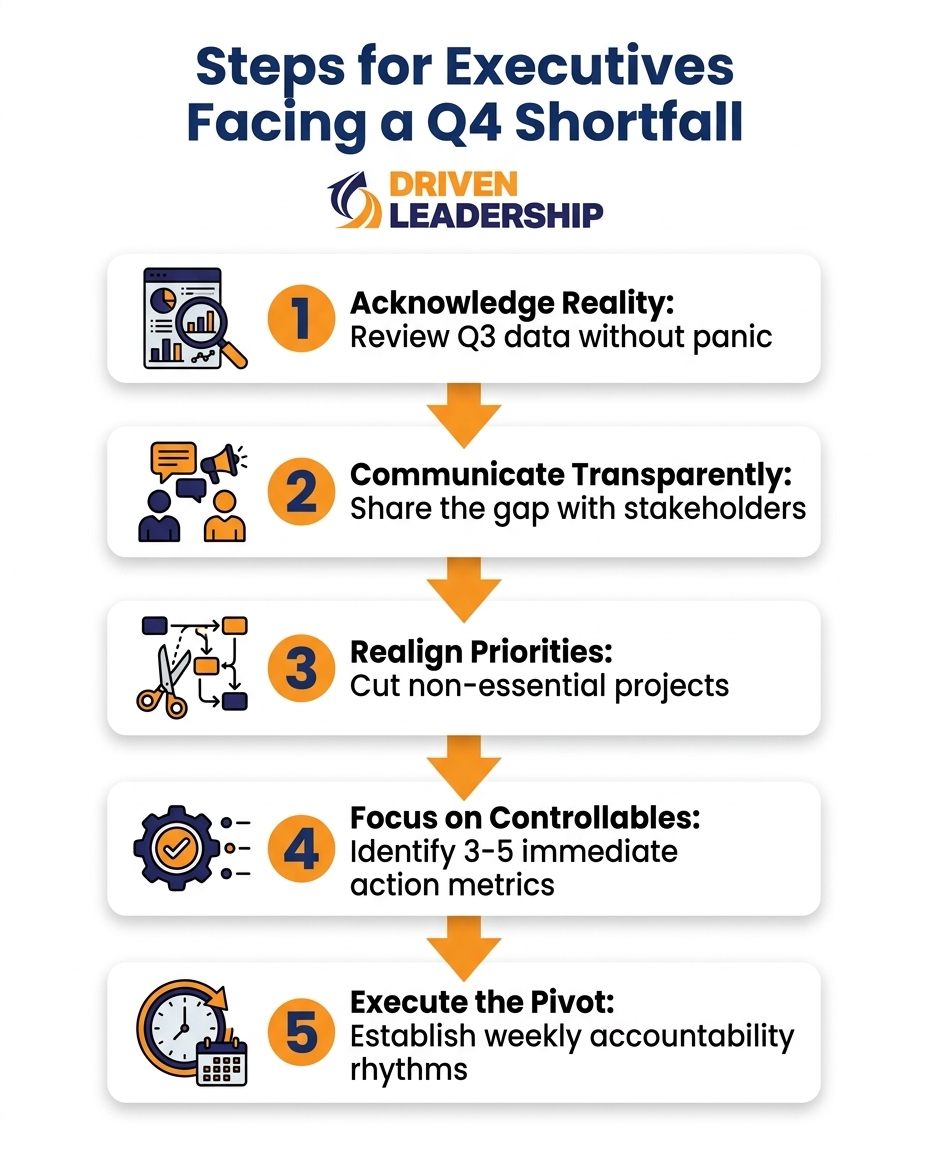
To communicate the shortfall effectively, follow a structured framework:
1. Acknowledge the Reality: Present the finalized numbers clearly. Avoid sugarcoating the situation. State exactly where the company stands relative to the initial targets.
2. Own the Narrative: Take responsibility at the executive level. Explain the market factors or internal misalignments that contributed to the gap, focusing on systemic issues rather than individual failures.
3. Present the Pivot Strategy: Immediately follow the bad news with a clear, actionable plan. Detail the specific steps the organization will take over the next 90 days to mitigate the shortfall.
4. Define New Expectations: Clarify exactly what is expected from each department in this new reality. Remove ambiguity so every team member knows their specific role in the recovery effort.
5. Open the Floor for Questions: Create a safe space for the team to ask difficult questions. Answer honestly, even if the answer is "we are still figuring that specific part out."
By framing the shortfall alongside a decisive action plan, you shift the organization's focus from past failures to future execution. This approach is fundamental to building trust and cooperation through bold training, ensuring the team remains united under pressure.
Realigning Priorities Without Burning Out Your Organization
The Problem: When the Q3 end-of-quarter revenue projection reports highlight a massive gap, the most common executive reflex is to issue a "do more with less" mandate. Leaders often attempt to accelerate every single initiative simultaneously, pushing the team to work longer hours and handle heavier workloads in a desperate bid to close the revenue gap before December 31st.
The Cause: This reaction stems from a place of panic rather than strategy. When leaders feel they are losing control of the financial outcome, they attempt to exert hyper-control over their employees' time and output. They fail to recognize that adding more priorities to an already stressed system does not increase productivity; it fractures focus and accelerates exhaustion.
The Solution: To survive a Q4 crunch, our team strongly recommends ruthless prioritization. This means making the difficult decision to pause non-essential projects, even those that were previously deemed important. Every initiative must be evaluated through a single lens: Does this directly and immediately impact Q4 revenue? If the answer is no, it must be shelved until the following year. By narrowing the team's focus to a handful of critical, revenue-generating actions, you provide clarity and relieve the pressure of competing demands.
Maintaining team energy is paramount. You can demand high performance without demanding burnout by implementing effective team execution strategies. Celebrate the micro-wins, ensure the team has the resources necessary to execute the narrowed priorities, and actively monitor your staff for signs of fatigue. A burned-out sales team cannot close deals, and an exhausted operational team will make costly mistakes. Bold leadership requires protecting your most valuable asset—your people—even while pushing for aggressive financial targets.
Executing the Pivot: A Framework for Controllable Actions
Once the strategy is communicated and priorities are realigned, the focus must shift entirely to execution. During the September Q4-prep transition, leaders must provide their teams with a tangible framework that breaks the massive revenue gap down into daily, controllable actions. You cannot control whether a client signs a contract, but you can control the number of calls made, proposals sent, and follow-up meetings scheduled.
Establish a rhythm of accountability that keeps the team focused on forward momentum without suffocating them in administrative reporting. We encourage our clients to ensure this framework is highly visible and relentlessly pursued.
• Identify 3-5 Controllable Metrics: Strip away complex dashboards and focus on the handful of leading indicators that directly precede closed revenue. Ensure these metrics are entirely within the team's control.
• Establish Daily Huddles: Implement a brief, 10-minute daily stand-up meeting. The agenda should be strictly focused on identifying roadblocks and confirming the top priority for the day.
• Implement Weekly Accountability Rhythms: Use the end of the week to review the controllable metrics. Did the team execute the actions they committed to? If not, why? Adjust the approach for the following week based on this data.
• Celebrate Micro-Wins: Rebuilding momentum is critical. Do not wait until the final revenue target is hit to celebrate. Acknowledge the small victories—a great discovery call, a cleared operational bottleneck, or a successfully paused non-essential project—to rebuild confidence as the quarter progresses.
• Remove Friction: Actively ask your team what is slowing them down. If an internal approval process is delaying a proposal, bypass it. Your job as a leader is to clear the path for execution.
By shifting the focus from the intimidating end-of-year target to the controllable actions of today, you empower your team to take ownership of the recovery process. This structured execution is the hallmark of a leadership team that has successfully moved past panic and into decisive action.
Frequently Asked Questions: Navigating End-of-Year Financial Pressure
How should leaders communicate a revenue shortfall to their team?
Leaders should communicate a shortfall with radical transparency and a clear action plan. Start by objectively sharing the finalized Q3 end-of-quarter revenue projection reports without assigning blame or sugarcoating the reality. Immediately follow the data with a structured pivot strategy, explaining exactly how the organization will adjust its priorities over the next 90 days. This approach maintains psychological safety while directing the team's energy toward execution rather than anxiety.
How do you effectively pivot a team's focus in Q4?
Pivoting effectively requires ruthlessly pausing non-essential projects and narrowing the team's focus entirely to revenue-generating actions. You must identify 3-5 highly controllable metrics and build daily or weekly accountability rhythms around them. By removing administrative friction and clearly defining the new expectations, you empower the team to execute the revised strategy without suffering from burnout or competing priorities.
What are the defining traits of bold leadership in a crisis?
Bold leadership in a crisis is defined by decisive, experiential action, radical accountability, and the ability to manage internal executive panic. Rather than relying on passive management theory or hiding behind spreadsheets, bold leaders step forward to transparently communicate the reality of the situation. They make the difficult decisions to cut distractions, protect their team's energy, and drive forward momentum through highly focused, controllable daily actions.
How do you motivate a sales team during an end-of-year financial crunch?
Motivation during a crunch comes from clarity and achievable milestones, not just intense pressure. Break the massive end-of-year gap down into daily, controllable leading indicators so the team feels a sense of agency over their success. Celebrate micro-wins frequently to rebuild confidence, and ensure that leadership is actively removing roadblocks rather than just demanding that the team "do more with less."
What is the biggest mistake executives make when projecting missed targets?
The biggest mistake is succumbing to reactive panic, which often leads to across-the-board emergency budget cuts and the implementation of a "do more with less" mandate. This fractures the team's focus and accelerates organizational burnout precisely when high performance is needed most. Failing to transparently communicate the shortfall and instead shifting goalposts weekly destroys trust and paralyzes the team's ability to execute a cohesive recovery strategy.
Turn Q4 Anxiety Into Decisive, Forward-Looking Leadership
Missing an end-of-year target is a heavy reality of business, but how a leader responds to those finalized Q3 end-of-quarter revenue projection reports ultimately defines their legacy. The transition from the September Q4-prep transition into the final sprint of the year does not have to be defined by executive panic, reactive cuts, or organizational burnout. By choosing to confront the shortfall head-on, you can stabilize your environment and guide your team with strategic clarity.
The shift from anxiety to structured action requires transparent communication, ruthless prioritization of revenue-generating tasks, and a relentless focus on controllable metrics. When you replace passive management theory with bold, experiential leadership, you empower your organization to execute a meaningful pivot. We encourage leaders to explore advanced methodologies to fortify their mindset, ensuring they possess the resilience and strategic frameworks necessary to turn current challenges into a foundation for future success.