Detailed Guide to the Entrepreneurial Operating System EOS

Why So Many Leadership Teams Are Turning to the Entrepreneurial Operating System EOS
What is the Entrepreneurial Operating System EOS? It is a complete set of practical tools and concepts — created by entrepreneur Gino Wickman — that helps leadership teams in small and midsize businesses get aligned on a shared vision, build accountability, and execute with discipline. Here is a quick summary:
• Creator: Gino Wickman, introduced publicly in his 2007 book Traction
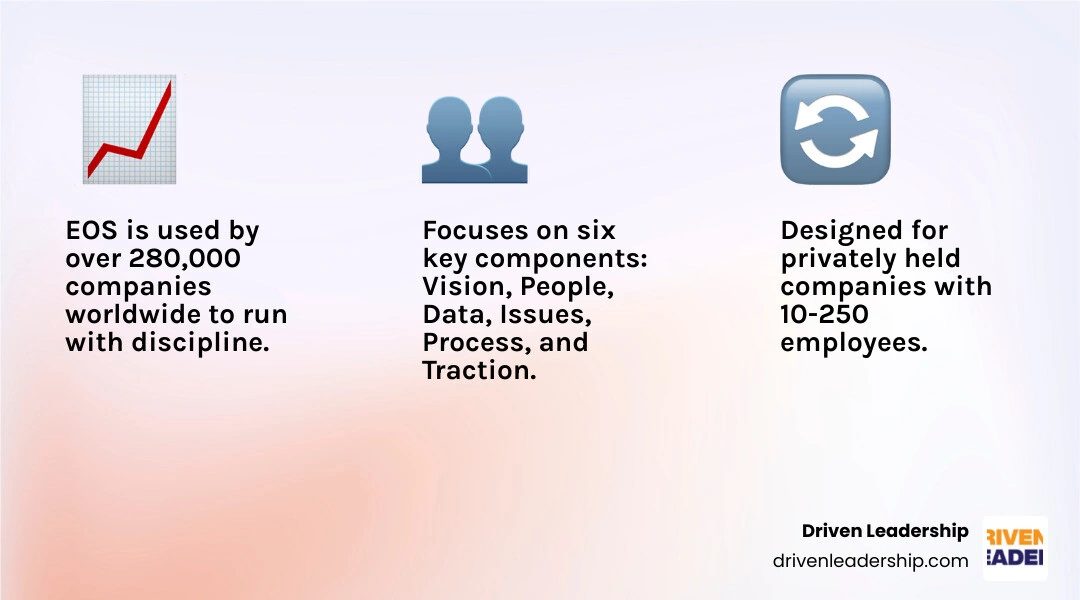
• Best for: Privately held entrepreneurial companies with 10 to 250 employees
• Core focus: Six Key Components — Vision, People, Data, Issues, Process, and Traction
• Goal: Help leadership teams clarify where they are going, who does what, and how to move forward every 90 days
• Implementation: Can be self-implemented or guided by a certified Professional EOS Implementer
• Adoption: Over 280,000 businesses worldwide currently run on EOS
If you lead a growing business, you have probably felt it — the team is talented, the revenue looks decent on paper, yet something always feels stuck. Meetings go in circles. The same problems come back week after week. Everyone is busy, but the company is not moving forward the way you imagined it would.
One leadership team described arguing about the exact same issue 19 times before finding a structured way to finally solve it. That story is not unusual. It is the norm for entrepreneurial companies that have outgrown informal ways of operating but have not yet put a real system in place.
That is the problem EOS was built to solve. It is not a motivational program or a one-time workshop. It is a repeatable operating system — a practical framework that gives your entire leadership team a common language, a clear structure, and the tools to run the business instead of being run by it.
What is the Entrepreneurial Operating System EOS?
To truly understand what is the entrepreneurial operating system eos, we must look at how businesses grow. In their early days, most companies survive on pure hustle, grit, and the sheer willpower of their founders. But as the headcount climbs past 10, 20, or 50 employees, that unstructured approach begins to break down. What used to be simple communication becomes a game of telephone.
This is where EOS comes in. Created by entrepreneur and author Gino Wickman in the early 2000s, EOS is a complete business management framework designed specifically for small to midsize, privately held businesses. Rather than relying on academic business theories or fleeting management fads, Wickman synthesized real-world experience into a set of practical, easy-to-understand tools. He laid out this blueprint in his 2007 bestselling book Traction: Get a Grip on Your Business, which has sold over 3 million copies worldwide.
Unlike standard business coaching that only offers high-level advice, EOS provides a concrete operational infrastructure. It standardizes how a business communicates, sets goals, tracks performance, and solves problems. By establishing a unified way of working, it eliminates the friction of mismatched expectations.
For leadership teams looking to transition from reactive firefighting to proactive growth, committing to a structured EOS Implementation is often the turning point that transforms a chaotic business into a scalable, self-sustaining organization.
The Six Key Components of the EOS Model
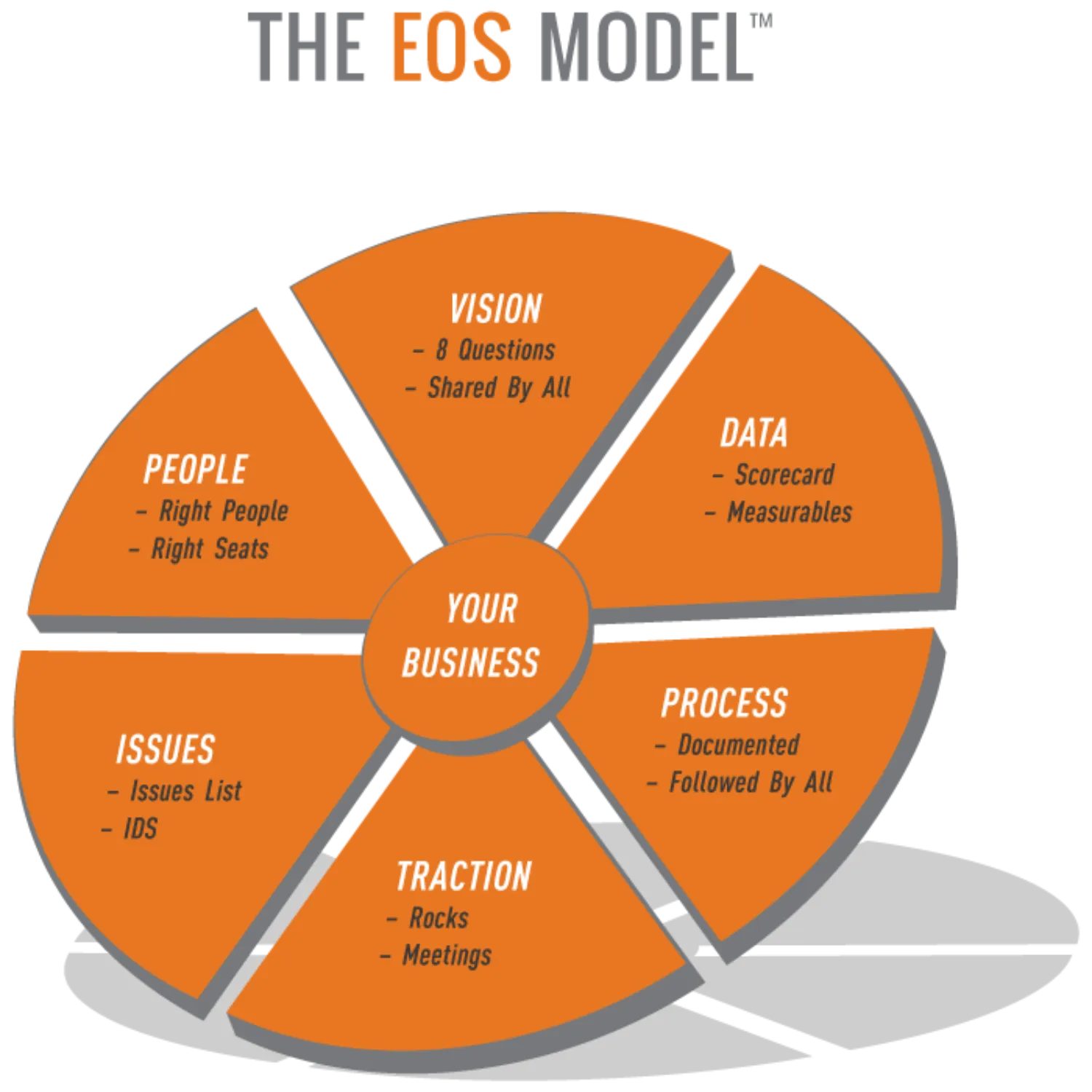
At the heart of EOS is the EOS Model, which asserts that every business is made up of Six Key Components. When a leadership team can strengthen these six areas, the business naturally falls into alignment, and common organizational frustrations begin to disappear.
Vision Component: Aligning the Team
The Vision Component is about getting everyone in the organization 100% on the same page regarding where the business is going and exactly how it is going to get there. Too often, business owners assume their team knows the plan, only to find out that different department heads are pulling in entirely different directions.
To strengthen this component, leadership teams must clarify their Core Values (the guiding principles that define who belongs in the culture), their Core Focus (the company's purpose, passion, and niche), and their 10-Year Target (the ultimate long-term goal). All of this is documented in a simple, two-page strategic planning tool called the Vision/Traction Organizer (V/TO).
People Component: Right People, Right Seats
A business cannot scale without the right human energy, but managing that energy is one of the greatest challenges leaders face. The People Component focuses on ensuring you have the "Right People in the Right Seats."
• Right People: These are individuals who naturally share your organization's Core Values. They fit your culture perfectly.
• Right Seats: This means every person is operating within their unique area of greatest strength, and their daily responsibilities align with their skills.
To achieve this, EOS replaces the traditional, hierarchical organizational chart with an Accountability Chart, and uses tools like the People Analyzer and the "GWC" framework (Get it, Want it, Capacity to do it) to objectively evaluate job fit and performance.
Data Component: Running on Facts
Many entrepreneurial businesses are run on feelings, personalities, and subjective opinions. This leads to emotional decision-making and finger-pointing when things go wrong. The Data Component strips away the noise and teaches teams to run their business on a handful of objective, weekly metrics.
By creating a weekly Scorecard containing 5 to 15 leading indicators, the leadership team can monitor the absolute pulse of the business in real time. This allows them to spot patterns, predict issues before they become disasters, and foster a culture of transparent accountability.
Issues Component: Solving Problems for Good
Every business has problems, but successful businesses solve them permanently. The Issues Component is designed to build an open, honest culture where problems are smoked out and addressed immediately, rather than swept under the rug.
EOS introduces the IDS (Identify, Discuss, Solve) method. Instead of just talking about symptoms, leadership teams learn to dig deep to find the root cause of an issue, debate it constructively, and assign a clear action item to resolve it once and for all.
Process Component: Scalability and Consistency
The Process Component is the secret to scalability, profitability, and freedom for the business owners. It involves identifying, documenting, and packaging the "core processes" that make up your unique business model (such as your HR process, marketing process, sales process, and operations process).
By documenting these processes at a high level—what EOS calls the "20/80 rule" (documenting the 20% of steps that yield 80% of the results)—and ensuring they are followed by everyone, you create consistency, reduce costly mistakes, and make the business much easier to manage.
Traction Component: Bringing Discipline to Execution
You can have a beautiful vision, great people, and excellent data, but without execution, it is all useless. The Traction Component is where the rubber meets the road. It brings focus, discipline, and daily accountability to the organization.
This component is driven by two primary tools: setting quarterly priorities (known as Rocks) and running highly structured, weekly leadership meetings (known as Level 10 Meetings). It forces the organization to live in a "90-Day World," breaking big, daunting annual goals down into highly manageable, bite-sized execution cycles.
Core Tools of the EOS Toolbox
To help companies operationalize these six components, EOS provides a practical execution infrastructure. While some businesses choose to manage these tools manually, as of 2026, more than 38,000 companies power their operational journey using specialized platforms like Ninety software. Let's look at the foundational tools in the EOS toolbox.
Understanding What Is the Entrepreneurial Operating System EOS V/TO Tool
The Vision/Traction Organizer (V/TO) is a simple, highly effective alternative to the traditional, overly complicated 50-page business plan. It is a living, two-page document that forces the leadership team to answer eight critical questions:
1. What are your Core Values?
2. What is your Core Focus?
3. What is your 10-Year Target?
4. What is your Marketing Strategy?
5. What is your 3-Year Picture?
6. What is your 1-Year Plan?
7. What are your Quarterly Rocks?
8. What is your Issues List?
By condensing the entire strategic plan onto two pages, the V/TO becomes an accessible blueprint that can be easily shared and understood by every single employee in the company.
The Level 10 Meeting and Weekly Pulse
Most business meetings are notoriously unproductive; they start late, lack an agenda, and end without clear decisions. The Level 10 Meeting is a weekly, 90-minute meeting designed to keep leadership teams perfectly synchronized. It is called "Level 10" because participants rate the productivity of the meeting on a scale of 1 to 10 at the end of each session, with the goal of consistently hitting an 8 or higher.
The Level 10 Meeting follows a rigid, non-negotiable agenda:
• Good News (5 mins): Sharing personal and professional wins to build team health.
• Scorecard Review (5 mins): Quickly checking weekly metrics to ensure they are on track.
• Rock Review (5 mins): Verifying whether quarterly priorities are on track (on-track vs. off-track).
• Customer/Employee Headlines (5 mins): Sharing quick, one-sentence updates about key people.
• To-Do List Review (5 mins): Checking off the tasks assigned during the previous week's meeting (aiming for a 90% completion rate).
• IDS (60 mins): The meat of the meeting, where the team prioritizes the Issues List and systematically identifies, discusses, and solves the most critical problems.
• Conclude (5 mins): Recapping new to-dos, deciding if any messages need to be cascaded to the rest of the company, and rating the meeting.
Setting Quarterly Rocks in the 90-Day World
Human beings naturally lose focus about every 90 days. To combat this "90-day fade," EOS establishes a operational rhythm called the "90-Day World." Every quarter, the leadership team steps away from the day-to-day business to review their progress and establish 3 to 7 critical priorities for the next quarter. These priorities are called Rocks.
A good Rock must be formatted as a SMART goal: Specific, Measurable, Attainable, Relevant, and Time-bound. Most importantly, every Rock must have exactly one owner who is fully accountable for its completion. By limiting the team's focus to a small handful of critical goals each quarter, the business maintains relentless forward momentum.
Implementing EOS: Process, Timelines, and Best Practices
Implementing EOS is a journey, not a quick fix. It typically takes an organization 18 to 24 months of consistent practice to fully master the system and achieve what is known as "EOS Mastery." The proven implementation sequence consists of several key phases:
• The 90-Minute Meeting: An initial, high-level introduction where the leadership team learns how the system works and decides if they are ready to commit.
• Focus Day: A full-day session dedicated to establishing the core execution tools, including the Accountability Chart, the initial Scorecard, and the weekly Level 10 Meeting rhythm.
• Vision Building Days (1 & 2): Two separate full-day sessions spaced about 30 days apart. During these days, the team answers the 8 questions of the V/TO, clarifies their long-term strategy, and sets their first official set of quarterly Rocks.
• Quarterly Pulsing: Full-day sessions held every 90 days to review the previous quarter's performance, solve deep-seated strategic issues, and set new Rocks for the upcoming quarter.
• Annual Planning: A two-day session held once a year to celebrate achievements, conduct team-building exercises, refine the multi-year vision, and set the upcoming year's plan.
For businesses located in major commercial hubs, accessing expert guidance during this transition is highly beneficial. Teams in Southern California regularly utilize regional resources such as Entrepreneurial Operating System Los Angeles CA, Entrepreneurial Operating System Long Beach CA, and Entrepreneurial Operating System Anaheim CA to launch their journey successfully.
Self-Implementation vs. Professional EOS Implementer
When deciding to run on EOS, leadership teams face a choice: should they self-implement or work with a Professional EOS Implementer?
• Self-Implementation: This is a cost-conscious option that works well for highly disciplined leadership teams with a strong internal facilitator. These teams typically use the books, free downloadable tools, and resources from the EOS Academy to guide their own sessions.
• Professional EOS Implementer: Working with a certified, outside specialist drastically accelerates the process. An implementer acts as a neutral facilitator, mediator, and teacher. They bring an objective outside perspective, call out "elephants in the room" that internal team members might avoid, and hold the leadership team strictly accountable to the pure EOS process.
For companies in the Pacific Northwest, seeking out localized expertise through regional hubs like Entrepreneurial Operating System Seattle WA or Entrepreneurial Operating System Tacoma WA ensures that your leadership team has the hands-on, professional facilitation needed to make the system stick.
How EOS Compares to Other Business Frameworks
Many business leaders wonder how EOS stacks up against other popular management methodologies. Choosing the right system depends heavily on your company's size, growth stage, and specific operational pain points. To build a highly cohesive, functional, and healthy organization, it is also valuable to study the principles found in The Advantage, which emphasizes organizational health as the ultimate competitive advantage.
• Primary Target Audience — EOS (Entrepreneurial Operating System): Small to midsize businesses (10–250 employees) — OKRs (Objectives & Key Results): Tech startups, mid-market, and enterprise organizations — Scaling Up (Verne Harnish): High-growth mid-market companies ($10M–$100M+ revenue)
• Core Focus — EOS (Entrepreneurial Operating System): Complete operational alignment across 6 key business components — OKRs (Objectives & Key Results): Goal-setting, rapid innovation, and cross-functional alignment — Scaling Up (Verne Harnish): High-velocity scaling across People, Strategy, Execution, and Cash
• Simplicity & Usability — EOS (Entrepreneurial Operating System): Highly simplified, practical, and easy to learn in a single day — OKRs (Objectives & Key Results): Moderately complex; requires continuous refinement of metrics — Scaling Up (Verne Harnish): Complex; heavy academic theory with a large, robust toolset
• Timeframe for Planning — EOS (Entrepreneurial Operating System): 10-Year, 3-Year, 1-Year, and 90-Day Rocks — OKRs (Objectives & Key Results): Typically quarterly cycles with monthly check-ins — Scaling Up (Verne Harnish): Long-term BHAG (10–25 years), 3–5 year, annual, and quarterly
• Meeting Cadence — EOS (Entrepreneurial Operating System): Weekly Level 10 Meetings, Quarterly, and Annual sessions — OKRs (Objectives & Key Results): Flexible check-ins, grading sessions, and quarterly reviews — Scaling Up (Verne Harnish): Daily huddles, weekly, monthly, quarterly, and annual meetings
Clarifying What Is the Entrepreneurial Operating System EOS vs. OKRs
While both frameworks help teams execute goals, they serve fundamentally different purposes. OKRs (Objectives and Key Results) are primarily a goal-setting framework. They are highly flexible and work incredibly well for aligning specific projects across cross-functional teams, especially in technology sectors. However, OKRs do not address core business infrastructure—they do not provide a framework for resolving people issues, documenting core processes, or structuring your leadership team.
In contrast, EOS is a complete business operating system. It provides a comprehensive infrastructure that covers everything from organizational structure and core values to meeting rhythms and metric tracking. Interestingly, OKRs can easily complement EOS; many companies format their quarterly Rocks using the OKR formula (setting an Objective with 3 to 4 measurable Key Results) to achieve the best of both worlds.
EOS and Agile or Scrum Compatibility
There is a common misconception that running on EOS means you cannot use Agile or Scrum. In reality, they solve entirely different problems and coexist beautifully.
Agile and Scrum are software development and project management frameworks designed to help technical teams build products iteratively. EOS, on the other hand, is a business operating system designed to run the entire corporate entity. Your development team can easily run their daily standups and two-week sprints, while your executive leadership team runs on a weekly Level 10 Meeting pulse and quarterly Rocks. Together, they create a highly efficient, aligned organization.
Frequently Asked Questions about EOS
What size company is EOS best suited for?
While the basic principles of EOS can help any business, the absolute sweet spot for a full EOS implementation is privately held, entrepreneurial companies with 10 to 250 employees.
Companies with fewer than 10 employees often find the full system too structured for their immediate needs, though they can still benefit from using individual tools like the V/TO and setting Rocks. Companies with more than 250 employees can still run on EOS, but they must carefully cascade the system down through multiple departmental layers to manage the increased organizational complexity.
What are the most common reasons EOS implementations fail?
Despite its high success rate, EOS implementations can fail. The most common reasons include:
• Lack of Commitment from the Top: If the visionary, founder, or CEO is not fully bought into the system and fails to model the required discipline, the rest of the team will quickly abandon it.
• Avoiding Honest Conversations: EOS forces leadership teams to have open, honest, and sometimes uncomfortable conversations. If a team is unwilling to address "people issues" or call out poor performance, the system cannot work.
• Incomplete Adoption: Some teams try to "cherry-pick" the tools, using the weekly meetings but ignoring the Accountability Chart or the Scorecard. Partial adoption of EOS inevitably leads to partial results.
How does EOS help solve common business frustrations?
EOS directly targets the five most common frustrations experienced by business leaders:
• People Problems: By using the Accountability Chart and the GWC framework, EOS helps you quickly identify and resolve cultural mismatches or poor job fits.
• Lack of Control: The weekly Scorecard and Level 10 Meeting pulse hand control of the business back to the leaders, replacing chaotic firefighting with predictable operations.
• Profit Issues: When your core processes are documented and followed by everyone, operational efficiency skyrockets, which directly improves your bottom line.
• Hitting the Ceiling: When a business plateaus, it is usually because the leadership team is overwhelmed. EOS provides the structural framework and delegation tools required to break through to the next level of growth.
Conclusion
Running a successful business does not have to feel like a constant, uphill battle. By understanding what is the entrepreneurial operating system eos and systematically strengthening the Six Key Components of your organization, you can transition from a state of constant overwhelm to a culture of clear alignment, high accountability, and predictable growth.
At Driven Leadership, we specialize in helping organizations navigate this transformative journey. Our immersive training programs, executive workshops, and professional EOS implementation services are designed to deliver measurable, lasting behavioral change that drives real business performance.
If you are ready to stop working in your business and start running it with absolute clarity, take the first step toward transforming your organization today. Explore our hands-on Entrepreneurial Operating System Seattle WA services, or connect with our teams across California and Tennessee to begin your journey toward a healthier, more profitable business.